


Organic saffron is saffron produced and handled under a recognised organic standard, then certified by an authorised control body. The word describes a verified production system. It does not, on its own, prove that the saffron has a stronger aroma, a higher colour grade or greater health benefits than a well-produced conventional batch.
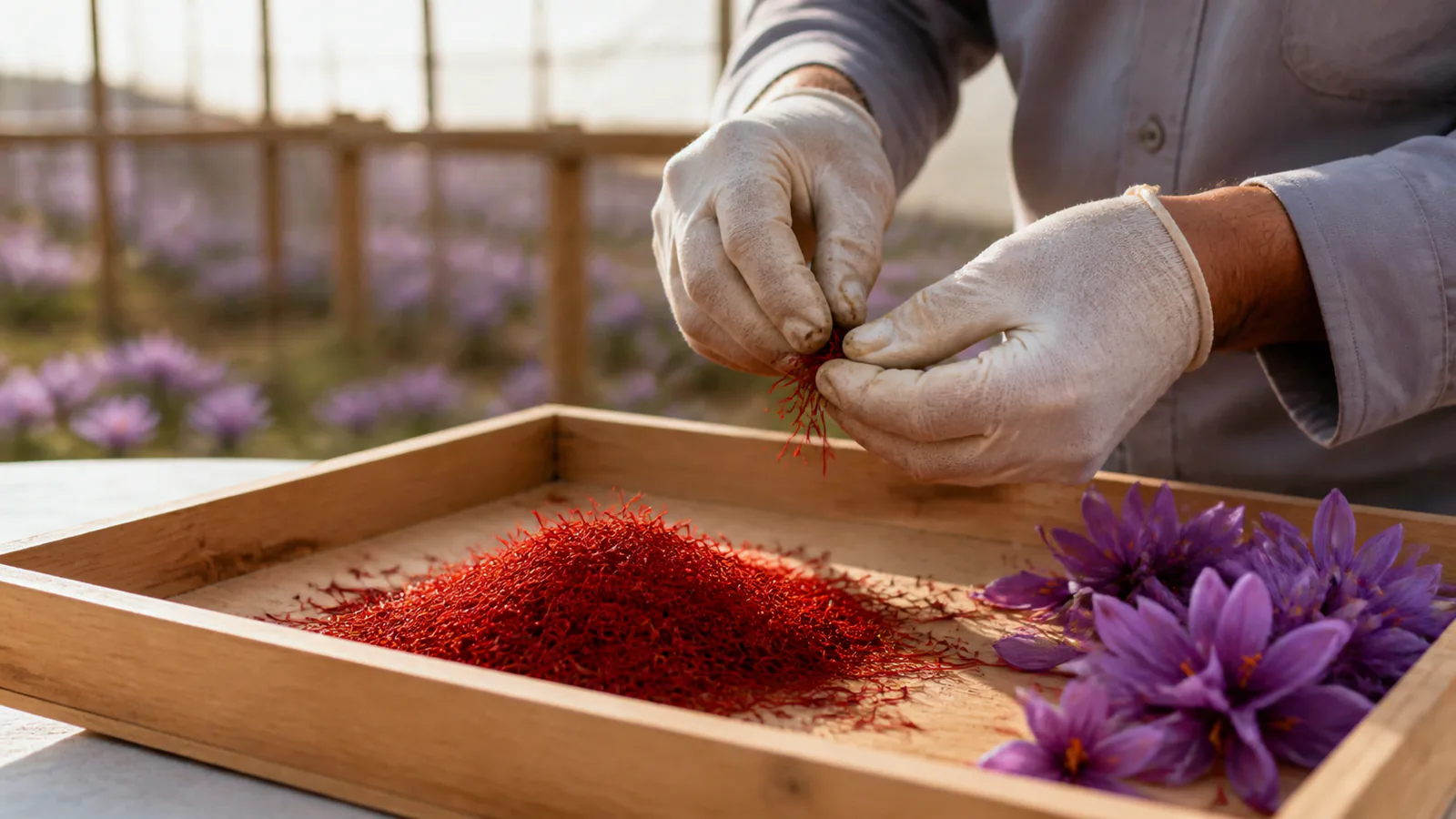
That distinction matters when you compare products. A credible organic claim should be traceable to certification and a batch, while quality still has to be judged through the threads, aroma, storage and laboratory evidence.
What organic saffron certification covers
Organic standards govern how a crop is grown, processed, separated from non-organic material, stored and documented. Certification is more than a farmer saying that no chemicals were used. An approved body inspects the operation and checks the records behind the claim.
For products sold in the European Union, the European Commission explains that the EU organic logo may be used only on certified products. The label must show the control body’s code and indicate whether the agricultural raw material was farmed in the EU or outside it. Imported organic food is also subject to control procedures.
In the United States, the USDA organic rules require certified production and handling for a product represented as organic. A packaged product in the “organic” category must contain at least 95% certified organic ingredients; a single-ingredient pack of saffron should therefore be straightforward to trace to its certified operation.
What the organic label does not prove
Organic certification is not a sensory grade or a laboratory certificate of saffron strength. Two certified batches can differ in harvest timing, drying, age, aroma and colouring power. Conversely, conventional saffron can be carefully grown, pure and excellent in the kitchen without qualifying for an organic label.
The label also does not establish that saffron prevents or treats a disease. Research on saffron and its compounds is continuing, but an agricultural certification cannot turn laboratory or preliminary clinical findings into a treatment claim. Culinary saffron should not replace prescribed medicine or medical care.
Organic status, origin and quality are different questions
It helps to assess a pack in three separate layers:
- Organic status: Who certified the operator, and can the product and batch be linked to that certification?
- Origin: Where was the saffron grown and processed, and is that origin supported by traceable records?
- Quality: Are the threads genuine, well dried and free from foreign material, and is there a recent batch test?
Iran is the world’s principal saffron-producing country, but “Iranian” and “organic” are not interchangeable. Origin identifies where the crop came from. Organic identifies the farming and handling system under which it was certified.
How to check an organic saffron label
- Identify the certifier. Look for the name or code of the authorised control body required in the market where the product is sold.
- Match the certified operation. The certificate should cover the named producer, processor or handler and the relevant product category.
- Check the dates and scope. A certificate that has expired or covers a different operation is not evidence for the pack in front of you.
- Ask for the lot number. Batch identification should connect the retail pack to the supplier’s traceability records.
- Read the origin statement. Do not infer origin from branding, packaging colours or a seller’s address.
If a seller uses the word “organic” but cannot name the certifier or connect the product to a current certificate, treat the claim as unverified.
How to assess quality as well as certification
Whole threads are usually easier for a buyer to examine than powder. Look for dry, distinct stigmas with a rich red colour and a complex aroma that is floral, hay-like and slightly bitter rather than simply sweet. A few yellow or orange style portions may be present depending on the grade, but excess pale material reduces the proportion of red stigma.
Visual checks cannot establish purity or potency on their own. The current ISO 3632-1:2025 saffron specification sets requirements for dried saffron in filament, cut-filament and powder forms. Ask a commercial supplier for a recent certificate of analysis tied to the batch, and check what was tested rather than accepting “ISO quality” as an unsupported phrase.
Packaging also matters. Saffron loses quality when it is exposed repeatedly to light, air, heat or moisture. Choose a sealed, food-safe container and follow our practical guide to storing saffron after opening.
Does organic saffron taste better?
There is no universal taste advantage created by the label. Flavour depends on the cultivar and growing conditions, but also on when the flowers were picked, how quickly the stigmas were separated, the drying method and the time since harvest. A fresh, carefully dried batch will often be more expressive than an older batch regardless of certification.
For cooking, compare aroma, freshness and traceable batch information. For wholesale purchases, request a representative sample and the same documentation that will accompany the delivered lot.
Why organic saffron can cost more
Every saffron flower yields only three stigmas, so harvesting and separation are done largely by hand. Organic production adds inspection, record-keeping, segregation and certification costs. Supply may also be smaller. Those costs can justify a premium, but a high price is not proof of either organic status or quality.
A practical buying checklist
- a current organic certificate whose scope matches the product;
- a certifier or control-body identifier appropriate to the sales market;
- a clear country-of-origin statement;
- a lot number that links the pack to supplier records;
- a recent, batch-specific laboratory report for commercial quantities;
- sealed packaging with storage and best-before information;
- whole threads when visual inspection is important.
Organic saffron can be a sound choice when certified production matters to you. Buy the evidence, not the adjective: verify the certification, assess quality separately and choose a batch whose origin, testing and storage history are clear.

![Exporting Saffron to Turkey + Price Guide [Complete 0 to 100]](https://img.rowhanisaffron.com/20260827003933/saffron-export-turkey-quality-inspection.webp)



