


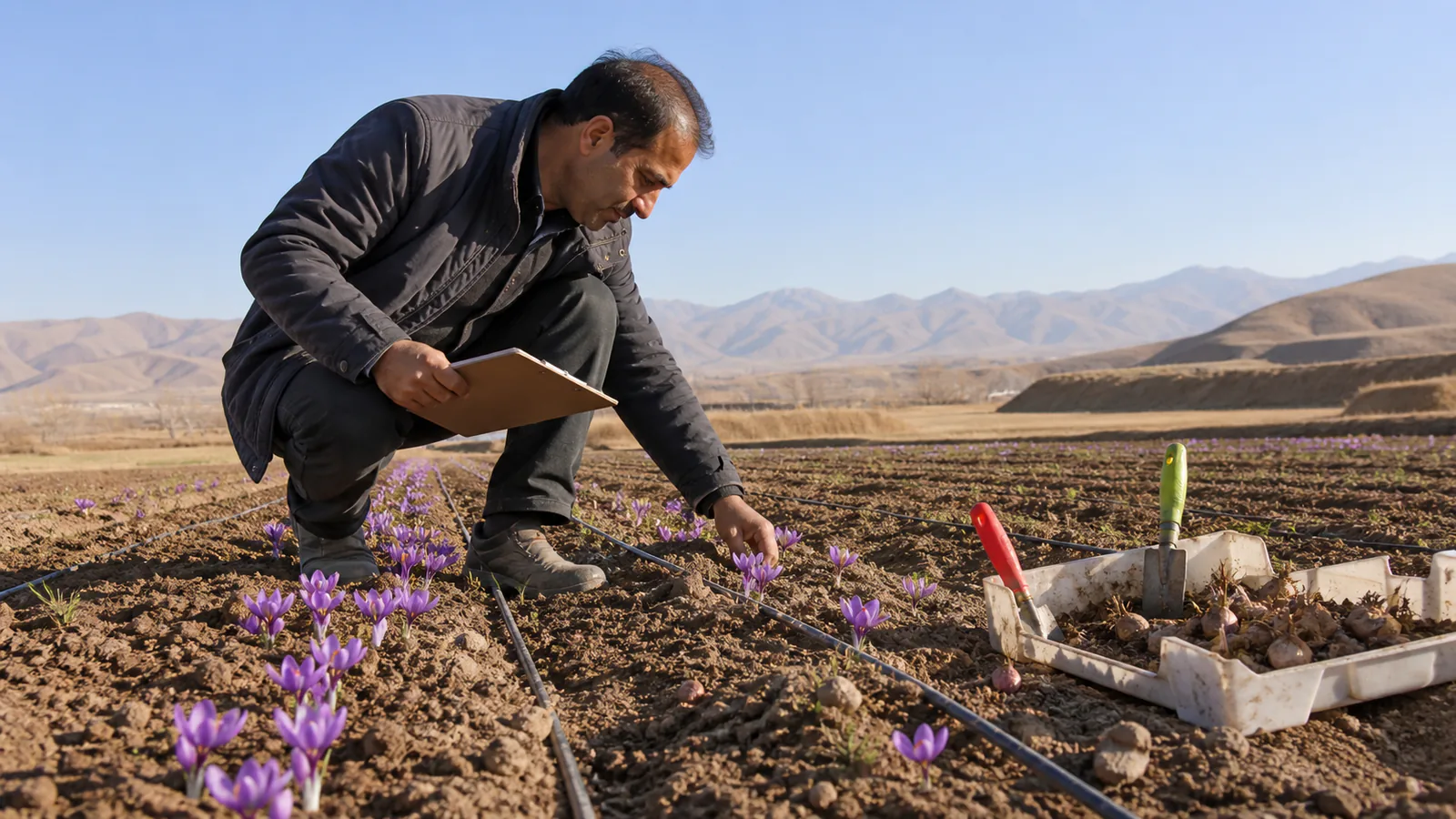
Saffron cultivation in Iran’s Central Province can be an investment, but the crop’s price alone does not make a field profitable. The experience of agricultural graduate Mehran Mir Davoodi shows why. He began with small medicinal-plant trials, struggled to secure suitable land, learned through costly attempts and eventually treated saffron production as a multi-year farm project rather than a quick return.
This account was first published as a 2015 farmer profile. Its personal history remains useful because it includes both progress and disappointment. Mir Davoodi believed areas around Arak could support saffron, yet he also said that planting on rented land did not produce the economic result or yield he wanted. Anyone considering saffron investment in Central Province should pay attention to both sides of that story.
How a medicinal-plant interest became a saffron project
Mir Davoodi’s interest began when he entered university to study agriculture. Medicinal plants caught his attention early, and by his second semester he was asking university officials for access to unused land nearby. After clearing a one-hectare plot, he trialled several crops and reported encouraging results.
He specifically recalled growing mint, chamomile and chicory with limited irrigation. That experience prompted a new question: if those plants could perform with the water available, could saffron work there too?
The profile identifies him as a native of Central Province, born in Solar Hijri 1346, and the father of two children who also studied agriculture. Their help became part of the family project. It also records recognition during Solar Hijri 1391–1392 as a leading saffron entrepreneur and an exemplary safflower grower. These are details from the historical interview, not current awards or official rankings.
Land was the first investment problem
Not owning suitable land repeatedly complicated the work. Mir Davoodi rented a field, cleared agricultural pests and first planted corn. He later prepared the plot for saffron. A loan from the provincial Agricultural Jihad organisation covered part of his costs, according to the interview.
The first harvest gave him confidence, but the rented arrangement exposed a weakness in the business model. Saffron is perennial: establishing the field costs money in the first year, while flowering and corm multiplication develop over several seasons. A short or uncertain lease can prevent a grower from capturing the productive years after paying the establishment cost.
Mir Davoodi was candid about the outcome. He said the rented fields did not deliver satisfactory economics or yield. He did not describe the attempt as worthless; the trial-and-error process built practical and scientific knowledge. That distinction matters. A successful flower does not by itself prove a successful investment.
A three-hectare site offered a more stable next step
The profile’s later phase involved cooperation with officials at Arak’s Amir Kabir Hotel. Mir Davoodi said the arrangement gave him access to three hectares for medicinal plants, especially saffron, and relieved the recurring problem of temporary rented land.
He had also visited saffron fields around Mashhad and Qom. By comparing those farms with the climate and ecosystem around Arak, he concluded that neighbouring counties in Central Province could contain suitable sites. This was a grower’s field observation, not a province-wide guarantee.
Modern research supports that cautious distinction. A published saffron location-suitability study evaluates several environmental variables together rather than using a single rule. Another Iranian study of geography and saffron quality found that cultivation conditions, local environment and viral infection can affect the final product. A field near Arak therefore needs its own soil, water, climate and plant-health evidence.
What “Central Province investment” should include
The original title uses investment in a broad sense. On a real farm, it includes more than corms and land rent. A credible budget accounts for:
- soil testing, field preparation and drainage;
- healthy, traceable saffron corms and the labour to plant them;
- secure access to land for the intended production cycle;
- irrigation water, energy, manure and other field inputs;
- hand weeding, flower picking and stigma separation during short work windows;
- clean drying, sealed storage, grading and testing;
- losses during the low-yield establishment period; and
- a buyer and price range that match the grade the farm can actually supply.
A study of 110 farms in Gonabad—not Central Province—shows why local numbers should not be copied as a promise. In that sample, corms represented about 32% of costs, labour 25% and water 22.5%; results varied by farm and year. The technical-efficiency study also found that excessive planting density could shorten a field’s productive life. Its useful lesson for Central Province is the structure of the decision, not a guaranteed profit ratio.
Scientific cultivation starts before the corm goes in
Mir Davoodi called for scientific methods, access to agricultural land and practical training. Those needs remain closely connected. Training is most useful when it helps a grower reject a weak site before money is committed.
For a new Central Province plot, the first checks are seasonal temperatures, soil texture and salinity, drainage, water quality and the availability of healthy planting material. The plan must also cover the autumn harvest. Flowers need to be collected promptly, stigmas separated hygienically and threads dried under controlled conditions. A good field can lose much of its value after picking if the handling system is not ready.
The site’s complete saffron cultivation process explains the general growing sequence. This page has a narrower purpose: deciding whether the Central Province opportunity has suitable land, stable access and a workable investment model.
Water efficiency should be measured, not assumed
Saffron is associated with arid agriculture because its seasonal cycle can fit regions with limited water. FAO’s account of the qanat-based saffron system in Gonabad describes how the crop works within a carefully managed dryland water system.
That does not mean saffron needs no water or that every low-water claim applies around Arak. A project should measure the water source, salinity, irrigation timing and the opportunity cost of using that water. It should compare saffron with crops that genuinely suit the same field, not with an unrealistic alternative.
The historical production ranking needs caution
In the 2015 interview, Mir Davoodi said Central Province ranked second in Iran for saffron cultivation and argued that scientific methods could move it into first place. The archived article provides no area, production year or national dataset for that statement, so it should be read as the interviewee’s historical claim rather than a verified current ranking.
Rank is also a weak investment target by itself. Expanding hectares without dependable yield, processing and demand can make individual farms less secure. A stronger regional measure would track healthy fields, dried-saffron quality, water productivity, traceable lots and the share sold through reliable channels.
Support works best when it reduces uncertainty
The profile ended with a request for greater cooperation between agricultural authorities and the private sector. Mir Davoodi wanted growers to have land, training, oversight and appropriately designed finance. Those tools can help, provided they are tied to evidence rather than a blanket push to plant more hectares.
Useful support can fund soil and water tests, small demonstration plots, corm-health controls, harvest training and shared drying or testing capacity. Finance should recognise the crop’s multi-year cycle and the risk of a lease ending too soon. Buyers can contribute specifications and purchase expectations before planting expands.
The practical lesson from Mir Davoodi’s experience
Saffron agriculture in Central Province is possible, and Mir Davoodi’s story documents a serious local attempt. It also records the cost of insecure land and the gap between growing a crop and earning an acceptable return.
The sensible next step for a prospective grower is a measured trial on land that can be used long enough to evaluate the field. Review the results across seasons, account for all labour and post-harvest costs, and confirm a realistic buyer. That approach preserves the optimism in the original profile without turning one farmer’s experience into an investment guarantee.

![Exporting Saffron to Turkey + Price Guide [Complete 0 to 100]](https://img.rowhanisaffron.com/20260827003933/saffron-export-turkey-quality-inspection.webp)



