


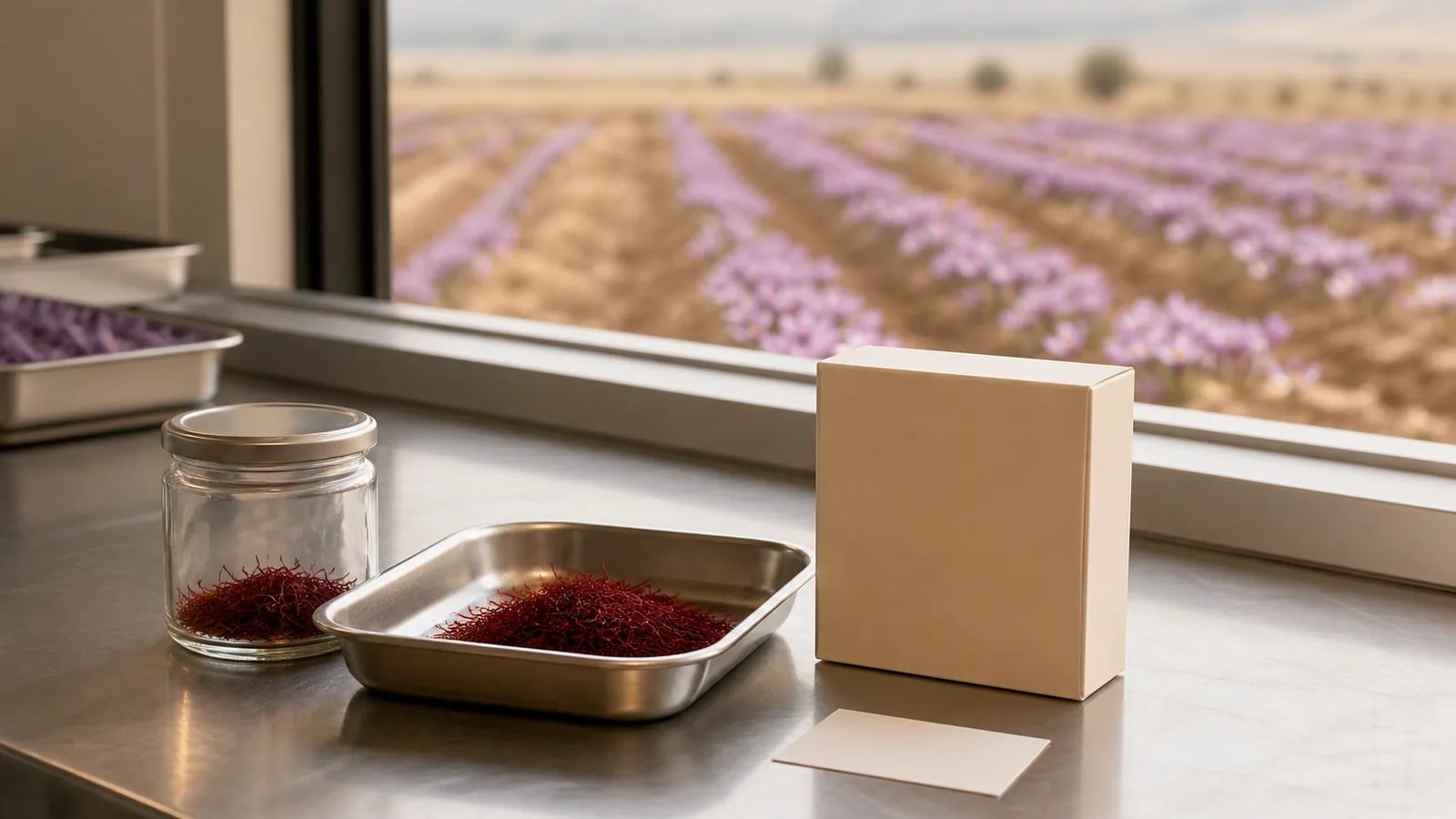
The Iranian saffron brand risked being forgotten because much of the value was being created after the crop left the farm. That was the warning Ali Hosseini, a member of Iran’s National Saffron Council, gave to ISNA in 2015. Iranian growers could produce the saffron, he argued, while businesses in other countries handled, packed and presented it under identities that consumers remembered.
His concern was not simply that a foreign company might put Iranian saffron into a different box. The deeper problem was a weak chain between field quality, processing, proof of origin and a recognizable promise to the buyer. If any link failed, producing more saffron would not necessarily protect Iran’s place in export markets.
What the 2015 warning actually said
Hosseini’s comments joined two arguments that are often treated separately. The first was agricultural: farmers needed practical training and better control of quality from cultivation onward. The second was commercial: Iran needed processing, packaging and market development that allowed the product’s origin to remain visible.
The old English version blurred those points through machine-translation errors. It called Hosseini “fennel,” confused institutions and turned several figures into broken sentences. The underlying message was more direct. In his view, exporters were spending too much time correcting or sorting the harvested product before it could be sold as a dependable high-quality lot. Unless the Ministry of Agriculture helped farmers improve production quality, he believed export markets could be lost.
He described much of the contemporary production system as relying on methods inherited from roughly 200 years earlier. That was a criticism of uneven modernization, not a claim that every traditional practice was poor. Hand harvesting, for example, remains appropriate for a delicate flower. The weakness appears when tradition is used to excuse mixed lots, slow flower handling, uncontrolled drying or a lack of records.
The historical figures behind the argument
Several numbers gave the warning its urgency. These were reported in September 2015 and should not be mistaken for current prices or production statistics:
- one gram of saffron was said to cost Iranian consumers about 5,000 tomans;
- the same quantity was valued at about US$2 in international markets;
- the livelihood of about 160,000 rural households was described as dependent on saffron production;
- Iranian production was said to have risen from around 20 tonnes roughly 80 years earlier to more than 300 tonnes; and
- a planning horizon of 500 tonnes was mentioned for future production.
Hosseini contrasted that trajectory with Spain, which he said had produced more than 100 tonnes about 80 years earlier but was producing roughly one tonne by 2015. The comparison was meant as a warning: production leadership can move when quality and markets are neglected. The article did not provide the underlying series, so the numbers are best preserved as his historical account rather than treated as a verified country-by-country dataset.
The same caution applies to the household figure. It shows why saffron policy mattered to rural communities, but it does not tell us whether every household depended on the crop to the same degree. Some farms may have relied on saffron for most cash income; others may have combined it with livestock, cereals or off-farm work.
Repacking, origin and branding are different questions
A brand is the name and set of expectations attached to a seller. Origin identifies where the saffron was harvested. A geographical indication is a distinct legal tool that can protect an origin-linked name when the product’s qualities or reputation are tied to that place. These ideas can work together, but they are not interchangeable.
That distinction matters when saffron crosses borders in bulk. A foreign buyer may sort, test, blend or pack it and then sell it under a private label. Whether the final label must state the harvest country, and how prominently, depends on the destination’s rules and the processing performed. Repacking by itself does not prove that origin was falsified. What it can do is move consumer recognition and retail margin away from the grower and original exporter.
The World Intellectual Property Organization explains that a geographical indication identifies goods whose quality or reputation is linked to a specific origin. It can prevent use of the protected name by products that do not meet the relevant specification. It is not a substitute for a company trademark, an export contract or accurate food labelling.
This is why “Iranian saffron” cannot be protected by a logo alone. The promise needs agreed specifications, legitimate users, traceable lots and protection in the markets where the name matters. Without that structure, dozens of unrelated packages may all refer to Iran while giving the buyer no consistent way to judge what the words guarantee.
Quality starts before the saffron reaches a package
Hosseini placed responsibility on the Ministry of Agriculture to train farmers, but quality is shared across the chain. A clean, attractive box cannot repair stigmas that were bruised, left warm in a full flower basket, dried unevenly or mixed with a poorer lot. Nor can a laboratory certificate rescue saffron that was sampled badly.
A credible Iranian saffron programme needs practical control at each handover:
- healthy planting material and field records that identify the producer and plot;
- harvest planning that gets flowers to separation promptly;
- clean handling and a controlled drying method;
- separate lot codes rather than anonymous mixing;
- representative sampling and testing by a competent laboratory;
- moisture-safe storage and packaging; and
- records that connect the retail unit to the tested batch.
The Codex Alimentarius Standard for Dried Floral Parts – Saffron gives the international baseline. It addresses the permitted styles of saffron, quality classes, moisture and volatile matter, defects, contaminants, hygiene, packaging, labelling and analysis. The standard is useful because it turns “high quality” from an advertising phrase into characteristics that can be checked.
ISO 3632 is also widely used to assess commercial saffron. Our guide to saffron processing, chemistry and standards explains what the familiar colour, aroma and bitterness measurements do—and what they cannot prove. A test result describes the submitted sample; traceability is what connects that result to the product a customer receives.
Packaging should carry evidence, not hide its absence
Good packaging protects saffron from moisture, light, contamination and tampering. It also gives the buyer enough information to use the product confidently. At minimum, the pack and accompanying documents should agree on the product name, net quantity, lot identity, responsible business, origin declaration required in the destination market, storage advice and any grade or certification claim.
The design still matters. A customer remembers a clear name, a consistent visual identity and a pack that opens and closes properly. But decoration should come after the less visible work: a repeatable specification, reliable supply, evidence for claims and a response when a lot does not meet the contract.
Packaging can also be appropriate at more than one scale. Retail units make origin and instructions visible to the consumer. Food manufacturers may need larger protected packs, a certificate of analysis and a stable supply agreement instead of an ornate box. Treating every export customer as a retail shopper can add cost without adding value.
Processing and market knowledge keep more value near the crop
Hosseini identified weak complementary industries, low yield per unit area and unsuitable processing as connected problems. That diagnosis remains useful. A producer cannot build a durable market only by increasing hectares, and an exporter cannot create trust only by changing the label.
Processing capacity close to production can shorten the time from flower to controlled drying, separate grades before they are mixed and create reliable lot records. Product development may also open uses beyond a jar of threads, but each extract, powder or food ingredient needs its own specification and regulatory path. “Value added” is not permission to make unsupported health claims or to turn a variable raw material into an unverified supplement.
Market knowledge is equally concrete. Before preparing a shipment, the exporter needs to know how the customer will use the saffron, which test methods the contract names, what pack size fits the channel, which language and food-labelling rules apply, and who owns the resulting customer relationship. Our report on Iranian saffron sold under brands in other countries looks at the related distinction between production origin, export route and the identity seen on the final pack.
A national name still depends on individual lots
The 2015 call for a national “saffron crisis headquarters” reflected concern that planned growth to 500 tonnes could outrun the market. A coordinating body can align training, research, standards and promotion. It cannot make every shipment trustworthy by declaration.
Hosseini also compared the danger with problems that had affected the Iranian pistachio market. He did not identify a particular pistachio policy or provide supporting figures in the report, so the comparison is best read as an analogy: production strength does not protect an export category when quality and market management become unreliable.
The reputation of Iranian saffron is renewed or weakened one lot at a time. If a buyer receives the promised style, test profile, net weight and documents repeatedly, the origin gains meaning. If the specification changes without warning or the paperwork cannot be connected to the pack, a broad national campaign will not compensate.
That is the lasting point in Hosseini’s warning. Iran’s production volume created an opportunity, but volume alone did not guarantee that customers would remember the Iranian saffron brand. The defensible route is slower and more practical: improve field and processing control, preserve origin through traceability, support claims with evidence, package for the real customer and build a name that performs consistently after the first order.

![Exporting Saffron to Turkey + Price Guide [Complete 0 to 100]](https://img.rowhanisaffron.com/20260827003933/saffron-export-turkey-quality-inspection.webp)



