


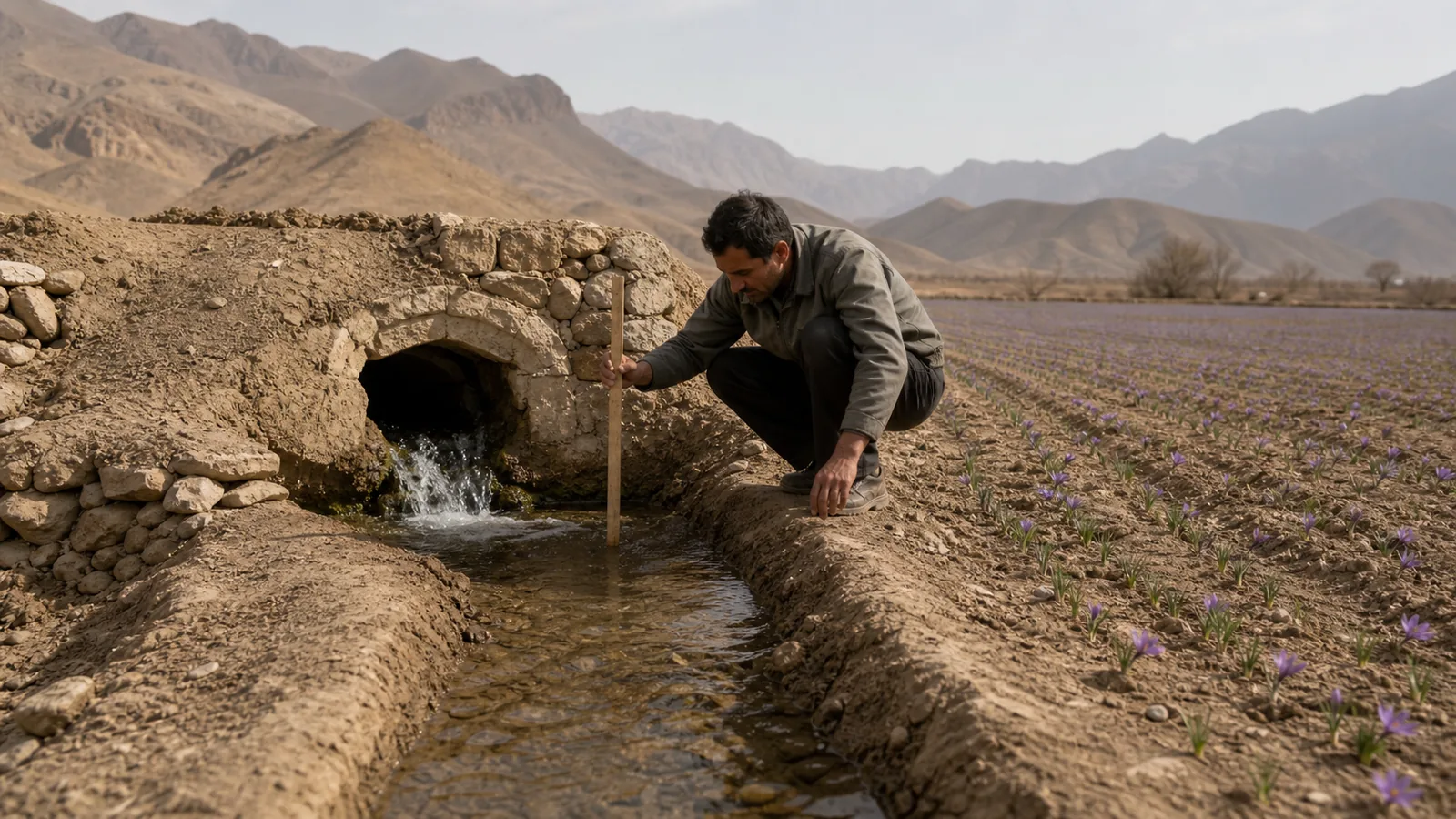
630 hectares of saffron is thirsty Bardaskan was the stark description used for a water emergency in the county’s Kuhpayeh foothill area in September 2015. Qanats and springs had dried, leaving saffron farms without their usual supply. The local agricultural director said about 2,500 households depended on the crop and called for 200 million tomans to bring water to the affected fields.
The report also described the wider drought response in Bardaskan. More than 2,000 tonnes of feed barley had been allocated to the county, subsidized bran was being held for livestock farmers, and a programme to purchase surplus or cull animals had begun. These measures appeared in the same agricultural briefing, but they addressed different losses: one protected the saffron crop, while the others helped livestock keepers through a feed shortage.
Why 630 hectares needed water
Hamid Hajinejad, then head of Bardaskan’s Agricultural Jihad office, attributed the saffron problem to dried qanats and springs in the foothill communities. A qanat carries groundwater through a gently sloping underground channel, allowing it to reach farms by gravity. When its source declines or the channel stops flowing, farmers cannot replace that water simply by opening a gate farther down the line.
Hajinejad said water delivery for the 630 hectares required 200 million tomans. He asked the provincial governorate and the Agricultural Jihad Organization to form a specialist committee to deal with the problem. The old English page rendered the amount as US dollars; the Persian text used tomans.
The announcement did not explain what the money would buy. It gave no number of tankers, water volume, source, delivery distance or allocation per hectare. It also did not record whether the committee was formed or the full sum was released. The 200-million-toman figure should therefore be read as a 2015 funding request, not a current aid programme or a verified final cost.
The crop was tied to 2,500 household incomes
According to Hajinejad, saffron cultivation was the only source of income for 2,500 households in the Kuhpayeh area. That statement explains the urgency behind the phrase “thirsty Bardaskan.” A missed irrigation did not affect an ornamental planting; it threatened the season’s main cash crop for a large rural community.
The source does not say how much land each household cultivated, whether all 2,500 owned fields or how farm income was shared. It is safer to preserve the official’s description than to turn it into an average farm size or household profit.
He used an expected average yield of four kilograms of dried saffron per hectare. Applied to 630 hectares, that would represent about 2,520 kilograms if every affected hectare were productive and reached the stated average. He valued the resulting local income at no less than 10 billion tomans.
Those two figures are planning assumptions, not a recorded harvest. Field age, corm density, soil, timing of irrigation, weather, labour and drying losses can all move actual yield. The 10-billion-toman number is also gross local income in the wording of the report; it is not farm profit after water delivery, harvest labour, processing and other costs.
Low-water does not mean no-water
Saffron is well suited to many dry regions, but the label “low-water crop” is easy to misunderstand. The corm becomes dormant during part of the hot season, and the crop can use autumn and winter moisture efficiently. It still needs water at the right stages. A dry traditional source can therefore put flowering and the next generation of corms at risk.
The UN Food and Agriculture Organization describes the qanat-based saffron system in nearby Gonabad as an adaptation to severe water scarcity. FAO calls the qanat a reliable source within that heritage system; it does not say that saffron can produce without irrigation.
Field research in semi-arid Mashhad provides a useful boundary. In a two-year experiment, supplying 50% of the crop’s water requirement reduced flower and dry-stigma yield in the second year compared with 75% or 100%. The study, published in Scientia Horticulturae, also found that planting density and corm development changed the response. It supports careful scheduling, not a universal volume for Bardaskan.
An emergency plan would need to work from the field rather than from saffron’s reputation for drought tolerance. Useful checks include:
- which qanats and springs had stopped or fallen below usable flow;
- the mapped area served by each source;
- soil moisture and field age before water was assigned;
- water quality and the capacity of the replacement source;
- delivery time, conveyance losses and access to dispersed plots; and
- records of hectares actually reached, rather than water merely dispatched.
The 2015 article supplies none of those operational records. It identifies the scale and the requested budget, not the outcome.
The later Bardaskan drought report was a separate event
Bardaskan faced a similar problem again in a report published in 2022. That account described more than 600 hectares in the foothills, about 2,500 affected families and a request for 15 tankers over a 40-day irrigation period. It also said a crisis well had been equipped, leaving transport as the immediate constraint.
The repeated geography and household figure do not make the reports interchangeable. The 2015 account concerned 630 hectares and a 200-million-toman funding request after qanats and springs dried. The later account concerned a crisis well, tankers and a broader forecast of lower citywide production. Our article on the later Bardaskan saffron drought preserves that separate sequence.
Reading the two records together suggests a recurring delivery vulnerability in the foothill system. It does not prove that the same farms missed water in both years or that the 2015 proposal failed. Parcel maps, water-delivery logs and final harvest records would be needed to establish continuity.
More than 2,000 tonnes of barley went to Bardaskan
The second subject in Hajinejad’s 2015 briefing was drought support for livestock farmers. Bardaskan was described as the county with the greatest drought damage in Razavi Khorasan Province. From a provincial feed-barley quota of 9,000 tonnes, more than 2,000 tonnes had been assigned to Bardaskan.
The detailed figures make the intended scale clearer. Hajinejad said 900 tonnes had already been transported to the county and warrants or allocations had been obtained for another 1,260 tonnes. Together, those components total 2,160 tonnes. The damaged English version reduced “more than 2,000 tonnes” to “more than 2 tons” and reduced the pending amount to 260; both were translation errors.
He added that Bardaskan was the first county in the province to absorb its feed-barley quota fully. “Absorbed” in this administrative context means the allocation was taken up; it does not show which livestock keepers received feed, how quickly it was distributed or whether the quantity covered their losses.
Subsidized bran required real livestock lists
A county feed-distribution committee had also been formed. Hajinejad reported a reserve of 500 tonnes of subsidized bran and asked village administrators and the heads of Islamic village councils to submit accurate lists of local livestock keepers to the agricultural office.
That request reveals a practical problem in emergency distribution. A stored quantity is not the same as delivered assistance. Officials still needed to identify eligible keepers, check the lists and allocate the feed. The article records the stock and the intended process, but not the number of recipients, price, ration per animal or delivery completion.
Keeping the list at village level may improve local knowledge, yet it also needs basic controls: dated animal counts, duplicate checks, signed receipts and a way to correct omissions. These are reasonable accountability principles, not details confirmed in the historical programme.
The county also began purchasing cull livestock
Hajinejad’s final announcement concerned animals that farmers could no longer keep economically. Bardaskan had begun purchasing surplus or cull livestock from local keepers and was described as the first county in the province to carry out that work.
The translated page called this a “playoff” purchase, which obscured the meaning of cull livestock. Culling may involve older, unproductive or otherwise surplus animals; it should not be interpreted as a general purchase of every drought-affected animal. The report gives no species, head count, price, buyer, inspection rule or welfare protocol.
This measure belonged to the livestock response, not to the saffron funding request. Combining the two into a single programme would create a false connection between feed eligibility, animal sales and water for saffron fields.
What the 2015 Bardaskan record establishes
The report establishes four dated facts about the local response as officials described it: 630 hectares of saffron needed replacement water; 200 million tomans was requested; roughly 2,500 household livelihoods were said to depend on the crop; and the county was also distributing feed support and purchasing cull livestock.
It does not establish that the water reached every field, that four kilograms per hectare was harvested, or that 10 billion tomans became household profit. Nor does it confirm that the barley, bran and livestock programmes covered every eligible keeper.
The useful lesson is operational. A crop can tolerate a dry climate and still be vulnerable when the water system on which its timing depends fails. Protecting saffron income requires a mapped source, a delivery plan and field-level records. Protecting the wider rural economy may require separate livestock measures at the same time, with each programme measured against what actually reached farms.

![Exporting Saffron to Turkey + Price Guide [Complete 0 to 100]](https://img.rowhanisaffron.com/20260827003933/saffron-export-turkey-quality-inspection.webp)



