


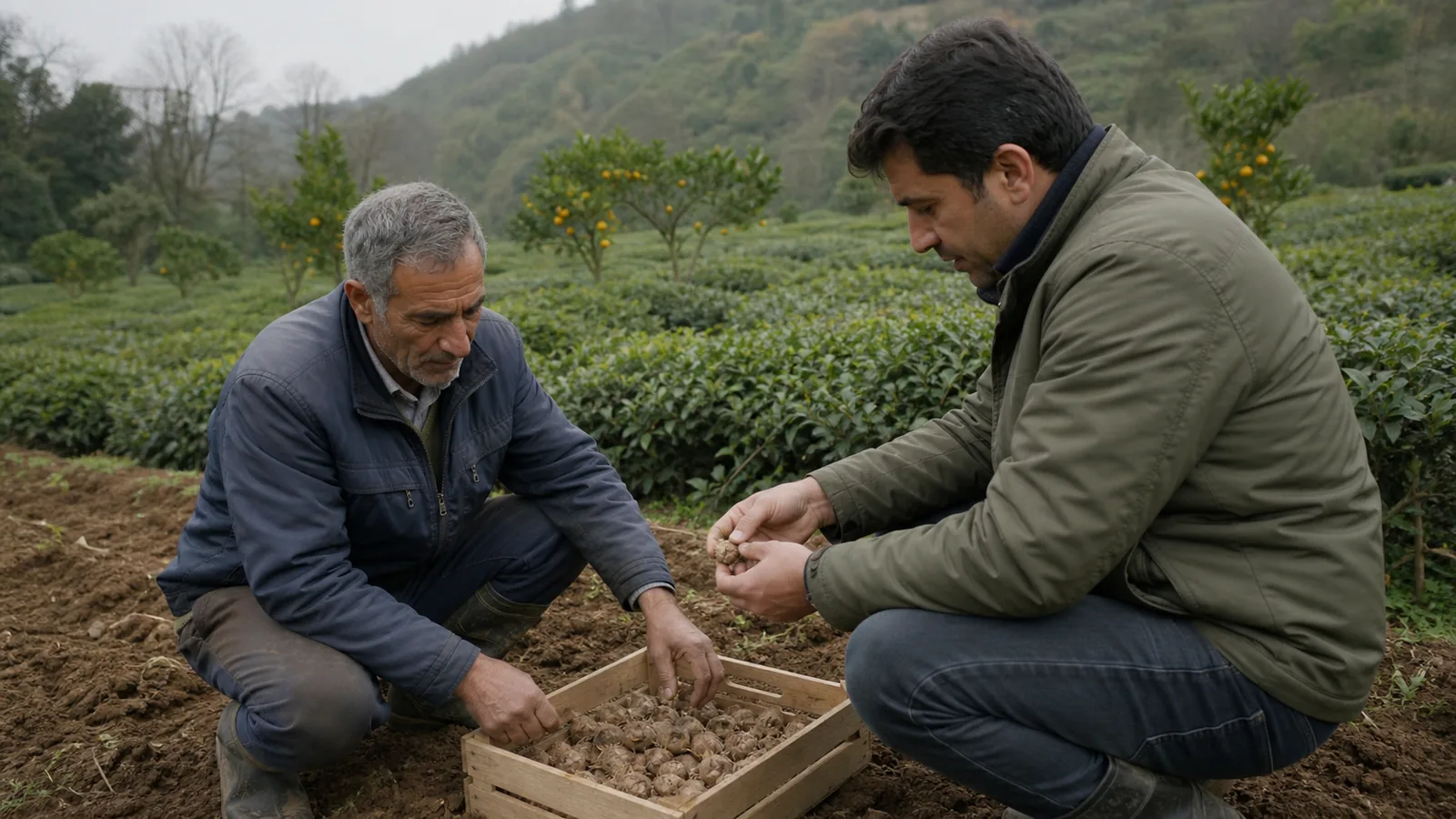
Saffron corm distribution in Amlash began as a small diversification programme reported in September 2015. The county agricultural office said 1.5 tonnes of planting material had been shared among growers around Kajid and Malekout, mainly for plots of 200 to 300 square metres. At the time, Amlash was said to have 30 saffron growers cultivating a combined 1.5 hectares.
The old page called this “Fennel seed distribution in Amlash,” but fennel was never part of the report. The Persian source referred to saffron planting material. More precisely, Crocus sativus is propagated with corms, not botanical seed. Correcting those two translation errors changes the headline, but not the historical event it describes.
What Amlash distributed in 2015
ISNA’s Gilan bureau attributed the figures to Masoud Amirbandeh, then director of Amlash County’s Agricultural Jihad office. Speaking at a county agriculture meeting, he said the 1.5 tonnes of saffron corms had been distributed to develop and promote cultivation in the Kajid and Malekout service areas.
A weight alone does not tell us how many corms were planted. Corm size, moisture, grading and rejected material all affect the count. The source gives no minimum weight or health standard, and it does not say whether each recipient received the same quantity.
It does say that programme plots were generally 200 to 300 square metres. Elsewhere in the same briefing, the county total was given as 1.5 hectares among 30 growers. Dividing the full area equally would produce an average of 500 square metres per grower, which is larger than the stated programme plots. That is not necessarily a contradiction: some existing land may have fallen outside the new distribution, or both figures may have been rounded. The report does not let us choose between those explanations.
Why corm is the accurate word
Saffron flowers are sterile and do not produce viable seed. The plant continues through a solid underground storage stem called a corm; daughter corms form around the parent and provide the next planting material. The Royal Horticultural Society’s saffron growing guide describes that cycle and distinguishes a corm from a true bulb.
In agricultural speech, “seed” is sometimes used broadly for planting stock. For a buyer or field record, the distinction matters. A corm lot can be weighed, sized, inspected and traced. Calling it seed hides the questions that determine whether a new plot has a fair start:
- where the corms were produced and how long they had been stored;
- their size distribution and visible damage rate;
- whether diseased, soft or injured corms were rejected;
- how each recipient lot was identified; and
- when the corms reached the field after distribution.
None of those controls is documented in the 2015 article. It records the mass delivered and the intended development area, not an audited planting-quality programme.
The reported yield was two kilograms per hectare
Amirbandeh described saffron as a perennial crop able to cope with difficult conditions, including limited water. He put Amlash’s average dried-saffron yield at two kilograms per hectare. Applied mechanically to the stated 1.5 hectares, that average would equal about three kilograms. It is an illustration of scale, not a measured county harvest supplied by the report.
Small new plots should not be judged against a mature-field average in their first flowering season. Establishment year, corm size, planting density, soil drainage, disease, weather, harvest timing and the method used to dry stigmas can all change the result. “Perennial” means the crop continues for more than one growing season; it does not mean that yield is fixed from year to year.
Amlash also differs from the dry saffron districts for which much cultivation advice was developed. Gilan’s wetter conditions make site drainage and local observation especially important. A field that retains water around corms cannot be made suitable merely because saffron is described as drought tolerant.
Our practical saffron cultivation checklist explains how growers can separate site selection, corm checks, establishment records and harvest handling. The 2015 Amlash figures should not be substituted for a current local field assessment.
What would show whether the distribution worked
A corm handout is an input. Its success depends on what happened after recipients left the distribution point. A useful evaluation would follow each plot for several seasons and record:
- planted area and corm mass actually placed in the ground;
- emergence and flowering by plot and field age;
- fresh flowers and accepted dry stigmas, kept as separate measures;
- losses from rot, rodents, weeds or poor drainage;
- labour and drying capacity at the flowering peak; and
- daughter-corm condition before any field was expanded.
The report provides no follow-up harvest, survival rate or income. It is therefore reasonable to say Amlash began a small saffron-promotion effort, but not that the 1.5-tonne distribution established a profitable industry.
A separate biological-control programme covered 400 hectares
The agricultural meeting then moved to tea and citrus. Amirbandeh said expanding biological pest control was a county priority. During Shahrivar, the Iranian calendar month spanning late August and much of September, beneficial Cryptolaemus beetles had been released against mealybugs across 400 hectares of tea and citrus orchards.
The damaged translation called the beetle an insecticide and referred vaguely to “citri scale.” Cryptolaemus montrouzieri is a predatory lady beetle, commonly called the mealybug destroyer. Both larvae and adults feed on mealybugs. Cornell University’s biological-control profile of Cryptolaemus notes its history in citrus and the way effectiveness changes with pest density and conditions.
A release is not proof that an orchard is controlled. Field staff still need to confirm the pest, estimate infestation, record the number and timing of beetles released, avoid incompatible pesticide applications and check whether predator and pest populations change. The 400-hectare figure describes treated area as reported by the official; it is not a measured reduction in crop loss or pesticide use.
Amlash’s tea and citrus area provided the context
Amirbandeh placed the county’s tea gardens at 5,200 hectares and its citrus orchards at 2,936 hectares. These were 2015 administrative figures. The article does not identify the survey year, productive area, orchard age or whether the 400 biological-control hectares were split evenly between the two crops.
The figures help explain why the beetle release received space in the same briefing as a much smaller saffron programme. Tea and citrus already occupied thousands of hectares, while saffron covered 1.5 hectares and was being promoted through small trial-scale plots. The subjects shared an agricultural meeting, not a single crop plan.
The third issue was unauthorized land-use change
The meeting’s final topic concerned construction and conversion of agricultural land. Amirbandeh said sessions had been held to establish a consistent response to unauthorized changes in Amlash. Participants included the public prosecutor, the county judiciary’s crime-prevention office, district administrators, Roads and Urban Development, the electricity authority, the Housing Foundation, village administrators and heads of Islamic village councils.
He expressed concern that some village administrators and government offices had acted independently in giving permissions. He warned that such conduct would be dealt with firmly and said rural construction had to proceed with the legally required Agricultural Jihad authorization.
That is a record of the official’s 2015 statement, not current legal advice. The article does not name the governing statute, define every permit category or document an enforcement case. Anyone planning construction or a land-use change now needs written guidance from the current competent authorities for that parcel.
How the three Amlash initiatives fit together
The 2015 briefing captured an agricultural office balancing three very different tasks. It was testing saffron on a small scale, using a beneficial predator in established tea and citrus orchards, and trying to protect farmland from unauthorized conversion.
Each needed a different measure of success. For saffron, the missing evidence is plot survival, accepted dry yield and grower economics over several seasons. For biological control, it is pest monitoring before and after release. For land protection, it is lawful, consistent decisions rather than the number of meetings held.
The corrected record is modest but useful. Amlash had 30 reported saffron growers and 1.5 hectares under the crop; 1.5 tonnes of corms were distributed around Kajid and Malekout; local yield was reported at two kilograms per hectare; Cryptolaemus releases covered 400 hectares of tea and citrus; and officials raised a separate concern about rural construction permits. It does not claim that fennel was distributed, that saffron grows from seed or that any of the three programmes achieved an outcome the source never measured.

![Exporting Saffron to Turkey + Price Guide [Complete 0 to 100]](https://img.rowhanisaffron.com/20260827003933/saffron-export-turkey-quality-inspection.webp)



