


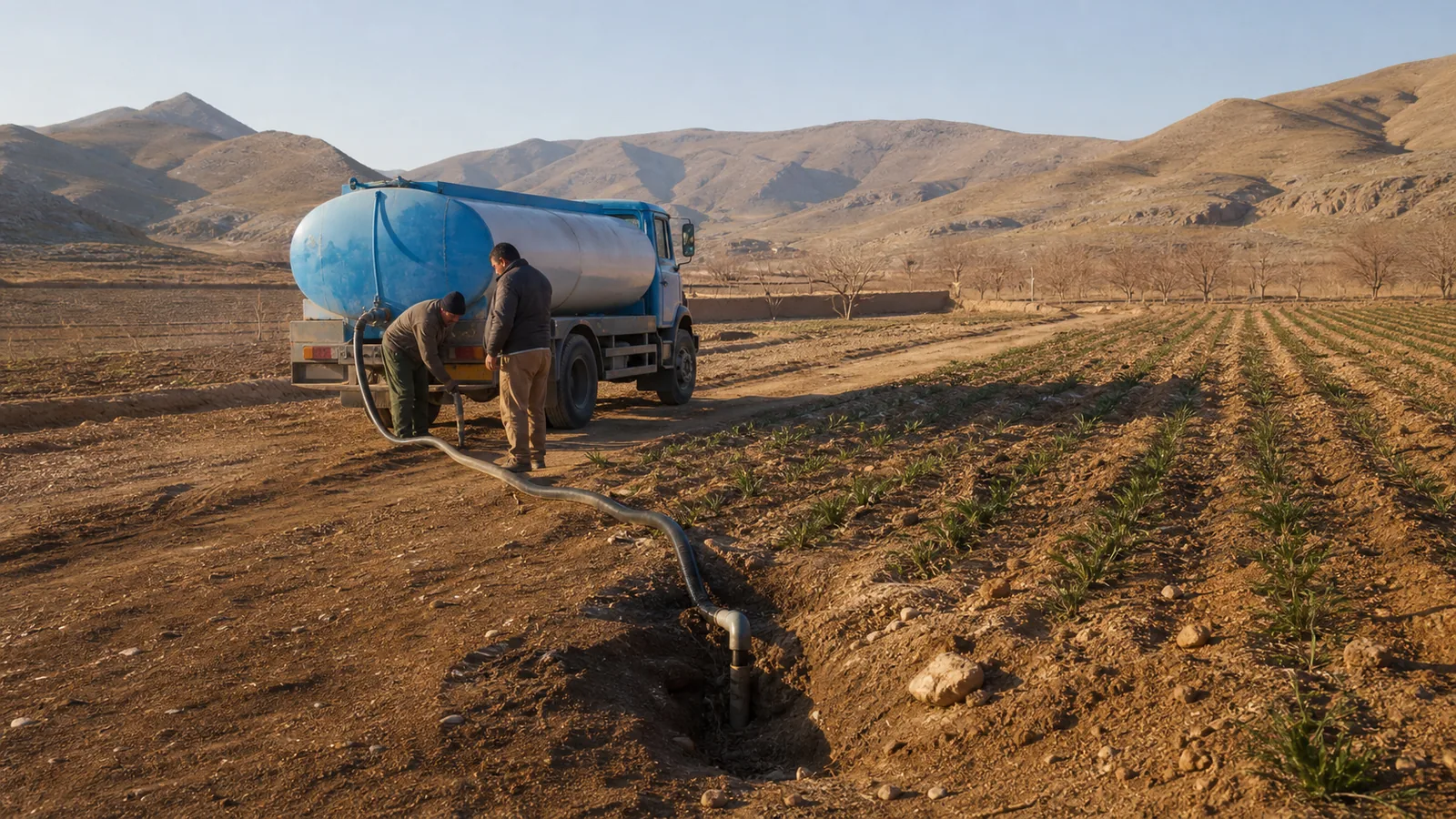
Bardaskan saffron fields faced two connected pressures in the historical reports: more than 600 hectares in the foothills needed water deliveries, while production across the city was forecast to fall by about 30% after a dry crop year. Together, the accounts show that the immediate problem was not simply finding water. It was moving enough water to farms during a roughly 40-day irrigation period.
The figures come from statements by local officials and describe conditions at the time of publication in 2022. They should not be read as a current drought bulletin, a current funding offer, or a guarantee of the final harvest.
Why 600 hectares of Bardaskan saffron needed water
Mohammad Ismail Yaghoubzadeh, then governor of Bardaskan and head of the local Crisis Management Coordination Council, said more than 600 hectares of saffron farms in the Kuhpayeh foothill area were “thirsty” as harvest approached. He linked those farms to about 2,500 families awaiting assistance.
According to his account, drought had dried the foothill area’s qanats and springs. Saffron income was especially important to the affected communities, which made a missed irrigation more than an agronomic problem: it threatened household livelihoods as well.
A crisis well had been authorized with the agreement of provincial authorities and the regional water organization. The local agricultural office had carried out and equipped the work on credit. Yaghoubzadeh said water was therefore available, but the city lacked the vehicles needed to deliver it to dispersed fields.
The request for 15 tankers over 40 days
The officials asked for 15 tankers to serve the foothill farms. Hamid Hajinejad, director of Bardaskan’s agricultural office, described an irrigation window of at least 40 days and said the fields could be covered within that period if the tankers were dispatched.
The original destination article contains incomplete translated sentences, but its central sequence is clear:
- the traditional qanats and springs had dried;
- a crisis well had been permitted and equipped;
- the remaining constraint was water transport; and
- local officials requested 15 tankers for the irrigation period.
The report also records a funding dispute. Correspondence had been sent to the provincial agricultural authority, but officials said that body had no plan or budget for supplying water to the saffron farms. The article does not say whether the tanker request was ultimately approved or whether all 600 hectares received water.
Citywide production was forecast to fall 30%
A companion report provides the broader production context. Hajinejad placed Bardaskan’s saffron area at about 3,350 hectares and said the city hoped to harvest more than 13 tonnes. The translated source mistakenly labels the 3,350 figure as tonnes, but the surrounding wording identifies it as cultivated area; the 13-tonne figure is the production forecast.
On those rounded figures, 13 tonnes across 3,350 hectares would equal roughly 3.9 kilograms per hectare if every reported hectare were productive. That is a calculated illustration, not an official yield figure, because the report does not separate mature, newly planted, or inactive land.
The same official forecast a production decline of about 30% compared with the previous year, attributing it to drought and reduced rainfall in the preceding crop year. Because “more than 13 tonnes” was still an expectation rather than a final measured harvest, the decline and total should both remain labeled forecasts.
The 600 foothill hectares represent about 18% of the stated 3,350-hectare citywide area. This links the emergency water story to a substantial part of local cultivation without suggesting that every Bardaskan farm faced identical conditions.
What the “ideal saffron” pilot involved
Alongside the emergency response, Bardaskan’s agricultural office described an “ideal saffron” project intended to improve establishment practices. A supervising expert associated in the report with the United Nations Industrial Development Organization (UNIDO) was based in Shahrabad and monitored several saffron-producing villages.
A half-hectare pilot had been planted in Aliabad village. The program offered incentive payments to participating farmers who followed its technical criteria, including:
- using saffron corms weighing more than 8 grams;
- observing the specified planting depth and spacing; and
- disinfecting planting material as directed by the project.
These were conditions of that local historical program, not universal instructions for every soil, climate, or disease situation. The source does not provide the protocol, payment amount, trial results, comparison plots, or an independent evaluation, so it is too early to claim that the pilot improved yield.
The reported 500-billion-rial economic contribution
Hajinejad valued Bardaskan’s saffron production at about 500 billion rials and said it supported household economies. The figure is best treated as a reported gross production value. It is not farm profit, because the article gives no costs for corms, labor, water transport, drying, finance, packaging, or marketing.
That distinction matters in a drought year. A crop can carry a large market value while individual growers still face higher costs, lower output, or losses from fields that miss their irrigation window.
What remains unresolved
The two reports now form one account of the same Bardaskan season: a citywide production decline, a 600-hectare water emergency, the tanker request, and a small technical pilot. Several outcomes remain undocumented, including final rainfall, tanker deployment, irrigated hectares, actual dried-saffron output, and measured results from the Aliabad plot.
Until those records are available, the safest conclusion is limited but important. Drought affected a meaningful share of Bardaskan saffron land, local authorities identified water transport as the immediate operational gap, and the reported 30% production reduction was a forecast rather than a final audited result.

![Exporting Saffron to Turkey + Price Guide [Complete 0 to 100]](https://img.rowhanisaffron.com/20260827003933/saffron-export-turkey-quality-inspection.webp)



