


Reports of serious damage to saffron fields in Gonabad city described a season in which low winter rainfall, intense summer heat and sudden cold events converged. Fatemeh Gavahi, identified at the time as a UNIDO observer in Gonabad, said flowering and yield had fallen after the harvest was complete.
What Fatemeh Gavahi reported
Gavahi linked the weak harvest to a lack of rainfall during the preceding crop year and excessive heat in the following summer. She said the finished flower harvest showed less flowering than previous years and a significant drop in yield.
The original article did not give a harvest total, percentage loss, weather-station record or survey method. Its account should therefore remain an attributed seasonal assessment, not a precise measurement of present-day production.
The reported damage was not limited to one weather event
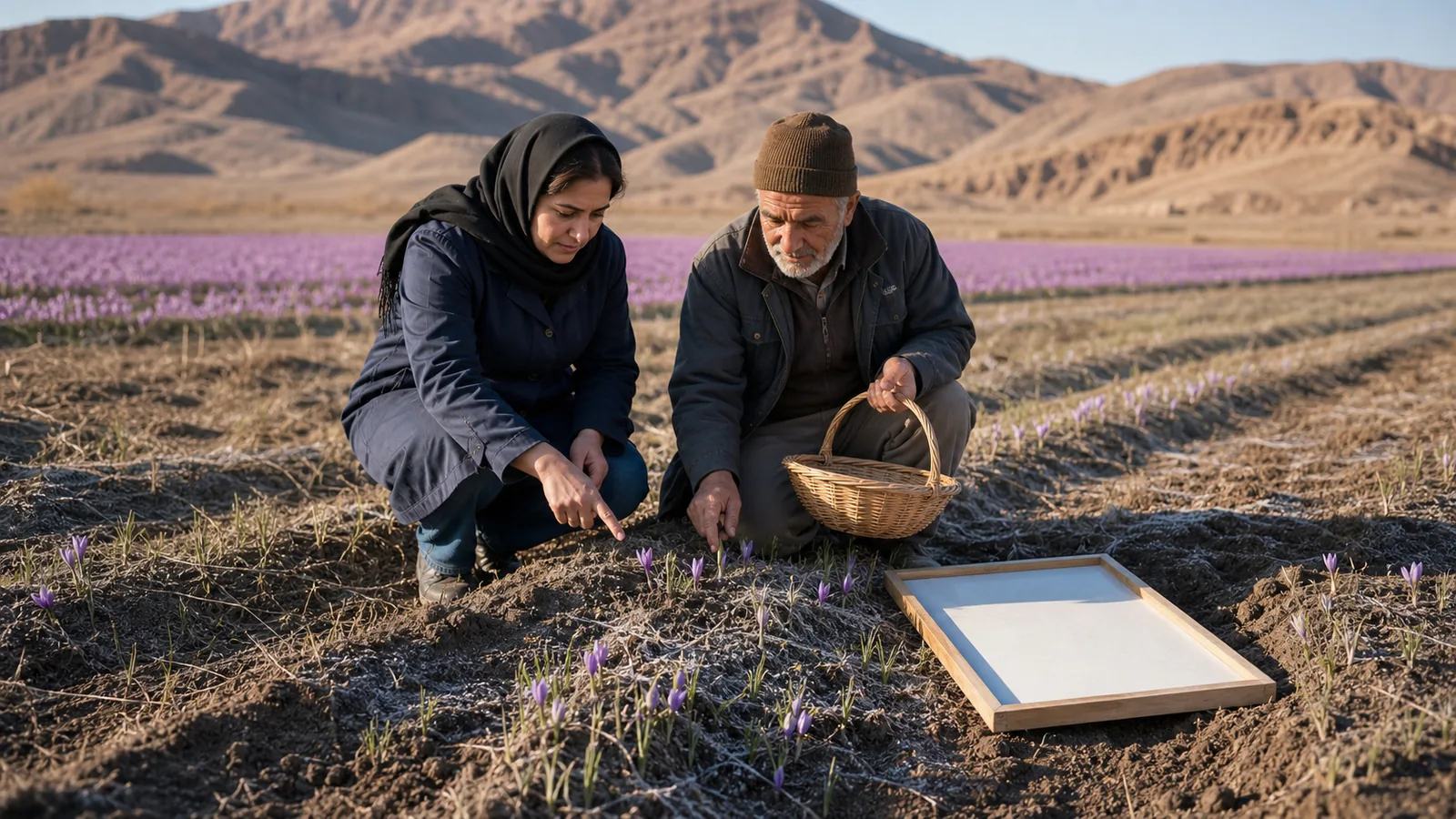
The source described several stresses. Winter rainfall had been low, summer heat had been intense, and some farms later experienced premature cold, frost and sudden hail. Gavahi said the cold events and hail broke saffron buds in affected fields.
Those mechanisms should not be collapsed into a single cause. Drought and heat can influence corm reserves and flower initiation, while frost or hail can physically damage emerged buds and flowers. A farm may experience one, several or none of these problems.
Why the crop can suffer before flowers appear
Saffron’s flower depends on work done inside the corm before harvest. Soil moisture, temperature, field age and corm condition all influence the following flowering period. A difficult summer may not leave an obvious mark above ground at the time, yet growers can see the result when buds emerge unevenly or in smaller numbers.
Peer-reviewed saffron research on temperature and moisture discusses their role in flower initiation and yield. It supports examining the crop cycle as a whole, while not proving what happened in any individual Gonabad field.
Low rainfall matters even for a drought-tolerant crop
Saffron is valued in arid areas because it can be productive with relatively little water. Drought tolerance is not immunity to prolonged water shortage. The crop still needs useful moisture at key stages, and rainfall also influences the qanats and other sources on which irrigation depends.
The FAO description of Gonabad’s qanat-based saffron farming system places the crop within an area of severe water scarcity. Its significance lies in the combination of local knowledge, water management and a high-value crop, not in an assumption that the plant will yield normally through every drought.
Heat can affect the next flowering period
Warm, dry summers are part of saffron’s normal cycle, but temperature still has biological limits and timing effects. An unusually hot period can influence conditions around dormant corms and flower development. The outcome depends on depth, soil, moisture and duration, not simply the highest air-temperature reading.
A useful investigation compares weather over time with field age, irrigation and flowering records. Without that comparison, “heat damage” remains a plausible observation rather than a quantified cause.
Frost and hail leave different evidence
A grower assessing a cold event should record when it occurred relative to emergence, which parts of the field were affected and whether buds were discoloured, split or physically broken. Hail often leaves a different pattern from frost because impact damage may be localized by the storm’s path.
Photographs taken promptly, a simple field map and notes from an unaffected comparison area make later estimates more credible. They also help avoid attributing old corm or drainage problems to a single night of weather.
Kakhk’s colder upstream villages
Gavahi said the decline was also visible in cold villages upstream of Gonabad’s Kakhk section, where harvest was lower than the previous year. The report did not name the villages or provide their individual yields, so no village-level loss can be calculated from it.
Elevation and local topography can create meaningful temperature differences over short distances. That is why county-wide advice needs to be checked against each village’s flowering dates and frost exposure.
Surrounding cities also reported lower harvests
The article said saffron harvests had decreased in surrounding cities as well. This broad observation is retained, but the places, comparison years and sources were not identified. It cannot establish the size or common cause of a regional decline.
A sound regional comparison would use the same unit—preferably dry stigma yield per harvested hectare—and separate lower planted area from lower productivity on existing fields.
How field damage should be measured
The first step is to divide the field into comparable areas and count flowers or damaged buds within repeated sample plots. Growers can then record the harvested area, fresh-flower weight, dried-saffron output and final dry yield.
Weather records, irrigation dates and visible damage belong beside those figures. A single photograph or total weight cannot explain whether the loss came from fewer flowers, smaller stigmas, unharvested area or post-harvest handling.
Protecting the value of a smaller crop
When volume is low, careful harvesting and processing become even more important. Sound flowers should be collected promptly, carried in shallow clean containers and separated without mixing damaged plant material into the stigmas.
Drying conditions and lot identity should remain controlled. A difficult season is not a reason to weaken specifications or combine traceable lots in ways that hide quality differences.
What the UNIDO connection means
Gavahi was described as a local observer connected with the United Nations Industrial Development Organization (UNIDO). The organization maintained an Iranian saffron production-efficiency project record focused on target villages and value-chain development. The article did not define her contract, mandate or the particular data behind this statement, so those details are not assumed.
The source also described UNIDO as working with 172 member countries to promote industrial development and alleviate poverty through productivity. That count reflected its publication period. UNIDO’s current official description lists 173 Member States and defines its mandate as inclusive and sustainable industrial development.
Recovery decisions need diagnosis, not one recipe
After a damaged season, a field may need adjusted irrigation, drainage work, corm assessment or simply better observation before the next cycle. The appropriate step depends on the cause. Applying extra water to a poorly drained field can create another problem; replacing corms without checking soil and field age can waste money.
Farm advisers should distinguish measures that protect surviving corms from longer-term decisions about replanting. Both need a record of the field’s condition and expected remaining life.
What should be monitored in the next cycle
Useful records include winter rainfall, irrigation availability, summer temperature, first emergence, flowering density, frost and hail dates, damaged-bud counts and dry yield. Marking high and low parts of the field helps reveal drainage or cold-air patterns.
Comparing these observations with an unaffected field nearby is especially valuable. It gives local context that a county average cannot provide.
Reading the Gonabad damage report today
The serious damage to saffron fields in Gonabad city was reported as a completed season’s outcome, with low winter rainfall, summer heat, reduced flowering and localized frost and hail damage all in view. The account is important, but it is historical and lacks the measurements needed to update it into a current production statement.
Its lasting value is the warning to watch the full crop cycle. Gonabad’s saffron system is adapted to a dry landscape, yet adaptation still depends on water, sound corms, local temperature and careful response to extreme events. Good records turn those risks from a broad story into decisions a grower can act on.

![Exporting Saffron to Turkey + Price Guide [Complete 0 to 100]](https://img.rowhanisaffron.com/20260827003933/saffron-export-turkey-quality-inspection.webp)



