


The statement that rainfall is a limiting factor in the production of Iranian saffron came from a specific regional concern, not a rule that rain is always bad for the crop. Sadollah Eskandari, identified in the original report as horticulture director of the East Azerbaijan Agricultural Jihad Organization, was discussing rain that overlaps the province’s saffron-flowering period.
What the East Azerbaijan warning meant
Eskandari said saffron flowering in the province generally ran from early to late November and could coincide with the rainy season. In that setting, rainfall could limit production. His comment was about the timing of rain around flowering and harvest, not a claim that saffron can grow without water.
The original report did not provide a weather station, rainfall total, field trial or measured loss. Its wording is best read as local agronomic guidance from that period, not a universal threshold for every Iranian saffron region.
Rain can help and hinder at different stages
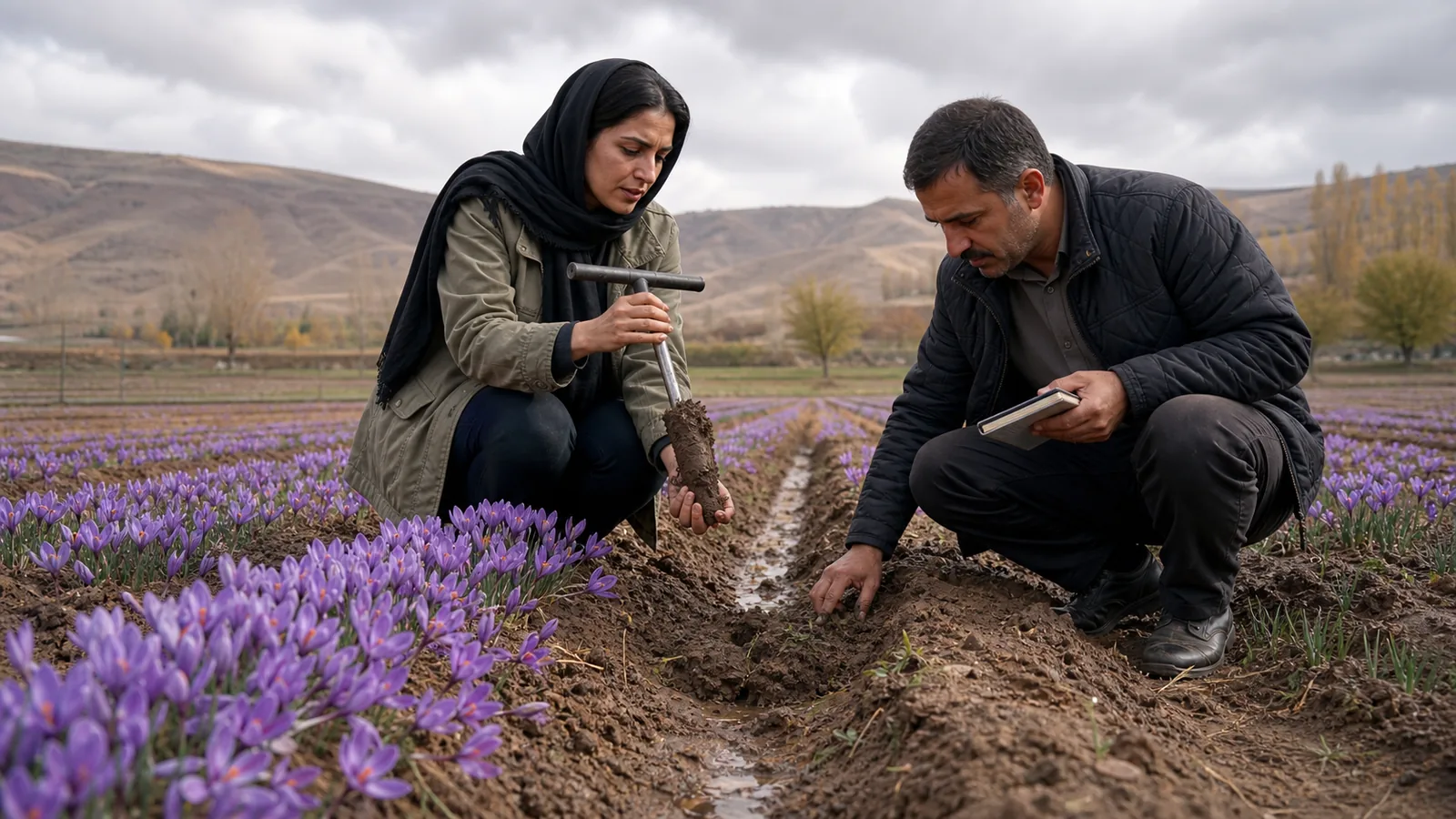
Saffron needs moisture to begin active growth and support its leaves and replacement corms. Rain can contribute useful water. The same rainfall can become difficult when it arrives with poor drainage, keeps soil excessively wet, disrupts the short picking window or leaves flowers wet during handling.
That is why annual rainfall alone says little. Distribution, intensity, soil texture, slope, drainage and the crop’s stage all influence the outcome.
Flowering creates a narrow operational window
Flowers are commonly picked early and processed quickly. Persistent rain can slow access to the field, increase mud on containers and complicate clean separation. Wet flowers also require especially careful handling before the stigmas are dried.
These are production-chain constraints as much as plant-water constraints. Even when plants have enough moisture, a harvest can lose value if labour, transport and drying cannot keep pace with flowering.
The traditional four-irrigation reference
Eskandari said traditional saffron management often used four irrigation rounds, while the crop’s needs still had to be met between October and May. That number is preserved as his description. It should not be copied as a fixed schedule without considering rainfall, soil and local growth stages.
A recent peer-reviewed review of saffron water management likewise explains that timing and distribution matter, and that irrigation needs change with climate and development stage. The evidence supports planned irrigation, not one calendar for every field.
More frequent does not mean more total water
The official’s practical point was to avoid a few very heavy applications and consider more frequent irrigation when conditions justified it. Smaller, timely applications can be easier to match to the active root zone, but frequency must still respond to measured soil moisture and rainfall.
Adding rounds without measuring the field can overwater heavy soil. Withholding water because rain was forecast can also leave a crop short if the rain does not reach the root zone. The decision needs observation, not a slogan.
Why soil texture and drainage change the answer
Water moves differently through sandy, loamy and clay-rich soils. A volume that wets one field evenly may run through another or remain near the surface of a third. Compaction, bed shape and slope add further variation.
Growers should check how far moisture actually moved and how long the root zone stayed wet. Ponding, slow infiltration or a persistent wet smell calls for a drainage assessment before more water is added.
The 2,500-cubic-metre estimate needs local context
Eskandari estimated saffron water requirements at 2,500 cubic metres per hectare. The report did not state whether that figure included effective rainfall, which irrigation method it assumed, the soil type or the production year. It remains an attributed regional estimate rather than a prescription.
Water requirements are normally calculated across the season and adjusted for weather, application efficiency and field conditions. Two farms can apply the same gross volume yet deliver different amounts to the useful root zone.
Planting depth and wetting depth
The source described corms planted about 20 centimetres deep and advised wetting the soil to roughly 40 centimetres, warning that much deeper percolation could be wasted. Those depths are retained as Eskandari’s guidance, not treated as exact limits for every planting system.
Corm placement varies, and roots do not stop at an identical line across every field. A grower can use a soil probe or small inspection hole after irrigation to see where moisture reached instead of assuming a depth from application time alone.
Water productivity is more useful than “low water use”
Saffron is attractive in dry regions partly because it can produce a high-value crop with less water than many alternatives. Yet a low gross requirement does not guarantee efficient use. Leakage, runoff, deep percolation and poorly timed irrigation can still waste a scarce supply.
A long-term study of saffron irrigation and water quality found that water depth, salinity and planting method affected yield over several seasons. It reinforces the need to evaluate water together with soil and cultivation method rather than judge a field by litres alone.
Why saffron cultivation expanded in East Azerbaijan
Eskandari linked the province’s interest in saffron to its relatively low water demand and to a seasonal pattern in which the crop may need water at times when some other crops do not. That difference can help distribute farm water and labour across the year.
Expansion still requires suitable land and a complete market path. A crop chosen for its water profile can disappoint if planting material, harvesting labour, drying, testing or buyer access are weak.
Education was part of the original recommendation
The horticulture director said both general and specialized education could increase agricultural production, including saffron. For irrigation, useful training is field-based: how to check soil moisture, interpret rain, maintain equipment, recognize poor drainage and keep records.
Specialists can provide regional ranges, but growers need to connect those ranges to what happens in their own beds. A simple log of rainfall, irrigation date, estimated volume, emergence, flowering and dry yield can reveal more than memory after a difficult season.
Planning for rain during harvest
Where November rain is likely, preparation should include clean shallow containers, protected transport and enough indoor space for separation. Labour plans need flexibility because flowering and field access may change together.
Flowers should not be compressed into wet heaps while waiting. Lots from muddy or damaged areas should remain identifiable so that handling problems can be corrected rather than hidden by mixing.
What a grower should measure
The core measurements are modest: rainfall at or near the field, irrigation timing and volume, soil moisture at useful depths, any standing water, flowering dates and finished dry yield. Recording field age and obvious differences in soil or slope makes the comparison stronger.
When several seasons are available, these records help separate a one-off storm from a repeating drainage or scheduling problem. They also make technical advice more specific.
Reading “rainfall is a limiting factor” carefully
For East Azerbaijan, the original warning focused on rain overlapping the early-to-late-November flowering season. The rest of Eskandari’s comments made the complementary point: saffron still needs managed water from autumn through spring, despite its reputation as a low-water crop.
The two ideas are not contradictory. Too little useful moisture can limit growth, while badly timed or excessive water can limit flowering, field access and post-harvest quality. Productive irrigation is the work of putting an appropriate amount in the right soil at the right time, then checking what actually happened.

![Exporting Saffron to Turkey + Price Guide [Complete 0 to 100]](https://img.rowhanisaffron.com/20260827003933/saffron-export-turkey-quality-inspection.webp)



