


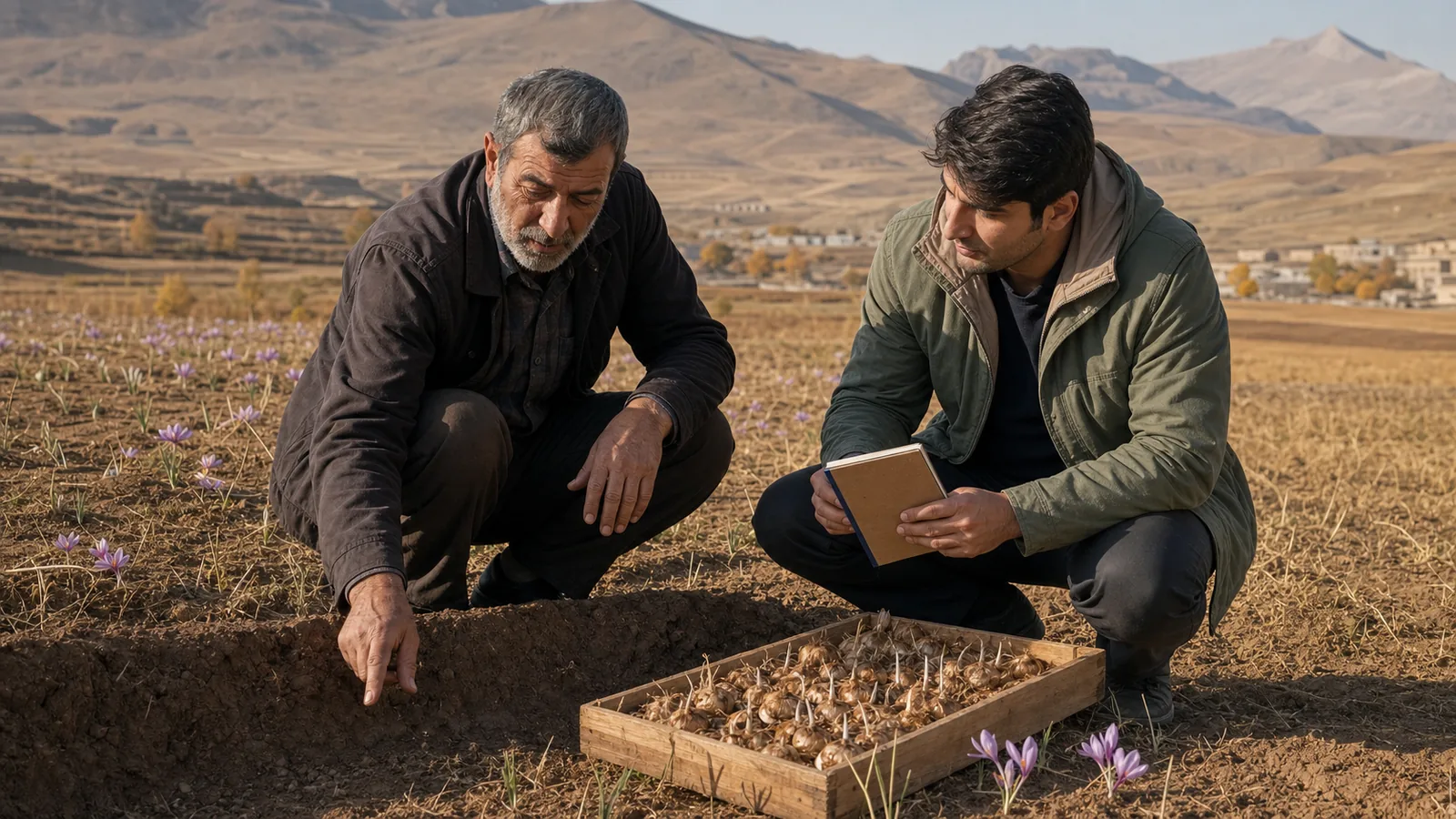
The statement that Hamedan province is the main source of saffron in terms of history came from a provincial agricultural official describing cultivation around the Alvand and Zagros region during the Median period. Hamedan saffron has a documented heritage, but that claim should not be confused with proof that today’s cultivated saffron was first domesticated there.
What the Hamedan agricultural official said
The original report quoted Bayat, deputy director of horticulture at the Hamedan Agricultural Jihad Organization. Referring to saffron’s several-thousand-year history, he presented Hamedan as an important source during the Median era.
He connected that history with local place-names, the province’s climate and soils, its November harvest, yields and cultivation in Tuyserkan, Nahavand and Malayer. These details preserve the account as it was given; they do not all carry the same level of historical or agronomic evidence.
Hamedan and saffron in the Median period
The Median kingdom was centred in western Iran, and the Alvand and Zagros landscape overlaps the wider historic setting associated with Hamedan. A peer-reviewed review of saffron’s history and genetics notes historical reports of a Persian “historic saffron,” possibly another crocus species, cultivated near the Zagros and Alvand mountains during the Median period.
That supports a long regional relationship with crocus and saffron use. The same review finds the strongest combined art and genetic evidence for the domestication of Crocus sativus in early Greece. Ancient cultivation in western Iran and the crop’s original domestication are related questions, not identical claims.
Why the word “source” needs care
“Source” can mean the place from which a product was traded, an early cultivation area, the biological origin of a plant or the location where domestication occurred. The headline does not specify which meaning it uses.
Bayat’s remarks are most defensible as a claim about Hamedan’s early cultivation and cultural history. Calling the province the single proven birthplace of cultivated saffron would go beyond the evidence cited in the report.
The place-names cited in the report
Bayat referred to names rendered in the translated article as Saffron Bahar and Rudavar Tuyserkan, saying they arose from the plant’s local history. Place-names can preserve agricultural memory, but their spelling, age and etymology need documentary or linguistic evidence before they establish a date of cultivation.
The names are still useful clues. They point attention toward communities where archival records, local histories, field remains and trade accounts may be compared rather than relying on one modern statement.
Historic evidence around Nahavand and Rudavar
There is clearer written support for saffron in the area during the early Islamic centuries. An academic study of trade on the Khorasan road cites early geographers who described abundant, high-quality saffron from Rudavar in the Hamedan region and said it was sent to other areas.
This evidence does not prove the headline’s broad origin claim, but it does show that saffron production and trade formed part of the region’s established economy long ago.
The climate described for Hamedan saffron
Bayat described a temperate to semi-warm setting with mild winters and hot, dry summers, while noting saffron’s resistance to cold. That is a broad provincial description. Elevation, frost timing, drainage and local temperature still differ from one field to another.
Saffron’s summer dormancy helps it tolerate dry conditions, yet flower initiation and emergence respond to temperature and moisture. Cold tolerance should not be read as immunity to poorly timed frost or abrupt weather during sensitive growth stages.
An annual cycle unlike many field crops
The source said saffron’s life cycle is the opposite of other crops: it becomes dormant in spring and grows green through the colder season. The awkward translated phrase “goes to autumn in spring” appears to describe that dormancy.
After flowering in autumn, leaves continue to support the corm through winter and spring. The above-ground growth then dries back as the plant enters its warmer-season rest. Field operations should follow that cycle rather than a conventional spring-planted calendar.
Soil texture matters less than drainage and condition
Bayat said saffron performs in sandy, clayey and light soils. Saffron can grow across more than one soil texture, but a texture label alone is not enough. Compaction, drainage, salinity, organic matter, field history and the depth of the rooting zone affect establishment and disease pressure.
A peer-reviewed agronomic review of saffron production shows why site conditions and water timing matter: poor corm quality, rodents, fungal disease, unreliable moisture and post-harvest handling can all reduce performance. Waterlogged or poorly drained ground is especially risky for corm rot.
Corm health, rodents and fungal disease
The original advice identified mice as a major field enemy and fungal diseases as another threat. Rodent pressure and corm rot are genuine management concerns, but a blanket instruction to disinfect all soil and planting material with fungicide is not safe without a diagnosis.
Growers should begin with healthy, traceable corms and reject lots showing soft tissue, dark lesions, decay or serious damage. Any pesticide or fungicide decision must follow local registration, the product label and advice suited to the identified problem. Good drainage, clean handling and field monitoring remain important whether or not a treatment is used.
The November harvest window
Bayat placed Hamedan’s saffron harvest from early November to the end of the month. That preserves the timing in the report, not a fixed annual promise. Flowering can move with elevation, autumn temperatures, moisture and the condition of the corms.
Fields need close observation as buds emerge because flowers are normally collected soon after opening. Delays can expose stigmas to weather and contamination and can make separation work harder.
The five-to-six-kilogram yield figure
The official gave a provincial yield of five to six kilograms per hectare. The report did not state the year, field age, sample size, drying basis or range between farms, so the number should be treated as an attributed historical benchmark.
Dry saffron yield is affected by corm size and density, establishment year, field age, flowering conditions, harvest speed and drying practice. A grower comparing farms should use like-for-like dry weights from the same season and explain how the figure was measured.
The comparison with Afghanistan
Bayat said Afghanistan obtained needed saffron corms from Iran and that Afghan cultivation had recently increased. He also cited a yield of ten kilograms per hectare there. Both statements belong to the date of the original report; “recently” does not describe the present day.
No survey, production year or measurement method accompanied the comparison. It should not be used as a current national average or as proof that one country’s farms inherently outperform another’s.
Management behind yield differences
The report correctly pointed to farm management, soil, timely irrigation and fertilisation as influences on yield. Their effects are connected. Irrigation timing depends on rainfall and soil drainage, while a fertiliser decision should follow soil or plant evidence rather than a fixed recipe.
Other practical variables include corm health, planting depth and density, weeds, rodents, disease, field age, picking labour and drying. Recording each season makes a yield number more useful than a provincial estimate by itself.
Cultivation across Hamedan Province
Bayat said Hamedan’s regions faced no special restriction preventing saffron cultivation and reported activity in all cities. That wording should not be read as evidence that every site is suitable. A province can support a crop while individual fields fail because of drainage, frost pockets, salinity, water quality or labour constraints.
He singled out Tuyserkan and Nahavand for cultivation since ancient times. The historical record for Rudavar and Nahavand supports a long tradition, while farm-level suitability still requires present-day assessment.
Malayer’s reported 20 hectares
The source said saffron cultivation in Malayer had reached 20 hectares. With no reporting year or later update, that figure is a snapshot and should not be presented as the city’s current planted area.
For a meaningful current comparison, authorities would need to publish planted and productive hectares separately, together with field age, dry production and the season covered.
Hamedan’s history without overstating it
Hamedan province is the main source of saffron in terms of history was Bayat’s way of emphasizing a regional legacy. Evidence for ancient crocus cultivation near Alvand and for later saffron trade around Rudavar and Nahavand gives that legacy substance.
The careful conclusion is narrower than the headline: Hamedan is an important historic saffron landscape, not a settled answer to every question about the plant’s domestication. Its modern future depends on healthy corms, suitable fields, measured management and transparent records as much as on an ancient name.

![Exporting Saffron to Turkey + Price Guide [Complete 0 to 100]](https://img.rowhanisaffron.com/20260827003933/saffron-export-turkey-quality-inspection.webp)



