


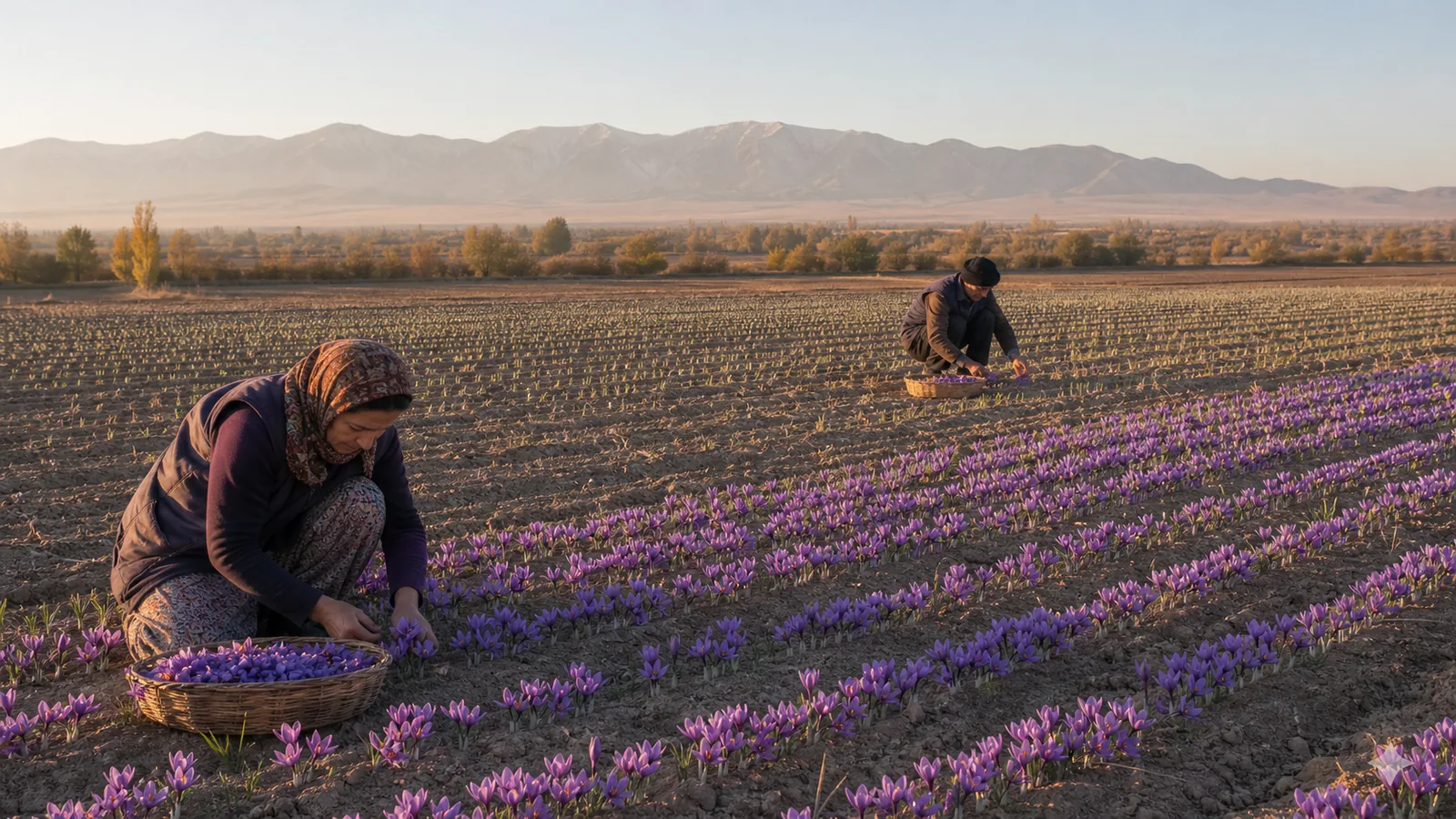
The reported area of saffron cultivation in Neishabour increased from 3,400 to 4,000 hectares, but not all 4,000 hectares were producing flowers. Of the total, 3,400 hectares were described as fertile or bearing and 600 hectares as young, non-bearing fields. The same historical report forecast 10.2 tonnes of dried saffron after a difficult season of low rainfall and extreme summer heat.
Those figures belong to the crop year covered by the original report; they are not a current acreage or production estimate. The article is also a useful comparison with Kermanshah, where officials were trying to build a much smaller saffron sector from a 43-hectare base. Together, the two cases show the difference between an established production centre and a province still scaling up.
What the 4,000-hectare figure included
Seyed Gholamreza Nabavi Namghi, then deputy director and acting director of Neishabour Agricultural Jihad, said the city’s saffron area had grown by 600 hectares, from 3,400 to 4,000. The report located much of the crop in the central district, Miyan Jolgeh, and Zeberkhan.
The 600-hectare increase and the 600 hectares described as young fields fit the same development picture: new saffron land had been established, but it had not yet joined the bearing area. A planted hectare and a productive hectare are not interchangeable. Newly established fields can flower lightly or remain outside the season’s commercial harvest figures while the corms establish.
This is why the article’s title should not be read as 4,000 mature hectares suddenly producing at full capacity. The more precise summary is 4,000 hectares in total, including 3,400 bearing hectares and 600 young hectares.
Production was forecast at 10.2 tonnes
The Neishabour report forecast about 10,200 kilograms of dried saffron. It also said production was expected to decline by 10 percent because rainfall had fallen and summer heat had been severe.
Using the 3,400 bearing hectares as the relevant base, 10.2 tonnes corresponds to an average of roughly 3 kilograms per bearing hectare. That calculation helps reconcile the large citywide total with the article’s separate reference to individual growers obtaining 10–14 kilograms per hectare. The higher figures were described as results achieved by some farmers, not the average for all Neishabour fields.
Weather is only one part of that gap. Field age, corm density and health, soil, irrigation timing, nutrition, weed and pest management, harvest labour, and drying practice can all influence the amount and quality of dried saffron obtained from a hectare.
What the employment figure actually means
The original English version said the sector provided direct and indirect employment to “more than 800 thousand people a day.” The underlying agricultural measure is better understood as more than 800,000 person-days of direct and indirect work. It describes accumulated days of seasonal labour across cultivation, flower picking, stigma separation, drying, handling, and related activity; it does not mean 800,000 different people were employed every day.
The same report put growers’ gross income at 459 billion rials for the period. Gross income is revenue before production costs. It should not be presented as profit, and the historical rial figure should not be converted into a current farm-income claim without the original year, costs, inflation, and market prices.
Why some farms reached 10–14 kilograms per hectare
Nabavi Namghi linked the strongest farm results to model projects, research on planting methods, more efficient use of inputs and facilities, and growers following technical guidance. Some participating farms reportedly harvested 10–14 kilograms per hectare.
That range shows what selected fields achieved under the reported conditions; it is not a promise for every grower. A useful benchmark needs the field’s age, planted corm weight and density, water and soil conditions, management method, and whether the figure refers to dried saffron of a consistent grade. Without those details, a high-yield example is evidence of local potential, not a universal expectation.
Kermanshah was expanding from a much smaller base
A separate provincial report said Kermanshah had developed 43 hectares of saffron and was planning expansion to at least 100 hectares. Its English wording can also be read as a plan to add 100 hectares per year, but it does not provide a completed area or timetable that resolves the ambiguity. The safe interpretation is that 43 hectares existed and a programme of at least 100 hectares was proposed, not that the extra land had already been planted.
The comparison is revealing. Neishabour was discussing thousands of hectares, the split between bearing and young fields, total dried output, and fine-tuning yields. Kermanshah was still focused on establishing a regional footprint. The same title phrase—“increasing the area of saffron cultivation”—therefore described two very different stages of development.
The Kermanshah plan sat inside a broader agricultural programme
The Kermanshah source did not treat saffron as an isolated project. It placed the 43-to-100-hectare plan alongside improvement work on 2,744 hectares of orchards and replacement of 221 hectares of old orchards. It also mentioned efforts to remove chickpea export tariffs, exchange knowledge with countries experienced in chickpea production and mechanisation, and improve sales.
Other activities in the same programme included two edible-mushroom units with a stated annual capacity of 527 tonnes and production of 39 million beneficial insects for pest control. These figures concern the wider provincial Agricultural Jihad programme, not the saffron fields themselves. Their value here is context: saffron expansion was one strand of a broader attempt to diversify production, update orchards, improve market access, and strengthen crop protection.
What the two regions teach about expansion
The two reports point to different questions at different scales:
- Neishabour: How much of the planted area is bearing, how did weather affect total output, and how can the average move closer to the results of well-managed model farms?
- Kermanshah: How quickly can a new production area expand from 43 hectares, and what support, planting material, training, finance, and market access will make that expansion durable?
Neither acreage alone nor a high-yield example answers those questions. Sustainable growth depends on matching corms and cultivation methods to local soils and climate, keeping field-level records, planning labour for the short harvest, drying the stigmas correctly, and building a market for consistent quality.
Reading the historical record responsibly
The clearest statement from the Neishabour report is that total saffron land reached 4,000 hectares, divided into 3,400 bearing and 600 young hectares, with 10.2 tonnes forecast in a season expected to be 10 percent lower. Its 800,000 figure is person-days, not a daily headcount, and its 459 billion rials is gross historical revenue, not net profit.
For Kermanshah, 43 hectares was the reported base and at least 100 hectares was the development plan. The orchard, chickpea, mushroom, and beneficial-insect figures describe the surrounding provincial programme. Keeping those definitions intact turns two brief translated news items into a coherent account of how mature and emerging saffron regions approached expansion.

![Exporting Saffron to Turkey + Price Guide [Complete 0 to 100]](https://img.rowhanisaffron.com/20260827003933/saffron-export-turkey-quality-inspection.webp)



