


The reported 3 times increase in saffron cultivation in Kermanshah province belonged to an earlier expansion programme, not the current agricultural year. Shahriar Ghasemi, identified in the source as director of Kermanshah’s Agricultural Jihad, linked the growth to drought, saffron’s relatively low water demand, farmer training and public support for planting.
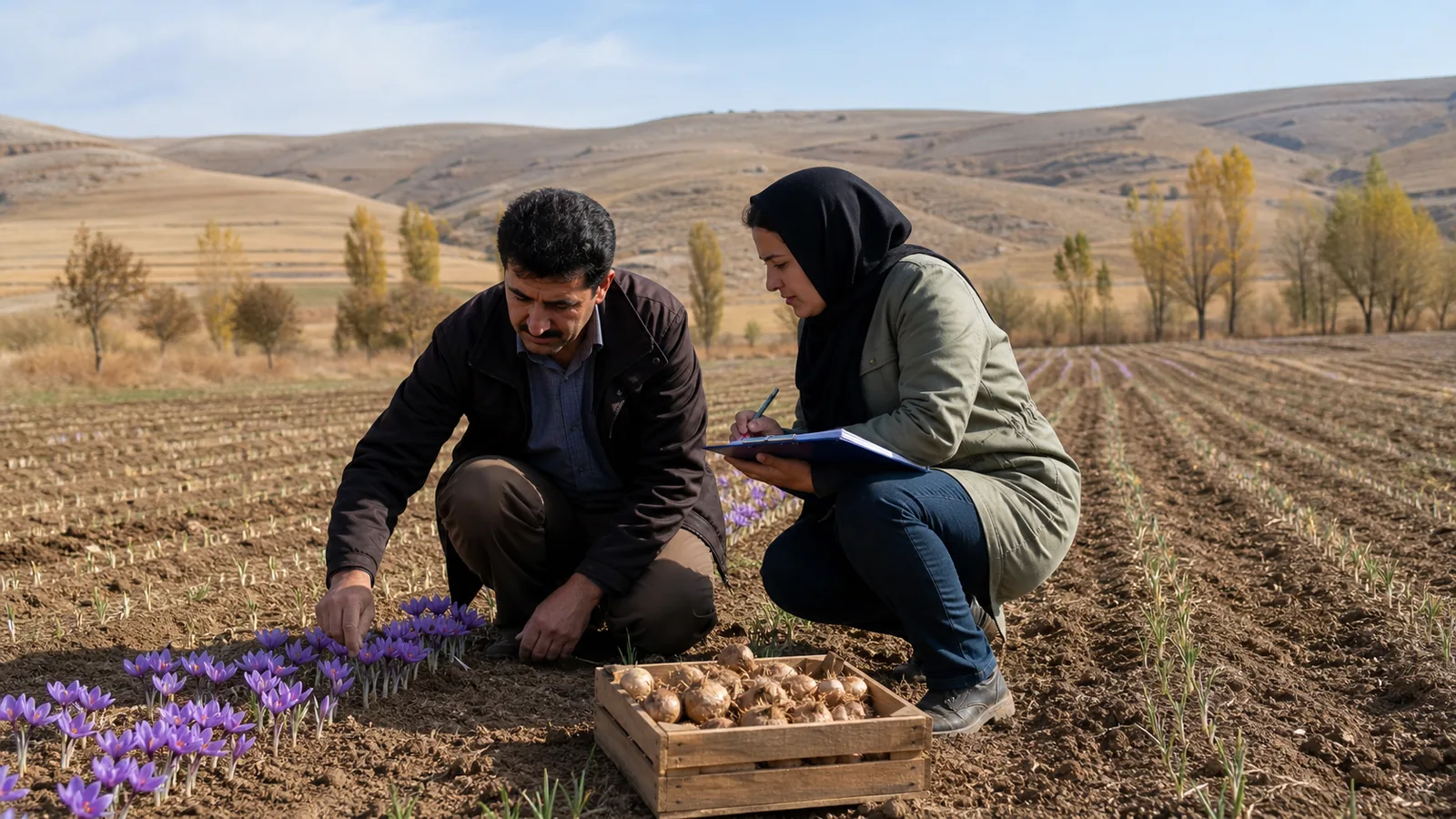
What the “3 times increase” claim tells us
The headline says cultivation tripled, but the article does not give the starting and ending area used for that comparison. It says eight hectares were added during the crop year, without stating the full provincial total before or after the addition.
Both points are preserved because they defined the report. They should not be combined into new arithmetic. A threefold change can be checked only when the same geography, dates and definition of cultivated area are available at both ends.
Shahriar Ghasemi’s explanation for the expansion
Ghasemi described Kermanshah as climatically suitable for saffron and said farmers had turned to the crop during continuing drought because its corms require comparatively little water. He credited promotion, encouragement and training by horticultural experts and local Agricultural Jihad service centres.
This was an official account of the programme. It did not provide farm surveys showing how each measure influenced the decision to plant.
Suitable land is not evenly distributed across the province
A peer-reviewed zoning study for Kermanshah Province used long-term climate, elevation, slope and land-cover data to identify favourable areas. It found suitable conditions in several locations while classifying a material part of the province as unsuitable.
That nuance matters. A provincial climate can support saffron without making every field a good choice. Soil, drainage, frost exposure, water quality and access to labour still need field-level review.
Why low water demand attracted attention
Saffron’s active growth occurs mainly through cooler months, and the crop can produce high value from a relatively small area. Those traits make it attractive when water limits other choices. They do not remove its need for well-timed moisture or make an unsuitable field productive.
A crop-pattern change should compare total seasonal water, irrigation reliability, expected dry yield and market access. Replacing one crop with another solely because it is called “low-water” leaves important costs out of the decision.
The eight hectares added that year
Ghasemi said training and extension support helped add eight hectares to Kermanshah’s previous saffron area during the year covered by the report. No district breakdown or list of participating farms was supplied.
A useful programme record would distinguish land newly planted with corms from mature fields already producing a normal crop. Newly planted area increases the footprint immediately, but it may not contribute a comparable harvest in the same season.
Training was a core part of the support
The original statement emphasized horticultural experts and Agricultural Jihad service centres. That emphasis is supported by later research into the educational needs of Kermanshah saffron growers, which treated local knowledge gaps as a development issue.
Training is most useful when it follows the crop cycle: field selection and soil testing, corm grading and planting, irrigation, weed and disease observation, harvest labour, stigma separation, drying and storage.
Corms were reportedly sourced from Khorasan Razavi
Ghasemi said saffron corms used in Kermanshah were purchased from Khorasan Razavi. Moving planting material can give new growers access to established supplies, but source alone does not guarantee field performance.
Lots should be traceable and inspected for size, physical damage and signs of decay before planting. Growers also need a plan for transport and storage so corms are not weakened before they reach the field.
Flowering and productive field life
The report said corms begin flowering one year after planting and may remain productive for seven to ten years. That is retained as Ghasemi’s general guidance. Actual first flowering and useful field life vary with corm size, planting time, density, soil, climate and management.
Annual yield should therefore be recorded by field age. Mixing a young planting with an established field can make a programme’s average look better or worse without revealing why.
The 4.5-kilogram yield reference
Ghasemi referred to an expected yield of about 4.5 kilograms of dried saffron per hectare. The source did not publish a sample size, grade basis or range across farms, so the number remains an attributed benchmark rather than a guaranteed result.
Yield should be measured after drying to a consistent endpoint. Fresh flowers, fresh stigmas and dried spice are different quantities and cannot be substituted for one another in comparisons.
Historic cost and income figures
The first-year cost of corm supply, planting and crop care was put at 15 to 20 million tomans per hectare. At the reported 4.5-kilogram yield, the statement estimated annual income at 28 million tomans per hectare.
These figures have no price date, grade, labour assumptions or distinction between gross revenue and net income. They document the programme’s economics at the time; they are not safe current budgets. Any new decision needs updated corm, labour, water, drying and sale-price data.
Planting and harvest calendar in the report
Ghasemi placed Kermanshah’s corm-planting period in late September and October and the saffron harvest in November. That calendar preserves the source’s local timing.
Farmers should still follow soil temperature, moisture, elevation and seasonal forecasts rather than one date for the whole province. Planting too late can reduce establishment time, while an early operation in unsuitable conditions creates its own risks.
Five tonnes of corms supplied to applicants
The provincial support described in the article included preparation of five tonnes of saffron corms for applicants, reportedly supplied free of charge. The report did not identify how recipients were selected, how many farms took part or the grade and inspection standard for the corms.
Those details matter when judging effectiveness. A distribution programme should record recipient fields, quantity, planting date, survival, flowering and later dry yield, not only the weight handed out.
The 40-million-rial support figure
Ghasemi also said the Kermanshah Agricultural Jihad Organization provided 40 million rials per hectare toward corm preparation and part of the cultivation costs. The translated source described it as free support rather than a repayable loan.
The programme year, eligibility terms and payment method were not stated. The figure is therefore historical and cannot be assumed to remain available.
How the expansion should be evaluated
A careful review would begin with the exact area before support, the eight hectares added and any other land included in the “three times” comparison. It would then follow field survival, age, dry yield, quality results, grower costs and sale outcomes over several seasons.
Continuation matters. If growers leave the new fields after initial corm support ends, planted area alone overstates success. If they maintain healthy fields, improve processing and find reliable buyers, the expansion has a stronger foundation.
From cultivated area to durable saffron production
The 3 times increase in saffron cultivation in Kermanshah province captured an early effort to broaden production beyond Iran’s best-known saffron regions. Its eight-hectare addition, 4.5-kilogram yield reference, corm distribution and financial support all belong to that historical programme.
The useful lesson is to treat expansion as more than hectares. Appropriate land, healthy corms, local training, measured yield, careful drying and a dependable market determine whether newly planted saffron becomes a durable crop for Kermanshah growers.

![Exporting Saffron to Turkey + Price Guide [Complete 0 to 100]](https://img.rowhanisaffron.com/20260827003933/saffron-export-turkey-quality-inspection.webp)



