


Saffron cultivation in line with Alborz water resources management was presented as one response to drought and declining groundwater and surface-water availability. A historical provincial report said saffron occupied 40 hectares in Nazarabad and yielded 121 kilograms that year. The useful principle is broader: saffron cultivation in Iran can support a lower-water crop strategy only when the water applied, aquifer impact, yield and farm return are measured together.
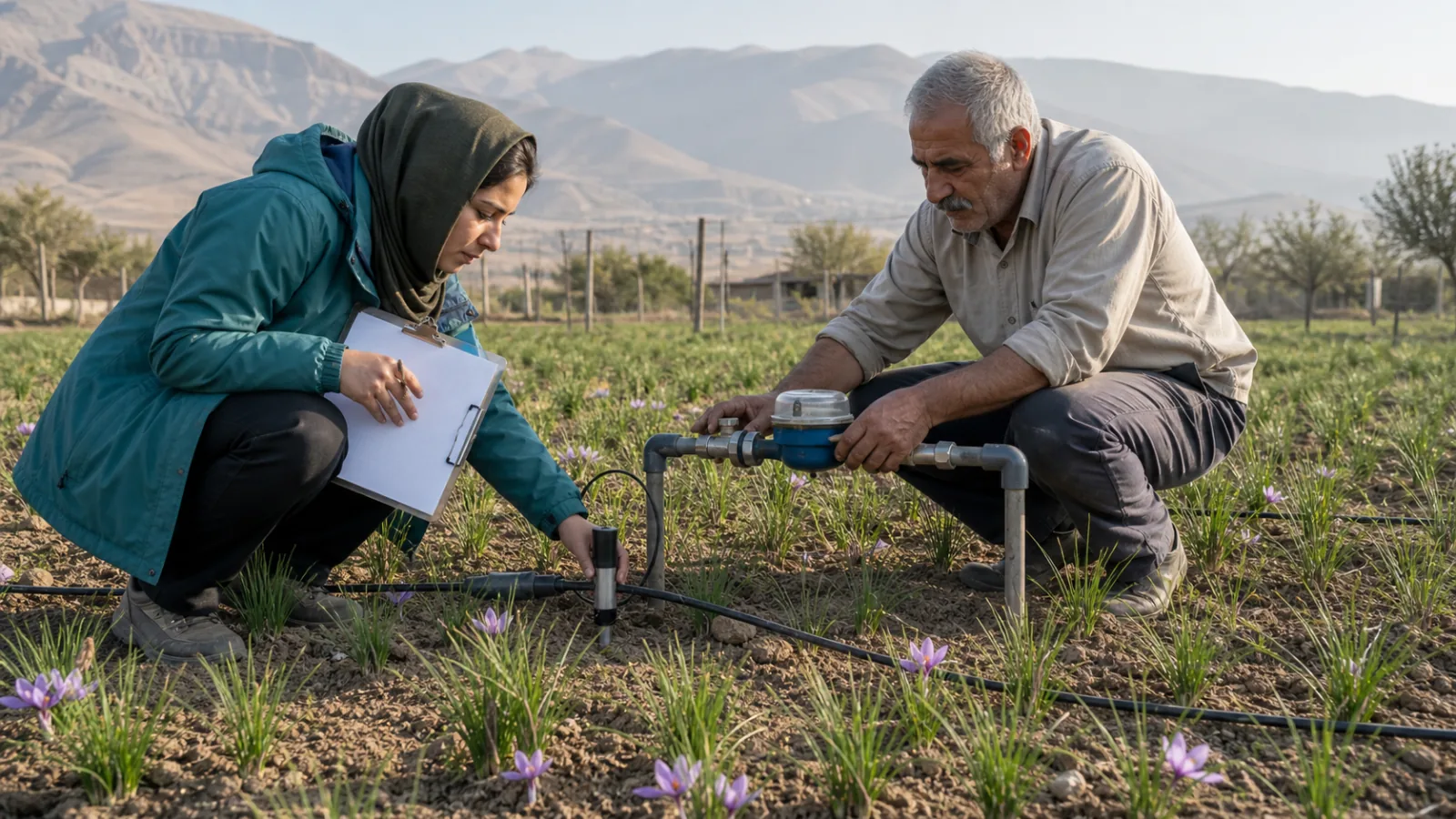
Saffron is not a water-free crop. It needs moisture at the right stages, suitable soil and a dependable harvest workforce. Expanding its area without an irrigation budget could still increase total withdrawals even if each hectare uses less water than the crop it replaces.
Why Alborz was considering its crop pattern
The original account opened with drought, falling aquifer levels and reduced surface water. It argued that these resources had to be protected for future generations while agriculture continued supplying food and rural livelihoods.
It estimated that agriculture used 70 to 90 percent of available water, without defining the geography or denominator. Current UN Food and Agriculture Organization water-accounting guidance reports agriculture at about 72 percent of global freshwater withdrawals. Local Alborz decisions still require basin and aquifer data; a global share cannot describe one province.
The report associated Ministry of Agriculture Jihad policy with greenhouse development, higher productivity, water-resource management and a shift toward crops with lower water needs. It identified saffron—often called red gold—as a valuable medicinal and spice crop traditionally concentrated in Iran’s eastern provinces but increasingly considered elsewhere, including Alborz.
The historical Alborz figures
Seyed Majid Mousavi, then head of the Alborz Agriculture Jihad organisation, said approximately 160 hectares in the province were under medicinal plants and about 500 tonnes had been harvested that year. He reported 38 cultivated medicinal-plant species.
Within that programme, he placed saffron on 40 hectares in Nazarabad. The reported harvest was 121 kilograms, valued at about 7.260 billion rials. Those figures imply an average dry-saffron yield of roughly 3.0 kilograms per hectare and an average reported value of about 60 million rials per kilogram. The arithmetic helps readers understand the announcement; it does not verify whether the areas were fully productive, how value was calculated or whether all figures used the same reporting period.
Mousavi hoped the cultivated area would increase the following year. That was an intention, not evidence that expansion occurred.
Does saffron automatically save water?
No. Saffron’s seasonal pattern and high value per unit of product can make it attractive where water is scarce, but water savings depend on what it replaces, the irrigation method, rainfall, soil storage, pumping and the area planted.
A credible crop-change decision should compare:
- annual irrigation and effective rainfall for the old and proposed crops;
- groundwater withdrawal, recharge and well level over time;
- marketable yield and value per cubic metre of water;
- energy, labour, corm, testing and marketing costs;
- salinity, drainage and the effect on neighbouring water users.
Water productivity is not the same as reducing total depletion. If a profitable crop expands across a larger area, the basin may use as much or more water unless the saved allocation is genuinely protected.
Irrigation practice still determines field performance
Calling saffron drought-tolerant can hide the importance of soil moisture during active growth. A three-year field study comparing saffron irrigation methods in Qaen found that drip irrigation produced the highest dry stigma yield and water-use efficiencies under that site’s conditions. The result supports precise delivery but is not a universal design for Alborz.
Growers need local soil and water tests, appropriate emitter spacing, checks for blocked lines, and a schedule based on the root zone and weather. Over-irrigation can waste water and harm aeration; unmanaged deficit can reduce flower and corm performance.
Why farmers were interested in saffron
Mousavi attributed grower interest to saffron’s price, expected profitability, lower water requirement, storage characteristics and medicinal reputation. Each reason needs a limit.
Price and profit vary with yield, labour, grade and access to buyers. Dried saffron can be stored, but only when protected from moisture, light, contamination and substitution. Medicinal properties should not be turned into claims that a farm product treats or cures disease.
The report said Nazarabad saffron had a favourable aroma and that tests by the Standards Organization indicated high quality. It did not provide sample numbers, methods or results, so this article does not convert that statement into a current certification. Quality belongs to a tested lot, not automatically to every product from a district.
Other medicinal crops and a damaged statistic
The provincial account also named Gol Mohammadi, or Damask rose, as a lower-water crop with economic value. It said 56 hectares were cultivated in a place translated as “Başiman” and then attached “5,600 tons” to an economic-value sentence. The location and unit are too damaged to present as reliable production or value data, so the wording is preserved here only as an unresolved part of the historical report.
Crop diversification can still be sensible. It reduces dependence on one harvest and lets farms match different soils, labour calendars and buyers. The choice should follow measured water and market performance rather than a general medicinal-plant label.
What support Alborz said it would provide
Mousavi listed a provincial working group for medicinal-plant cultivation, low-interest bank facilities, subsidies for seedlings and planting, training classes, home-business licensing and small workshops. These measures could lower entry barriers, but support should be evaluated by outcomes rather than approvals or money disbursed.
Useful programme reporting would show how many trained farms planted successfully, water applied per hectare, verified yields and quality, loan repayment, net income and the condition of the relevant aquifer. The historical article supplied none of those outcomes.
Putting the land figures in context
The report described Alborz Province as having 68,000 hectares of agricultural land, of which 35,000 hectares were arable land. Its 40 hectares of saffron were therefore a small pilot-scale share of the province’s agricultural base.
That scale makes careful learning more valuable than rapid expansion. Our guide to saffron irrigation explains the crop-cycle decisions behind water use. For Alborz, the best sign of alignment with water-resource management would be transparent field and aquifer evidence showing that saffron creates dependable value without shifting or increasing depletion.

![Exporting Saffron to Turkey + Price Guide [Complete 0 to 100]](https://img.rowhanisaffron.com/20260827003933/saffron-export-turkey-quality-inspection.webp)



