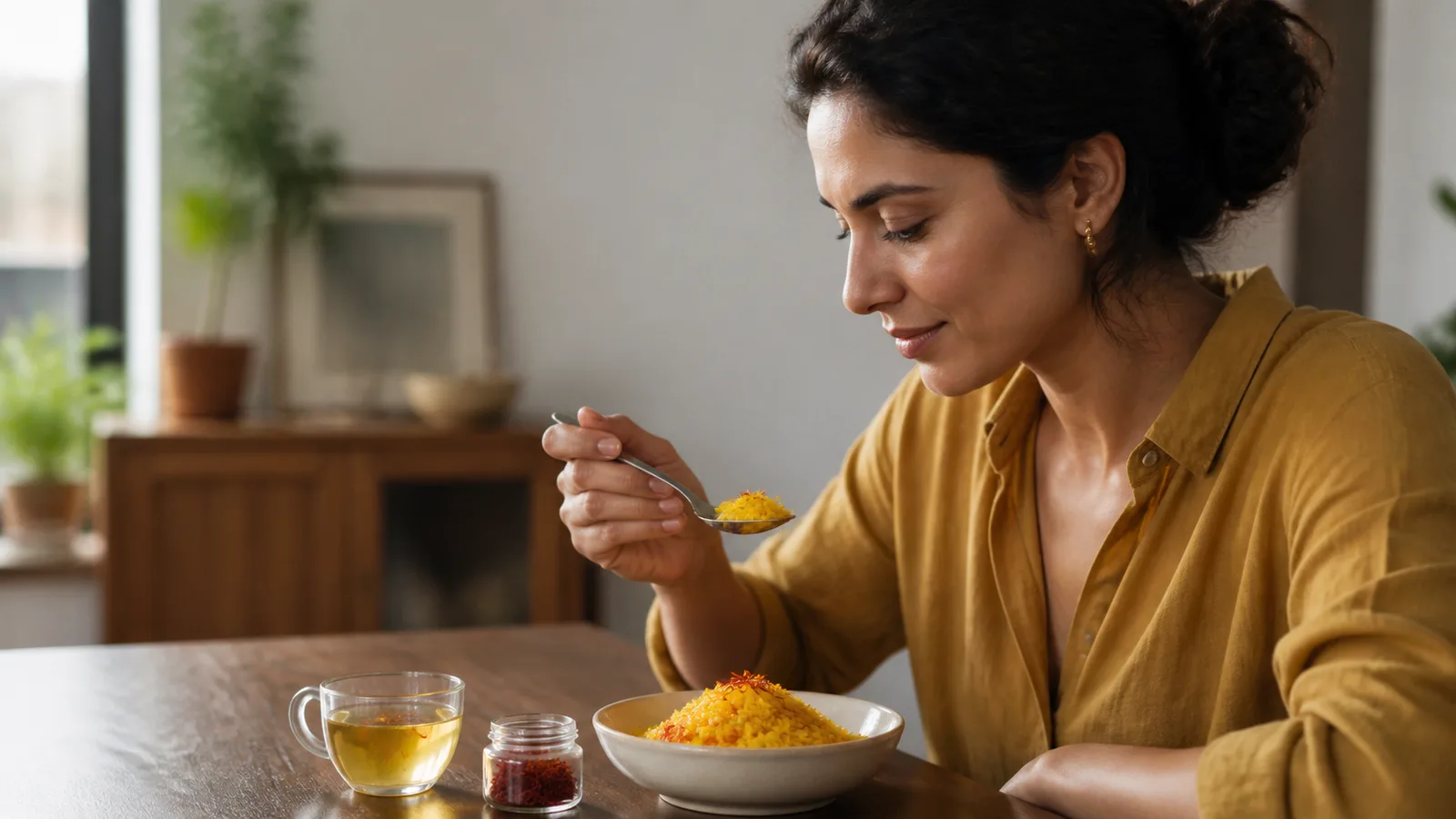
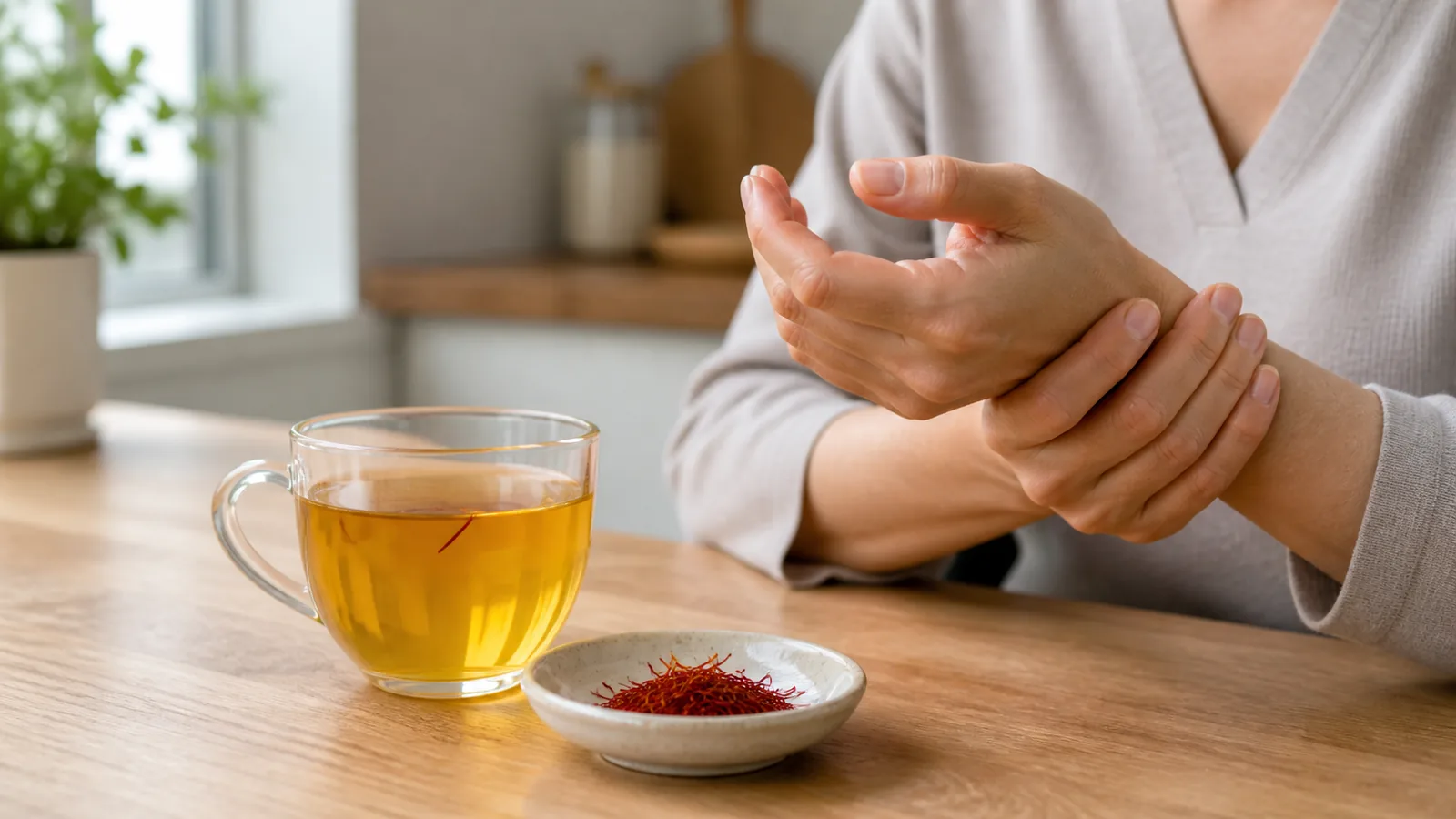
Saffron benefits for hair are usually advertised with more confidence than the research allows. Saffron contains well-studied pigments and aromatic compounds, but there is no convincing human trial showing that eating it, drinking it or rubbing it on the scalp regrows hair. It is better understood as a culinary spice with interesting chemistry than as a hair-loss treatment.
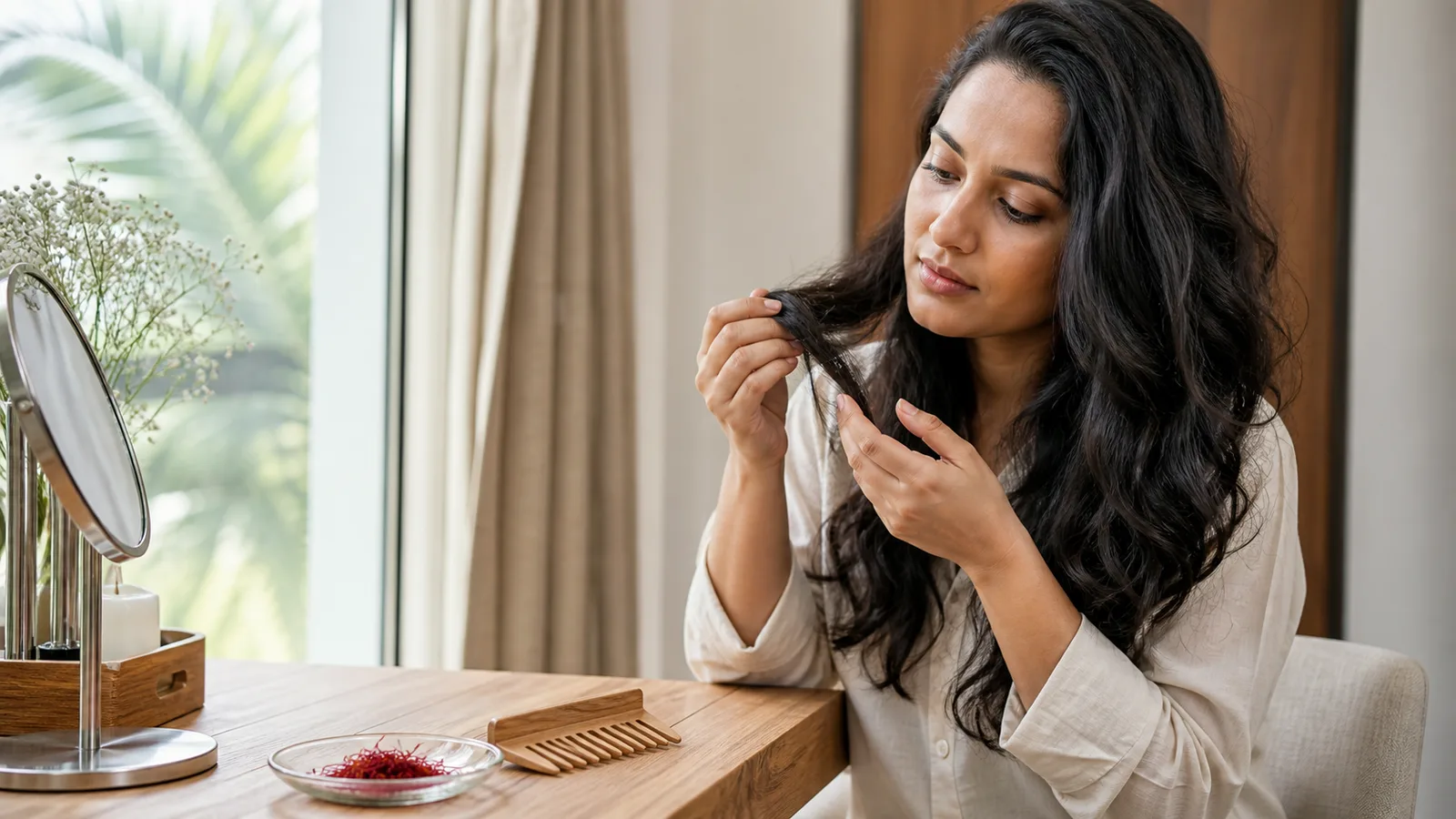
That distinction matters when someone is watching a part widen, finding handfuls of hair in the shower or trying to repair brittle lengths. These problems can look similar while having very different causes. A costly home remedy may delay the examination that actually identifies one.
Does saffron help hair growth?
At present, there is no reliable clinical evidence that Crocus sativus—true saffron—makes human hair grow faster, reverses pattern hair loss or repairs a damaged follicle. A broad map of saffron clinical evidence covered outcomes such as mood, cognition and metabolic markers; hair growth was not an established clinical outcome.
A targeted PubMed search for true saffron alongside hair growth, hair loss, follicles and alopecia also exposes a naming trap. The few apparent matches concern poisonous autumn crocus, also called meadow saffron, rather than the culinary spice. They describe hair loss after colchicine poisoning, not a benefit of Crocus sativus.
So the honest answer to “is saffron good for hair growth?” is not yet. For now, saffron for hair growth remains a marketing idea rather than a demonstrated treatment. A plausible laboratory mechanism is not the same as visible regrowth in people, and neither is a personal before-and-after photograph.
Saffron is not safflower
A search for “saffron hair growth” can surface positive-looking results about safflower, Carthamus tinctorius. One safflower-floret experiment reported effects in cells, isolated follicles and mice. Other work has used safflower oil bodies to deliver engineered growth factors. Those studies cannot be cited as evidence for saffron threads, saffron tea or saffron oil.
The names are easy to confuse, especially when a product page uses “saffron” loosely. The spice sold as kesar is Crocus sativus; safflower is a different plant. Claims about kesar benefits for hair should be checked against the botanical name in the actual study.
What saffron chemistry can and cannot tell us
Saffron stigmas contain crocins, crocetin, picrocrocin and safranal. These compounds help explain the spice’s colour, taste and aroma, and many have antioxidant activity in laboratory systems. That is a real chemical property. It does not prove that a pinch of saffron reaches a scalp follicle in a useful concentration or changes the human hair cycle.
Oxidative stress and inflammation are involved in some scalp and hair disorders, but they are broad biological ideas, not a diagnosis. Calling an ingredient an antioxidant does not show that it prevents breakage, reduces shedding or treats alopecia. The proposed benefits of saffron for hair therefore need hair-specific evidence, not an antioxidant label.
Is saffron a useful source of vitamins or iron for hair?
Saffron contains measurable nutrients when analysed by weight, but normal culinary servings are tiny. A few threads do not provide the amounts of iron, protein, zinc or vitamins found in a balanced meal. It is therefore misleading to describe saffron tea as a nutritional treatment for deficient hair growth.
Deficiency can matter. The American Academy of Dermatology’s review of hair-loss causes includes too little iron, protein, zinc or biotin among many possibilities. Testing and treating a confirmed deficiency is different from assuming one and taking more saffron. Excess supplements can cause their own problems.
Can drinking brewed saffron reduce hair loss?
No human study has shown that brewed saffron prevents hair loss. Drinking an unsweetened infusion may be an enjoyable part of a normal diet, but the cup cannot be treated as a follicle medicine.
Stress can sometimes contribute to excessive shedding, and saffron has been studied separately for mood. That does not establish an indirect hair-growth treatment. A person can also have stress-related shedding and hereditary loss at the same time. Our saffron benefit-and-risk guide explains why results from measured supplements should not be transferred automatically to tea or food.
What about saffron oil, masks and scalp applications?
There is no standard “saffron oil” pressed from the dry stigmas in the way olive oil is pressed from olives. The name may describe saffron infused into a carrier oil, a fragrance blend, an essential-oil product or a cosmetic containing an extract. These are not interchangeable.
Likewise, homemade milk, honey and saffron masks have no demonstrated hair-growth advantage. They can be sticky, stain pale materials and introduce ingredients that do not suit every scalp. Applying more or leaving a mixture on longer does not create evidence.
If you use a finished cosmetic, read the complete ingredient list and follow its directions. Test a small area first when the manufacturer recommends it, and stop if burning, swelling, hives or persistent irritation develops. Do not apply a kitchen mixture to broken, infected or severely inflamed skin.
Hair loss and hair breakage are different problems
Hair can snap along the shaft because of heat, bleaching, friction, tight styling or rough handling. Hair loss begins at the follicle and can involve hereditary pattern loss, an immune condition, hormones, illness, medication, infection or nutritional deficiency. Excessive shedding after fever, surgery, childbirth, rapid weight loss or major stress is another pattern.
The difference cannot always be settled in a mirror. The AAD’s guide to hair loss versus excessive shedding explains why timing and pattern matter. Saffron does not remove the need to find the cause.
What genuinely supports healthier-looking hair?
Protecting the hair you already have is more practical than trying to force an unproven spice treatment. Gentle care can reduce avoidable shaft damage:
- Handle wet hair according to its texture and avoid aggressive rubbing.
- Use heat and chemical processing conservatively.
- Avoid styles that repeatedly pull at the same part of the scalp.
- Choose products for your scalp condition rather than for a fashionable ingredient.
- Eat a varied diet and investigate a suspected deficiency instead of guessing.
These steps will not cure every type of loss, but they avoid making breakage or traction worse. The AAD provides more detail on styling hair without damage.
When hair loss needs professional assessment
Arrange a medical or dermatology assessment for a new bald patch, rapid or persistent shedding, a widening part, a receding hairline, scalp pain, heavy scaling, sores, pus, eyebrow loss or hair loss with other unexplained symptoms. Early diagnosis matters for conditions that can scar a follicle.
Do not stop a prescribed medicine because hair loss appears on its side-effect list. The prescriber can weigh the timing, alternatives and risks. A dermatologist may use the history, scalp examination, hair testing, blood tests or occasionally a biopsy to identify the cause; the AAD describes that diagnostic process.
Saffron benefits for hair: a realistic conclusion
Saffron is aromatic, colourful and chemically interesting. It is not a proven remedy for hair growth or hair loss. The strongest saffron hair benefits claim the evidence supports today is a modest one: a properly formulated saffron cosmetic may be pleasant to use, while the spice can remain part of an ordinary diet. Neither use has been shown to regrow hair.
If the concern is saffron hair loss, thinning or regrowth, start with the pattern and cause—not with a spice. That approach protects both your scalp and your time, while leaving room for better saffron research if human trials eventually provide it.