


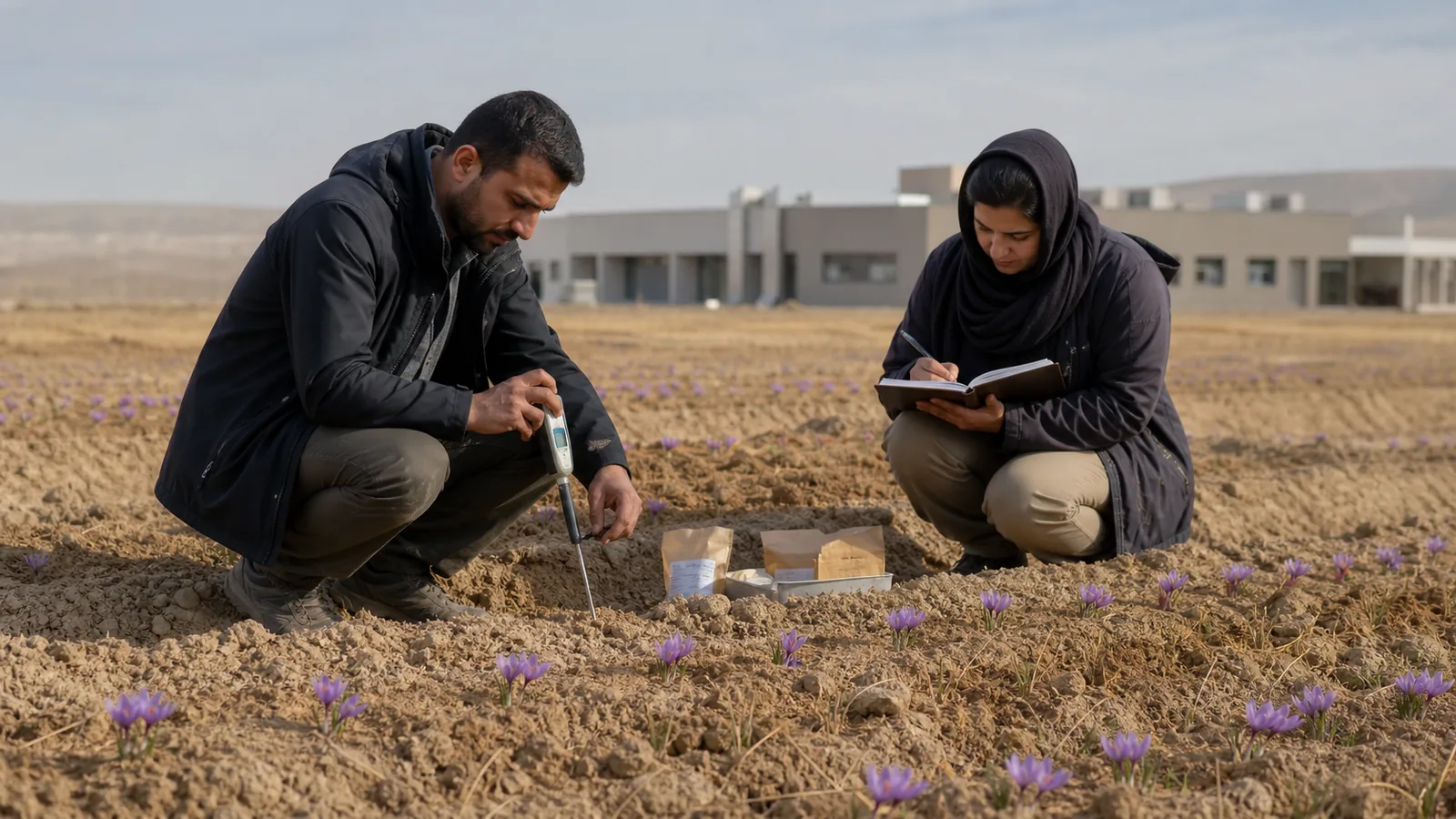
A saffron research institute was announced for Khorasan Razavi at a Ministry of Science press briefing in October 2015. Hassan Khoshghalb, an adviser to the deputy minister for research and technology, said the institute would be launched in the near future as part of work to put Iran’s medicinal-plants policy into operation.
The announcement was a plan, not a completion report. It did not name the host university, location, legal approval, budget, staff or opening date. The old title, “Research in Khorasan Razavi Saffron is launched,” turned a future statement into a finished event and scrambled the subject. The historical record supports a more careful description: a Saffron Research Institute was planned, while the article itself did not show that it had opened.
Where the announcement was made
ISNA’s Khorasan research desk reported Khoshghalb’s remarks from a press conference opening the first international conference on indigenous gums. Saffron was one part of a broader discussion about how the Ministry of Science wanted research institutions to work.
Khoshghalb said the ministry was emphasizing research quality and a mission-oriented approach within a knowledge-based economy. His language also referred to the contemporary policy of a “resistance economy,” sustainable development and national capability. These were stated policy aims; the article did not provide performance indicators or evidence that a particular research programme had achieved them.
The context matters because the native-gums conference and the saffron institute were not the same project. The conference was offered as an example of scientific diplomacy. The proposed institute was an example of building research around a region’s economic and biological capacity.
What mission-oriented saffron research should mean
“Mission-oriented” and “demand-driven” can sound persuasive while remaining vague. For saffron growers and buyers, the terms become useful only when the institute starts with a defined problem and finishes with evidence that someone can apply.
A credible Khorasan Razavi research agenda would connect several parts of the value chain:
- field establishment, corm health, soil, water and climate risk;
- harvest labour, flower handling and controlled drying;
- chemical, physical and microbiological testing of representative lots;
- processing and packaging that protect the measured quality;
- mechanization that is tested against damage, labour and cost rather than novelty;
- farm economics, market requirements and traceable supply; and
- training that translates results into a decision a grower, processor or laboratory can repeat.
That is more demanding than publishing a paper about saffron. A field result needs the location, soil, weather, field age, corm size, irrigation treatment, sample size and statistical uncertainty. A laboratory method needs validation and quality control. A market study needs a named period and transparent data. Without those details, a local finding can be mistaken for a universal rule.
Local capacity was supposed to shape the work
Khoshghalb said research institutes should produce knowledge from local capacities. Khorasan Razavi offers an obvious saffron setting: commercial fields, experienced growers, processors, exporters and laboratories sit within the same regional chain. Proximity can shorten the distance between a farm problem and a testable research question.
It can also create blind spots. An institute closely connected to a sector needs safeguards against choosing only projects that suit the largest organizations, confirming a sponsor’s preferred product or reporting the best plot as if it represented the province. Grower participation should include small farms, different counties and unsuccessful trials as well as showcase sites.
A demand-led process might begin with an annual list of problems submitted by growers, processors, laboratories and buyers. Researchers could publish why a question was selected, what evidence already exists, how the study will be measured and who funded it. Results should include negative or inconclusive findings, because those can prevent wasted investment just as effectively as a positive result.
A current institute exists, but the link to this announcement is unclear
The UN Food and Agriculture Organization now lists a Saffron Research Institute at the University of Torbat Heydarieh in Razavi Khorasan. Its directory entry describes three groups: planting, breeding and protection; food, pharmaceutical and cosmetic industries; and economics, marketing and mechanization. It also presents applied, fundamental, demand-driven and technology-based work as part of the institute’s remit.
That structure closely resembles the mission-oriented model discussed in 2015. It does not prove that the press-conference announcement created the Torbat Heydarieh institute. Historical accounts indicate saffron research activity there before the briefing, while the ISNA excerpt did not name Torbat Heydarieh. The 2015 statement may have referred to a new authorization, a reorganization, another institute or an imprecise description of an existing centre. Without the ministry’s approval document, the relationship remains unresolved.
This distinction prevents a common archival error. A later institution with the expected name and region is evidence of current capacity; it is not automatically evidence that every earlier launch promise was fulfilled exactly as announced.
Technology needs a route from laboratory to field
Khoshghalb said special attention should be given to technology when research centres were licensed. For saffron, technology can mean a soil-moisture sensor, a drying controller, an image-based grading aid, a validated authenticity method or a machine that reduces repetitive labour. The word by itself says nothing about value.
A practical evaluation asks:
- which problem the device or method solves;
- what it is compared with under the same conditions;
- whether quality, yield, labour, energy and failure rates were all measured;
- what calibration, maintenance and training are required;
- whether the result survives outside the original trial site; and
- whether the cost is realistic for the intended user.
Field adoption belongs in the research design, not in a promotional paragraph after the experiment. A machine that works only with one plot geometry or a test that cannot be reproduced by another laboratory may still be interesting science, but it is not yet a regional solution.
Quality and authenticity are natural regional missions
Saffron’s high value makes reliable identity and lot quality important. Colouring strength, aroma-related compounds, bitterness, moisture, foreign matter, adulteration and microbiological status require different tests. No single instrument result proves the origin, purity and safety of every pack.
Our guide to saffron processing, chemical composition and standards explains why sampling and traceability matter alongside laboratory methods. A research institute can add value by comparing methods, developing reference materials, running proficiency work and showing how uncertainty affects a commercial decision.
A recent example of demand-led cooperation is FAO’s agreement with Mashhad University of Medical Sciences to advance saffron authenticity testing. FAO says the work includes method development and training for farmers, traders and laboratory experts across the three Khorasan provinces. The official 2025 announcement is separate from the 2015 institute plan, but it shows what a defined research mission looks like: a named problem, institutions, methods and intended users.
The indigenous-gums conference had its own purpose
Khoshghalb described the first international conference on indigenous gums as an instrument of scientific diplomacy that could introduce other countries to Iran’s scientific capacities. Native plant gums have food, pharmaceutical and industrial applications, so the meeting fit the ministry’s wider interest in food-industry research.
He said issuing permits for food-industry research institutes was one of the ministry’s responsibilities. Those institutes, he argued, should use local capacity and focus on technology. He also mentioned licences for specialized journals, noting that several had already been issued.
The final goal in the briefing was a specialized laboratory for indigenous gums. The article did not say where it would be housed, when it would open or which tests it would perform. It should remain a stated objective, not be rewritten as an operating laboratory.
How a research institute earns trust
A building and a launch notice are not enough. A useful saffron institute should publish its mandate, governance, researchers, facilities, funding sources and conflict-of-interest rules. Projects need protocols or at least clear methods, while reports should show data and limitations rather than only success language.
The strongest sign of impact is not the number of conferences or licences. It is a chain of use: a documented sector problem, a reproducible result, an extension or industry pathway, adoption under real conditions and a measured outcome. Public lists of completed projects, open summaries, corrected errors and follow-up studies make that chain visible.
The 2015 announcement deserves to be preserved as a statement of direction. It connected saffron, indigenous gums, food research, specialized publications, technology and scientific exchange under a demand-driven policy. What it did not provide was the evidence needed to declare the new Khorasan Razavi institute launched. The careful conclusion is therefore narrower: the plan was announced, relevant research capacity now exists in the province, and the institutional connection between the two still needs an official record.

![Exporting Saffron to Turkey + Price Guide [Complete 0 to 100]](https://img.rowhanisaffron.com/20260827003933/saffron-export-turkey-quality-inspection.webp)



