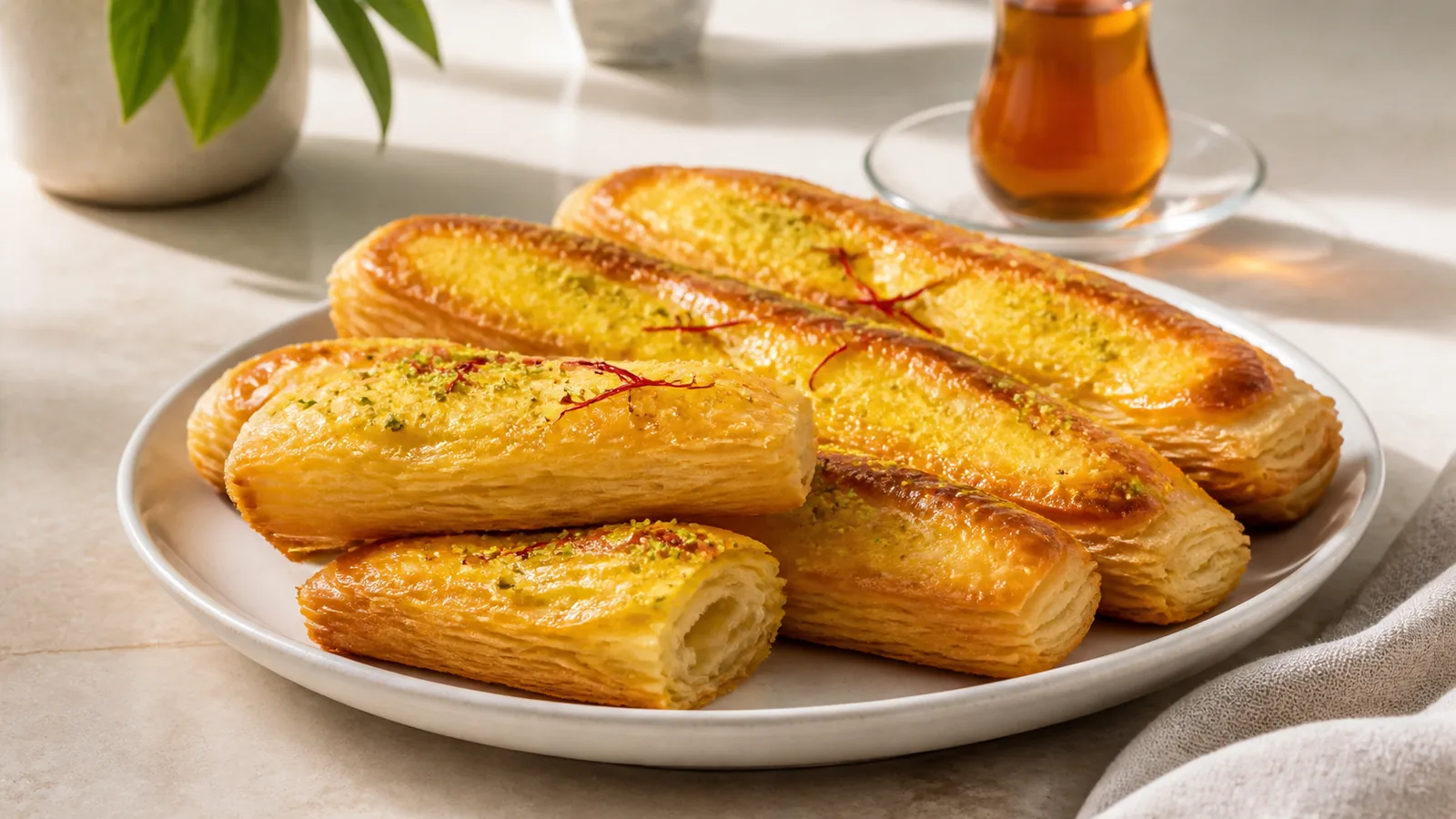
Zaban sweets are crisp Iranian pastries made from carefully folded Hazarla dough, then glazed with rosewater-and-saffron syrup.
What is Zaban?
Zaban (also written Zabaan) means “tongue,” referring here to the pastry’s long shape. It is not the savoury tongue dish that can also appear under the name zaban food. This Zaban recipe uses a homemade laminated dough—Hazarla, or “thousand-layer,” dough—whose thin butter-and-flour layers rise and separate in the oven.
Ingredients for Zaban sweets
For the Hazarla dough
- 3 cups plain flour, plus a little for rolling
- 1 glass cold water
- 250 g butter, kept cool and divided
- A small pinch of salt
For the saffron nectar and finish
- 300 g sugar
- 1 glass water
- 3 tablespoons rosewater
- 1 dessertspoon prepared saffron infusion
- 1 egg yolk
- 1 tablespoon milk
The old recipe called the saffron measure a “jam spoon”; a dessertspoon of prepared infusion is the practical reading. Do not add that quantity as dry saffron. Bloom finely ground threads in a little hot water first, then measure the liquid.
Make the saffron and rosewater nectar
- Put the 300 g sugar and 1 glass water in a small saucepan.
- Warm gently, stirring only until the sugar has dissolved.
- Add the prepared saffron infusion and simmer for about 10 minutes, until the syrup has thickened slightly.
- Add the 3 tablespoons rosewater and let it bubble for another 1–2 minutes.
- Remove from the heat and leave it to cool. It should remain brushable rather than becoming hard.
Do not reduce the nectar to the thickness of caramel. It will become more viscous as it cools, and the Zaban pastry needs only a thin glaze before and after baking.
Prepare the basic Hazarla dough
- Put the flour in a large bowl. Add 50 g of the butter, the salt and most of the cold water.
- Mix, adding the remaining water gradually if needed, until a firm but workable dough forms. Different flours absorb water differently, so do not force in the final splash if the dough is already soft.
- Knead for 10 minutes, following the original method, until the dough feels smooth.
- Shape it into a square, cover it and let it rest briefly while keeping it cool.
The remaining 200 g butter creates the layers. It should be cool and flexible: too warm and it leaks into the dough; too hard and it breaks into pieces when rolled.
Enclose the butter
Lightly flour the work surface and roll the dough into a square with a slightly thicker centre. Flatten the remaining butter into a smaller square and place it diagonally in the middle. Bring the four dough corners over it like an envelope and pinch the seams closed.
Press gently with the rolling pin before rolling lengthways. Work from the centre out and stop if butter begins to break through. Dust away excess flour before each fold so dry pockets do not form between the layers.
Fold and chill the dough six times
- Roll the enclosed dough into a long rectangle.
- Fold the top third down and the bottom third up, like a letter.
- Wrap and refrigerate for 20 minutes.
- Turn the dough so the open edge faces the opposite direction, then roll and fold again.
- Chill for another 20 minutes.
- Repeat until the dough has received six folds in total, changing the rolling direction each time as the original Zaban recipe instructs.
These repeated folds are why the old recipe calls it Hazarla dough. The name evokes many layers; it does not mean that a baker literally counts one thousand. Keep a simple pencil tally of the six turns so none is missed or repeated.
Shape the Zaban pastry
After the final chill, roll the layered dough carefully to about 1 cm thick. Use a Zaban cutter, an oval cutter or a knife to make long, tongue-shaped pieces. Cut straight down instead of dragging the blade, which can press the layers together.
Arrange the pastries on a lined baking tray with space between them. Mix the egg yolk with 1 tablespoon milk. Brush the tops lightly, avoiding the cut sides so the layers can rise freely.
Brush a thin film of saffron nectar over the top and score a shallow line or small decorative cuts along each pastry with a sharp knife. Do not cut through to the tray.
Bake the Zaban sweets
- Preheat the oven to 180°C (350°F) before the shaped pastries go in.
- Bake for about 25 minutes, until the layers have risen and the tops are evenly golden.
- Do not open the oven repeatedly during the early rise.
- Move the tray to a rack and let the pastries cool for a few minutes.
- Brush the warm tops again with a small amount of saffron nectar.
Look at the sides as well as the top. A properly baked Zaban sweet shows distinct layers and a dry, crisp base. If the top colours before the centre is baked, lower the tray or shield it loosely rather than removing the pastry while the inside is still dense.
Can honey replace the sugar syrup?
The original cook offered a honey alternative: dilute 3 tablespoons honey with a little boiling water and brush it over the sweets. This changes the flavour, shine and sweetness, and honey is still a source of sugar; it should not be presented as automatically healthier.
Use the honey mixture sparingly because a wet glaze can soften the crisp layers. It is a variation, while the saffron, sugar and rosewater nectar remains the recipe’s standard finish.
Why the layers sometimes fail
- Butter leaks: the dough or room became too warm. Chill before continuing.
- Butter shatters inside: it was colder and harder than the dough. Let the packet rest briefly before rolling.
- The pastry stays flat: the cut edges may have been pressed or coated with egg wash.
- The centre is doughy: the pieces were too thick or removed before the layers dried.
- The surface is sticky: too much nectar was applied.
Hazarla-style laminated dough is also associated with bow-tie and Napoleon pastries. Danish pastry belongs to the broader laminated-dough family but usually uses an enriched, yeasted dough, so it is related rather than identical.
For this Zaban sweet, patience is the important ingredient: keep the butter cool, complete all six folds with 20-minute rests, cut cleanly and apply the saffron nectar in thin layers. Those details produce the crisp, light pastry the name promises.