


Saffron cultivation in Khorramdareh is possible, but the local evidence described so far is small-scale. Agricultural officials in this Zanjan Province county reported successful plots totalling about 1.2 hectares and identified the area as suitable for expansion. That is encouraging; it is not yet proof that every farm, soil or water source in the county will produce saffron profitably.
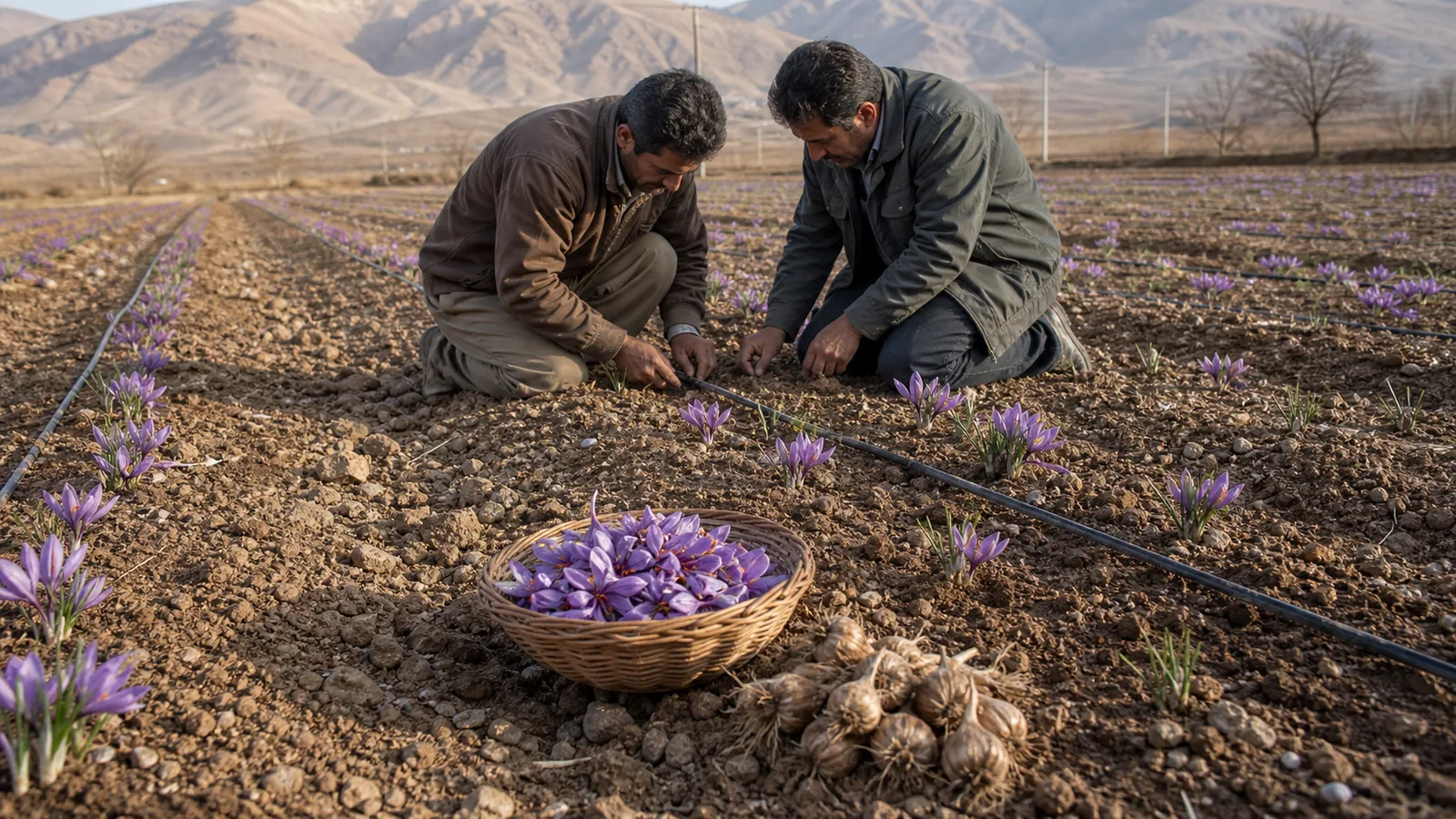
The most useful way to read the proposal is as a careful crop-diversification project. Khorramdareh faces falling groundwater levels while many farmers still grow water-demanding crops. Saffron can fit dry and semi-dry systems, yet it still needs timely irrigation, sound drainage, healthy corms, skilled harvest labour and a market that rewards quality.
Why Khorramdareh was considered suitable for saffron
Alireza Asadollahi, the local Agricultural Jihad director quoted in the original report, said saffron had been grown for years in small plots and gardens around Khorramdareh. He described the harvested product as good quality and said it was usually sold within the county.
Officials planned training classes, technical advice from planting through harvest, and help obtaining suitable planting corms. They projected that the planted area could grow as much as fivefold. Starting from the stated 1.2-hectare baseline, that would mean roughly six hectares, but the article supplied no timetable or later survey confirming that the expansion happened.
What suitable land actually means
A county-level statement cannot replace a field assessment. Research across Iranian saffron regions found that climate, soil and management interact, and that high irrigation volume alone did not produce higher yields. The study specifically included Zanjan among regions where greater water use was not associated with greater output.
Before planting, a grower should evaluate:
- soil texture, structure and drainage, because corms do poorly in waterlogged ground;
- soil pH, salinity, organic matter and nutrient status from representative samples;
- reliable water availability for the crop’s critical irrigation periods;
- winter cold, summer heat and the local flowering window;
- the health, size and traceable origin of planting corms;
- access to workers for a short, labour-intensive flower harvest; and
- a clean place to separate, dry, test, store and sell the stigmas.
A peer-reviewed review of saffron soils reports that Iranian production commonly occurs on calcareous sandy- or silty-loam soils under irrigation. That is a useful pattern, not a substitute for testing a Khorramdareh field. Even farms in the same district can differ in compaction, drainage, salinity and frost exposure.
Saffron uses less water, but it is not a no-water crop
The local article called saffron a low-water crop and proposed it as part of Khorramdareh’s response to groundwater decline. FAO makes a similar but more precise point about the traditional Gonabad system: saffron suits an arid region and does not require large quantities of water, while qanat irrigation provides a dependable supply.
That does not make the crop immune to drought. Irrigation timing affects flowering, daughter-corm growth and the following season’s yield. A multi-environment Iranian field study reported wide variation in water productivity and found no simple relationship between applying more water and harvesting more saffron. Local scheduling therefore needs soil-moisture observations, weather and crop stage rather than a fixed claim that saffron will always save a particular percentage.
Gonabad shows both the opportunity and the water risk
A source article provides a useful comparison with an established producing area. Gonabad’s Agricultural Jihad director, Alireza Hosseinzadeh, announced a saffron-flower harvest from 1,500 hectares that was expected to continue until 5 December. He forecast about 5 kg of dried saffron per hectare; the stored translation called this “straw saffron,” which is not a recognized output unit.
The same report said some farms affected by water shortages had been irrigated by tanker with public participation because continuing drought had reduced water available to farmland and gardens. In other words, even an established saffron area can face serious irrigation stress.
The 1,500-hectare figure is a dated harvest snapshot. FAO’s current description of the Gonabad qanat-based saffron heritage system says the area’s saffron farmland exceeds 2,000 hectares. The two figures need not conflict: they may cover different dates or geographic definitions.
What a 5 kg per hectare forecast can and cannot tell us
Yield is meaningful only when the product basis and measurement method are clear. Five kilograms of dried stigmas per hectare is different from five kilograms of flowers, fresh stigmas or a local commercial grade. Field age also matters because saffron is a perennial corm crop and yields can change across seasons.
Khorramdareh should therefore record planted hectares, field age, irrigation, fresh flowers, dried stigma weight, grade, labour hours and sale value separately. A headline yield borrowed from Gonabad is a benchmark for questions, not a guaranteed result for Zanjan.
Why flower prices can fall without retail saffron becoming cheaper
Hosseinzadeh also discussed a roughly 50% fall in the price of saffron flowers before that harvest. He said flower prices were set by supply and demand and cautioned that the decline should not be assumed to reduce the final consumer price by the same amount.
That distinction is reasonable because fresh flowers are only the starting material. Picking, rapid transport, stigma separation, drying loss, grading, laboratory testing, packaging, storage, finance and distribution all sit between the field and a jar of dried saffron. The percentage remains a dated local observation; it is not a current market price for either Gonabad or Khorramdareh.
South Khorasan’s drought warning
A second source records a warning from South Khorasan governor Parvizi. He said the province had more than 15,000 hectares under saffron but that repeated drought threatened cultivation and the processing businesses around it. He urged the Agriculture Ministry and Chamber of Commerce to consider other provinces that genuinely have suitable conditions.
That argument supports testing places such as Khorramdareh, but not indiscriminate expansion. Moving cultivation does not solve groundwater depletion if the new area lacks a water budget or if growers replace one stressed system with another. Pilot plots should be expanded only after several seasons show acceptable yield, quality and water productivity.
The governor also criticized unstable incentives and overlapping water rules, including policy around long-standing illegal wells. He offered provincial co-funding for a comprehensive saffron plan and called for investment in processing and branding. These were policy positions in a historical meeting, not confirmation that funding or legal reforms were later implemented.
A practical path for responsible expansion
For Khorramdareh, a sensible expansion sequence would be:
- Map suitable fields. Test soil and water, document frost and drainage risks, and exclude land that would worsen aquifer stress.
- Run comparable pilot plots. Record the same inputs, water use, field age and yield definitions on every site for more than one season.
- Use healthy corms. Keep supplier, lot and sanitation records so disease is not spread with planting material.
- Plan the harvest before planting. Flowers must be collected and processed quickly, so labour and a clean drying space cannot be an afterthought.
- Test the finished spice. Colour, aroma, moisture and contamination control determine whether “good quality” can be supported beyond a visual judgment.
- Secure a market. Compare local direct sales, wholesale contracts and branded packs after including labour, testing and packaging costs.
- Scale from evidence. Expand only where the pilot shows a reliable return without exceeding the local water budget.
Can Khorramdareh become a saffron-growing area?
Yes, Khorramdareh has demonstrated small-scale potential for saffron cultivation, but responsible growth needs field-level evidence. The old 1.2-hectare base, local training and reported product quality justify continued trials. Gonabad and South Khorasan show the other half of the lesson: saffron is well suited to dry regions, yet established farms still suffer when drought and governance weaken the water supply.
The strongest result would not be the largest planted area. It would be a stable group of farms that can document water use, produce clean and consistently graded saffron, pay harvest labour fairly and sell through a dependable market. That is how a promising crop becomes a durable part of Khorramdareh agriculture.

![Exporting Saffron to Turkey + Price Guide [Complete 0 to 100]](https://img.rowhanisaffron.com/20260827003933/saffron-export-turkey-quality-inspection.webp)



