


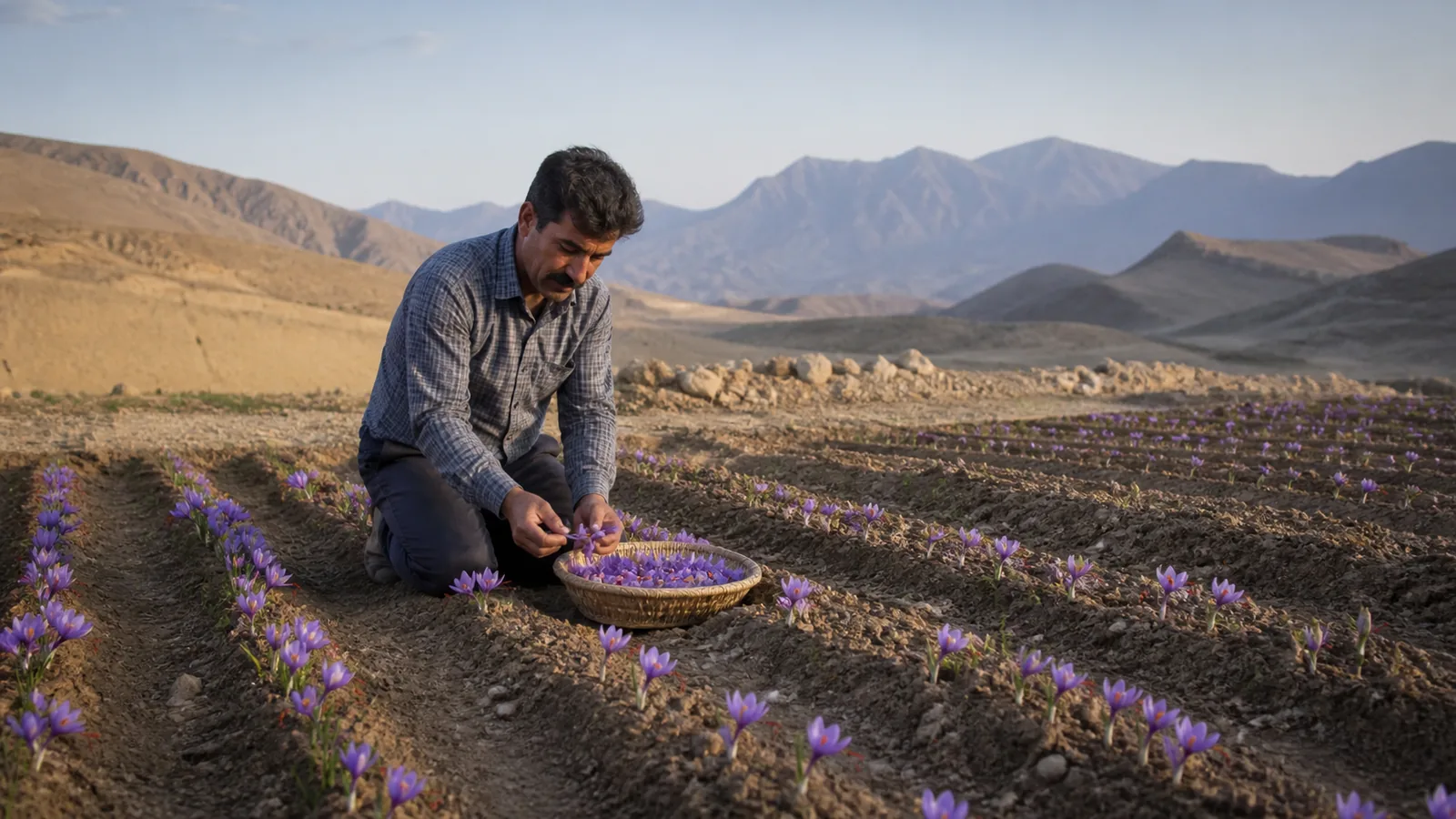
Planting saffron in the city of Baft developed from a limited local crop in the early 1990s into part of Kerman Province’s move toward lower-water agriculture. A historical Agricultural Jihad report recorded 70 hectares of saffron in Baft and plans to replace another 30 hectares of more water-demanding crops. Most fields were still young, so average production was about two kilograms per hectare, while the best reported field reached seven kilograms.
Those figures describe one stage in the county’s development; they are not a current acreage report or a guaranteed yield. Their lasting value is the pattern they reveal. Baft has real experience with saffron, but successful planting still depends on the exact field, healthy corms, well-timed irrigation and enough labour to handle a short flowering season.
When saffron cultivation began in Baft
The original Persian report said cultivation began on a limited scale in the year 1370 of the Iranian calendar, roughly 1991–92, and expanded from 1386, roughly 2007–08. An old machine translation turned “the year 70” into “70 years,” changing the history of the crop. The corrected timeline shows a long-running local experiment followed by more organized growth.
Karimi, then acting head of Agricultural Jihad management in Baft County, reported 70 hectares under saffron. He also described a plan to allocate 30 additional hectares by moving land away from crops with higher water requirements. The article did not name those previous crops, so it would be misleading to guess.
At provincial level, a 2020 report from Iran’s Agricultural News Agency listed Baft among Kerman counties suited to saffron. It reported 1,600 hectares and a projected 5,100-kilogram harvest across the province, with the greatest area in Zarand. Those province-wide totals should not be substituted for present-day Baft data, but they confirm that Baft belongs to a broader Kerman saffron belt.
Why early yields in Baft varied
The original report placed average production at two kilograms of saffron per hectare and the highest local result at seven kilograms. It also explained that many of the county’s fields were newly established. That detail is essential: saffron production usually changes as a stand matures and daughter corms develop, so a young-field average cannot be compared casually with the yield of a mature, well-managed plot.
Field age is only one influence. Yield can also move with:
- the size, health and planting density of the corms;
- soil drainage, fertility and previous disease pressure;
- the timing and uniformity of the first autumn irrigation;
- winter and spring moisture during leaf and daughter-corm growth;
- weed control and soil crust management; and
- the speed and care of flower picking, stigma separation and drying.
A grower reviewing the two-to-seven-kilogram range should use it as evidence of local potential and management variation, not as a financial forecast.
Preparing a Baft field for saffron
The historical Baft account said planting began in Shahrivar, approximately late August to late September. That is a local programme date, not a rule for every season. The field should be ready before corms arrive, and planting material should not be left exposed to heat or stored carelessly while a grower waits for the calendar.
Start with a soil and water assessment. Saffron corms need a root zone that drains freely; a compacted or waterlogged parcel can turn a seemingly low-water crop into a costly failure. Test nutrient status rather than applying fertilizer by habit. Choose firm, graded corms with no visible rot or injury, and keep batches traceable to their supplier.
Then plan water by growth stage. Saffron is dormant during summer and active through the cooler months, but it still needs properly timed moisture for emergence, flowering and vegetative growth. Our guide to saffron irrigation explains why a fixed schedule copied from another region can fail when soil and weather differ.
Harvest capacity matters as much as acreage
Flowers arrive over a brief autumn period and are best collected while cool and fresh. An extra hectare is useful only if the farm can mobilize pickers, move flowers without crushing them, separate stigmas hygienically and dry the saffron consistently. Delays at any of those stages reduce the value that justified choosing the crop.
The original report also mentioned a route through local agricultural experts and the Agricultural Bank for farmers seeking finance. That was a time-specific administrative arrangement. Anyone considering a loan now should ask the Baft Agricultural Jihad office and the bank directly about current eligibility, documents and terms rather than relying on an older notice.
A sensible decision for a new Baft grower
Baft’s cultivation history and its inclusion among Kerman’s saffron-suitable counties make the crop worth evaluating. They do not remove the need for a farm-level decision. A small first planting can show how the exact soil, water supply and labour team perform before more land is committed.
Keep records of corm grade, planting density, each irrigation, flower weight and dry saffron yield. After the field has passed through flowering and a full leaf-growth period, those records will say far more about expansion than a provincial average. In Baft, the strongest planting plan is the one built around a verified field and a realistic harvest operation, not simply the promise of a high-value crop.

![Exporting Saffron to Turkey + Price Guide [Complete 0 to 100]](https://img.rowhanisaffron.com/20260827003933/saffron-export-turkey-quality-inspection.webp)



