


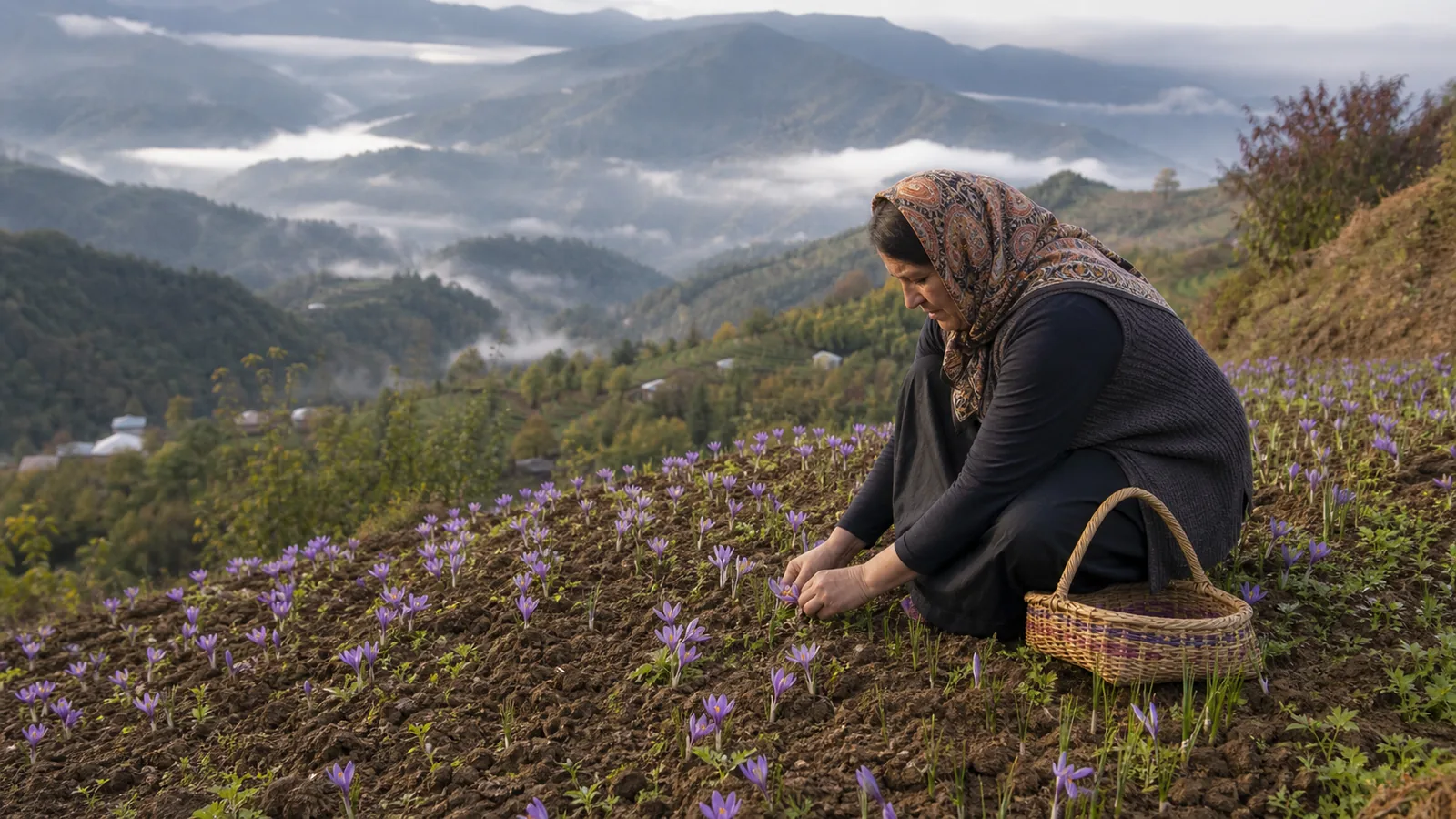
The saffron harvest in Gilan developed in a setting very different from Iran’s dry eastern growing regions. Local agricultural reports placed the crop on cooler mountain land above the province’s humid plains, where small plots could give farming households another autumn activity without displacing rice, tea or other established crops.
Historical figures described 11 hectares planted by 130 households and a forecast of 33 kilograms of dried saffron. A companion report preserved the earlier one-hectare harvest around Kajid and Malakut and explained why officials focused on mountain villages rather than treating saffron as a province-wide replacement crop.
Gilan’s reported harvest: 11 hectares and 33 kg
Habib Jahansaz, identified as a provincial agricultural official, forecast that Gilan would harvest 33 kilograms of saffron with a stated value of about 300 million rials. The report said 130 households cultivated 11 hectares of mountain land.
The forecast implies an average of three kilograms per hectare and a reported value of roughly 9.1 million rials per kilogram. Neither figure is a final measured result: the article did not provide a post-harvest total, grade, moisture result or actual farm-gate price.
It also said the previous year’s planted area was eight hectares and described the increase as 10%. Those statements do not reconcile. Moving from eight to 11 hectares is a 37.5% increase. Because the source does not identify which number was wrong, the responsible approach is to retain the stated areas and flag the percentage conflict rather than silently choose one.
Where saffron was planted in Gilan
The provincial programme identified mountain areas around Rudsar, Amlash, Siahkal, Talesh, Rudbar and Rezvanshahr. One report described sites at about 1,300 metres above sea level. Its English translation rendered this as 300 metres, but the embedded Persian source text says “one thousand and 300,” supporting the 1,300-metre reading.
The companion account named Kajid and Malakut as centers of the first reported harvest, with Motlakuh and Kalamrood identified as the villages involved. That early harvest covered one hectare. These place names add useful context: the project began as a localized mountain trial, not as a blanket recommendation for all Gilan farmland.
Why officials separated the mountains from the plains
Gilan’s warm, humid lowlands are well known for rice and tea. The source used absolute language, saying saffron planting was impossible on the plains because of heat and humidity. Agricultural suitability is rarely that simple, so the stronger conclusion is narrower: officials considered the humid plains unsuitable for this programme and selected cooler, better-drained mountain locations.
Saffron grows from underground corms and returns over multiple seasons. Persistent wetness and poor drainage can create problems for a corm crop, while local temperature, field exposure and irrigation timing also matter. A mountain label alone does not guarantee success; each field still needs an agronomic assessment and healthy planting material.
Extra income, not a replacement for rice and tea
The officials explicitly said the saffron initiative was not intended to replace Gilan’s traditional crops. Rice and tea remained priorities where conditions supported them. Saffron was proposed for mountain areas where those crops were less practical and as a possible supplementary income stream for households with available time after their main harvests.
That distinction protects the original intent of the project. Saffron can be valuable by weight, but flower picking and stigma separation require concentrated hand labor. Establishment also requires corms, suitable land and careful drying. A small saffron plot should be evaluated on its own costs and sales, not promoted by comparing retail spice prices with the gross value of another crop.
When did saffron cultivation begin in Gilan?
The two historical articles use different time references. One says provincial cultivation began in “year 87,” which in this Iranian context most likely means 1387 in the Solar Hijri calendar, spanning parts of 2008 and 2009. The other says planting in Gilan had begun five years earlier but does not state the underlying report date clearly.
Those references may describe different stages or may come from reports published at different times. They are not precise enough to construct one definitive start date. What can be said safely is that a one-hectare early harvest preceded the later report of 11 hectares and 130 participating households.
The 4,000-year saffron history claim
The source repeated a familiar account that saffron had 4,000 years of history in Iran and that Iranians introduced it to Greeks, Romans, Chinese and Arab peoples. Saffron certainly has an ancient, multicultural history, but that specific one-way transmission story was not sourced in the report.
Modern historical and genetic reviews present a more complex picture. Evidence places saffron across ancient Greece, Persia and other cultures for more than three millennia, while genetic and art-historical research has argued for domestication in early Greece. Other literature documents long use in Iran. The evidence supports an ancient crop shared across regions, not a simple claim that one named people introduced it to every other civilization.
What the first Gilan harvest contributed
The one-hectare Kajid and Malakut report supplied the missing beginning of the story. It showed where the first flowers were gathered, connected the crop to Motlakuh and Kalamrood, and set a clear policy boundary: saffron was an experiment for selected mountain communities.
The later 11-hectare report showed wider participation and named additional districts. Together, the articles describe progression from a local trial to a small provincial programme. They do not show that every planted hectare remained productive or that the forecast value became household income.
What should be measured in a follow-up
- Final dried-saffron weight, not only the pre-harvest forecast.
- Productive and newly planted hectares, field age and corm condition.
- Labor days for flower picking and stigma separation.
- Drainage, rainfall, irrigation and disease losses by site.
- Quality-test results and the price actually received by growers.
- Net household income after corm, labor, drying and packaging costs.
Those measurements would show whether saffron delivered the supplementary income envisioned by the programme and which mountain sites performed reliably.
A careful reading of Gilan’s saffron story
Gilan’s saffron harvest is best understood as a targeted mountain-farming initiative. Its strongest details are local: one early hectare in the Kajid and Malakut area, later cultivation across 11 hectares by 130 households, a 33 kg forecast, and an explicit decision not to displace rice and tea.
The weaker parts are now labeled rather than repeated as facts: the 10% area calculation does not match the hectare figures, the start date is imprecise, humid plains were described too absolutely, and the ancient-history claim simplifies a debated origin. Preserving the useful local record while identifying those limits produces a clearer account of what the Gilan project was meant to achieve.

![Exporting Saffron to Turkey + Price Guide [Complete 0 to 100]](https://img.rowhanisaffron.com/20260827003933/saffron-export-turkey-quality-inspection.webp)



