


Planting saffron in the city of Chalus first made local news through a modest trial in the Marzanabad district. That distinction matters. The trial showed that saffron corms could flower and multiply on one upland plot; it did not establish that every field in Chalus, especially wetter coastal land, would be suitable for commercial production.
The most useful lesson from the story is therefore not a blanket promise. It is a practical way to test a field before a farmer commits more land, labour and planting material.
What happened in the Marzanabad trial
In the original report, Marzanabad agricultural director Jafar Salehi told ISNA that this was the first recorded saffron planting in the district. He also described a much older, smaller custom: local farmers returning from a pilgrimage to the Imam Reza shrine in Mashhad sometimes brought a few saffron corms home and planted them in their gardens.
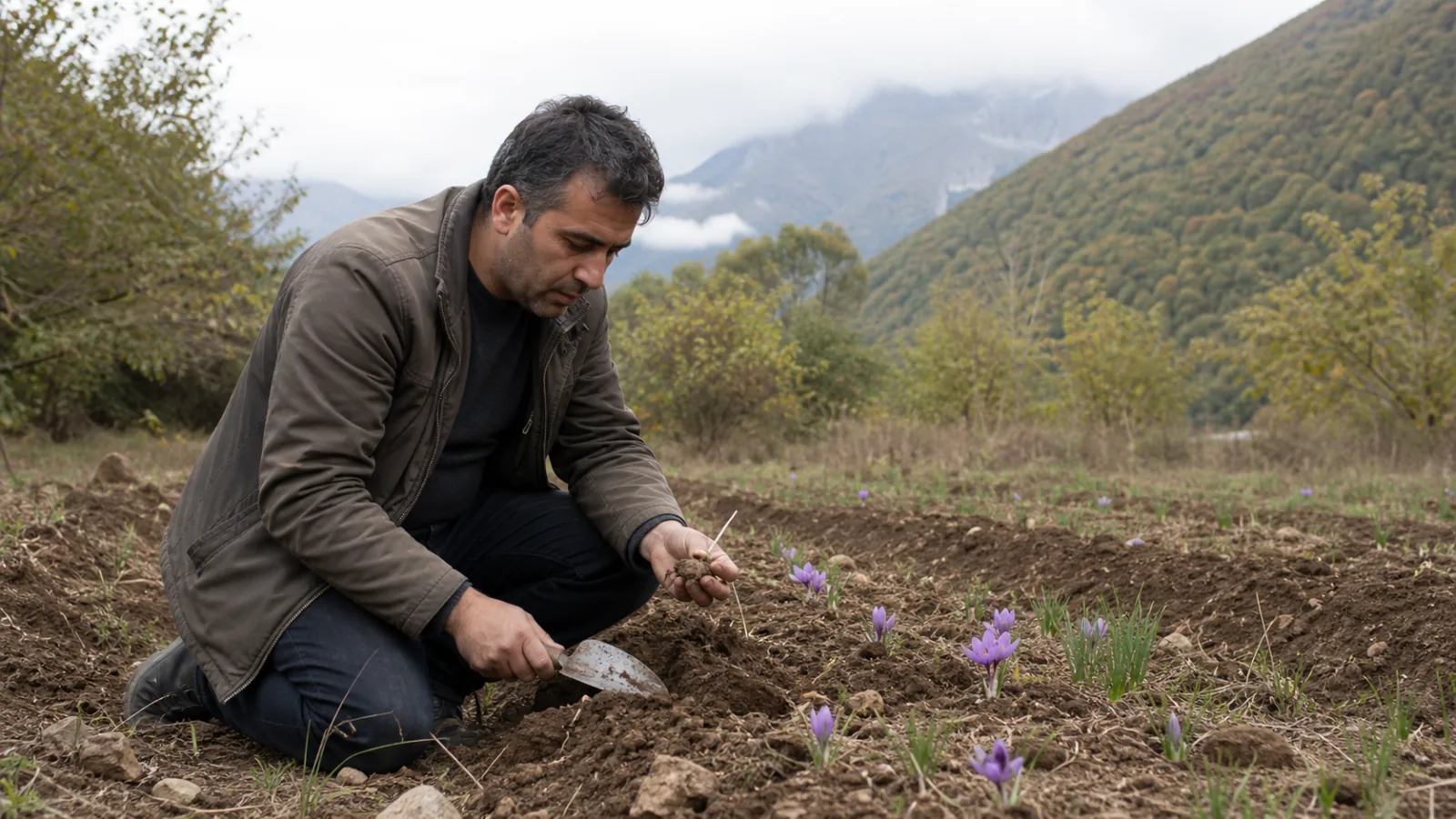
One farmer took that experiment further. The archived English version describes an initial plot of “200 metres”; from the surrounding account, this appears to mean roughly 200 square metres rather than an elevation. The corms flowered, produced daughter corms and were replanted over about 500 square metres the following summer.
Officials visited the field soon afterwards. Their inspection and the condition of the lifted corms encouraged interest among other farmers. The grower was pleased, but Salehi was careful about the unanswered question: a saffron specialist would still need to compare the crop’s yield and quality with established production around Mashhad.
Why Marzanabad cannot represent all of Chalus
“Chalus” can describe very different growing conditions. Marzanabad sits inland among mountain valleys, while Chalus city and the central coastal area are more directly affected by Caspian humidity and rainfall. Elevation, slope, soil depth and air movement can change over a short distance. Two fields in the same district may drain very differently after the same storm.
Saffron is not a crop that can be judged from a place name alone. The FAO’s EcoCrop record says Crocus sativus performs best in temperate, fairly dry climates and warns that rain during flowering can damage the crop. A UNIDO saffron value-chain document adds an equally important soil requirement: saffron can grow in several soil types, but the soil needs a moderate structure and good drainage.
That explains the warning in the local report about autumn moisture and low, wet ground. It should not be read as “saffron never needs water.” It means that standing water, saturated soil and poorly timed rain can become serious problems around corm activity, flowering and harvest.
What the first flowering proved—and what it did not
A successful first flowering is meaningful. It confirms that the corms survived planting and dormancy, emerged and completed a flowering cycle under that field’s conditions. Daughter corms are another encouraging sign.
Those results still fall short of a commercial recommendation. The account gave no dry-saffron weight, flower count, corm-loss rate or laboratory quality result. It also covered too short a period to show how the planting would cope with several wet autumns, soil-borne disease or declining corm health.
Before expanding, a grower needs answers to four questions:
- Does water leave the root zone promptly after heavy rain?
- How many healthy flowers and how much dried saffron does a measured area produce?
- How many corms remain sound when a sample is lifted after the season?
- Can flowers be picked, separated and dried quickly enough during damp weather?
If one of those answers is uncertain, a larger field only makes the uncertainty more expensive.
How to test a Chalus-area field responsibly
Begin with a small, measured trial on the best-drained part of the farm. Avoid hollows where runoff collects. A local soil assessment should consider texture, compaction, drainage depth, organic matter and any history of corm or root disease. Raised beds may help on some sites, but they cannot repair a field with persistent waterlogging.
Use sound, disease-free corms from a traceable source. Record their number or weight, planting date, spacing and the exact area. During the season, keep a simple field log for rainfall, irrigation, emergence, flower count, visible rot and harvest labour. After drying, weigh the saffron from that plot rather than judging the crop by flower colour or appearance.
Repeat the measurement over more than one season. An unusually dry autumn can make a marginal site look better than it is; one severe wet spell can expose a drainage problem that was invisible in the first year. Our guide to weather and field conditions for planting saffron explains the seasonal pattern in more detail.
Comparing local saffron with Mashhad saffron
Place of origin alone does not settle quality. The comparison should use samples harvested at similar maturity and dried under controlled conditions. Moisture, cleanliness and the compounds associated with colour, aroma and flavour must be assessed consistently. A local grower’s satisfaction is valuable field evidence, but it is not a substitute for a comparable yield record and laboratory analysis.
The original Marzanabad report was right to leave that judgement with qualified saffron specialists. It preserved the promise of the trial without turning an early result into a claim the evidence could not support.
A hopeful start, with the next step still to prove
The 200-square-metre trial and its expansion to roughly 500 square metres were a reasonable beginning. They showed enough promise to justify observation and further local trials. For another farmer, however, the sound decision is to test the actual field—not to assume that a result from one Marzanabad plot applies across the city of Chalus.
Good drainage, measured yield, healthy corms and repeatable performance are the evidence that should support expansion. Until those records exist, a small trial remains the safest and most informative next step.
Sources
- The original local account attributed to Jafar Salehi and the Iranian Students’ News Agency (ISNA), preserved in this post’s archive.
- FAO EcoCrop: Crocus sativus crop record.
- UNIDO: Saffron Industry Value Chain Development project document.

![Exporting Saffron to Turkey + Price Guide [Complete 0 to 100]](https://img.rowhanisaffron.com/20260827003933/saffron-export-turkey-quality-inspection.webp)



