


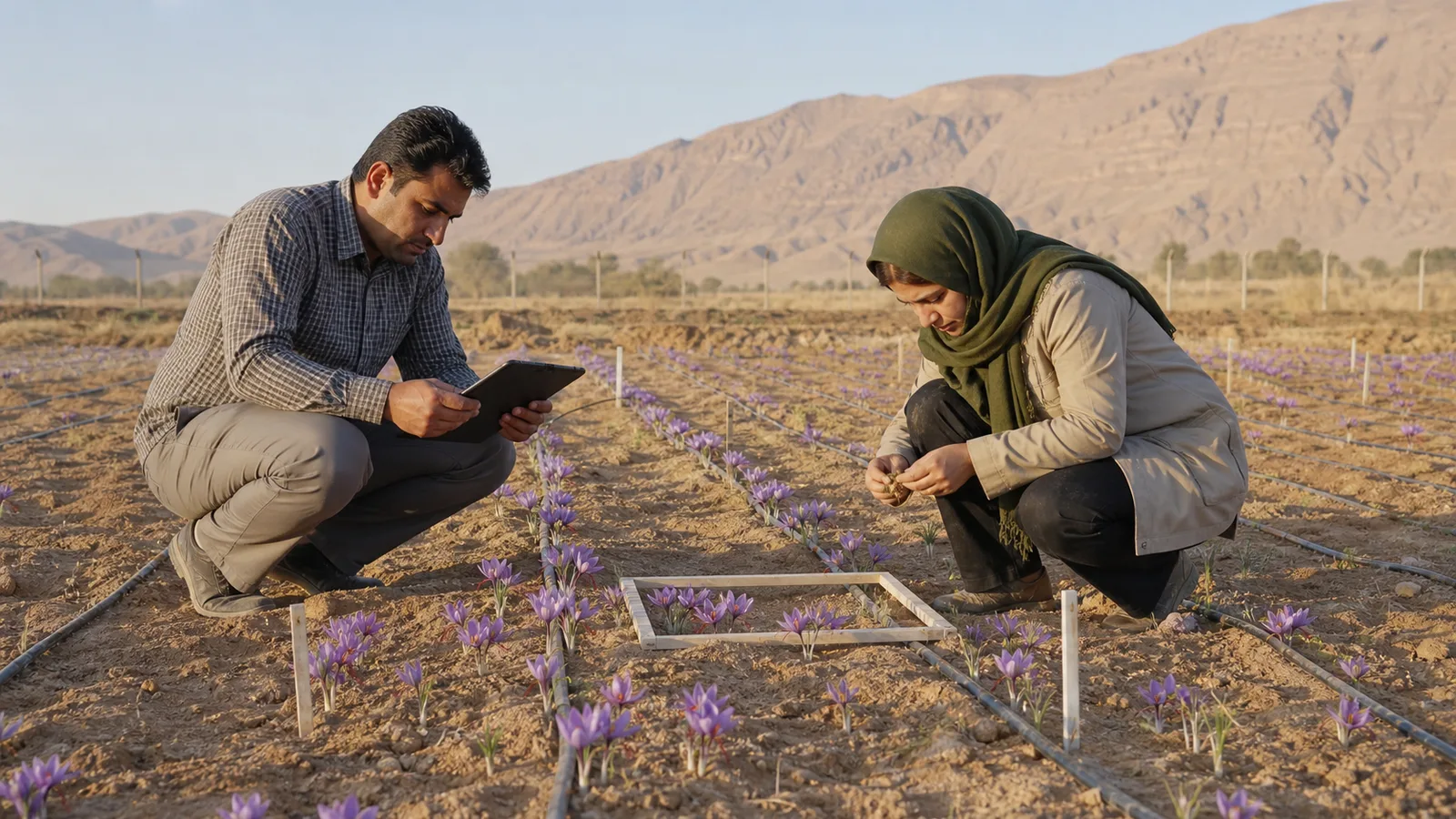
Saffron Planting at Research Institute of Zabol University referred to an experimental field at the university’s Baqiyatallah Al-A’zam Complex. In the historical announcement, saffron corms planted by researchers flowered during their first growing year. That was an encouraging observation for the trial, but it was not yet proof of a profitable crop system for the wider Sistan region.
The distinction matters because the original article moved quickly from “the corms flowered” to low maintenance, substantial farmer profit, job creation and regional economic development. A university research plot can test those possibilities. It cannot establish them from flowering alone.
What Zabol University reported
The report was attributed to Fars News in Zahedan, drawing on Zabol University public relations, and was later reproduced by the Young Journalists Club. It said researchers at the university’s Agricultural Research Institute had planted saffron in the experimental fields of the Baqiyatallah Al-A’zam Complex. The corms produced flowers in their first year.
The institution’s name appears in English as both Zabol University and University of Zabol; older translations also use Zabul University. The complex is variously romanised Baqiyatallah, Baqiyat Allah or Baghiatallah Al-A’zam. These variants refer to the same university and research setting described by the source, not separate projects.
The translation called the planting material “saffron onions” or bulbs. The more precise term is corms: compact underground storage stems from which saffron leaves, flowers and replacement corms develop.
Why first-year flowering is useful
Flowering shows that at least some planted corms survived handling and field conditions, completed the relevant growth stages and received a combination of temperature and moisture that allowed flower emergence. For a new trial, that is a meaningful observation.
It does not by itself reveal:
- the percentage of planted corms that emerged or flowered;
- the corm source, size, health, density or planting depth;
- the plot area, soil properties, salinity or drainage;
- the irrigation dates and total water applied;
- the number and fresh weight of flowers;
- the dried stigma yield or laboratory quality;
- labour, input cost, sale price or net return.
Without those measurements, the trial demonstrates biological possibility at one site rather than a repeatable production recommendation.
Research for an arid region must be site-specific
Zabol and the Sistan region face a different combination of temperature, wind, soil and water constraints from Iran’s established saffron centres. A crop’s reputation for relatively low water demand is not enough to prove that it suits every dry location.
Climatic-zoning research on saffron shows why local measurement is necessary. Studies combine variables such as minimum and maximum temperature, frost, rainfall, elevation and slope to distinguish stronger and weaker planting zones. The exact result from another province cannot be transferred to Zabol, but the method is relevant: define the saffron growth stages, map the conditions that affect each stage and verify them with field results over more than one year.
Water quantity also has to be paired with water quality and timing. An experimental plot should record salinity, irrigation uniformity and the crop response after each application. “Drought tolerant” should never be translated into “needs no dependable water plan.”
The university’s wider agriculture programme
The announcement described Zabol University as a “third-generation university” with an entrepreneurship and regional-development mission. It said the university was researching and promoting new cultivation patterns in line with Ministry of Science, Research and Technology policies and economic needs assessment.
It also named olive-orchard development under Iran’s Sixth Development Plan as an earlier or parallel step. Saffron was then presented as another high-value Iranian crop to investigate for the region. Those details explain the project’s institutional purpose: it was part of a broader effort to connect research, extension and local economic development, not an isolated flower display.
What would justify farmer guidance?
Before an agricultural research institute recommends expansion, it should compare treatments and publish the conditions. A useful saffron experiment would include a control or clearly defined baseline and replicated plots where possible. It would record corm grade, density, depth, soil preparation, irrigation, weeds, disease, flower count, dry stigma yield and daughter-corm development.
The work also needs time. Saffron is a multi-year field crop, and first-year performance may differ from later seasons as daughter corms multiply and field pressure changes. Annual results should identify the actual bearing area and report variation rather than only the best plot.
Quality belongs in the same dataset. Colouring strength, aroma-related compounds, flavour-related measures, moisture, foreign matter and contamination affect whether dried saffron can reach a particular market. A high dry weight with weak quality is not the same outcome as a smaller, verified premium lot.
Low maintenance and “great profit” were goals, not results
The old article said expert care could keep maintenance costs low and bring farmers substantial profit. It also said expansion could draw many jobseekers into agriculture and strengthen household income. The announcement supplied no cost, labour, price or employment data to demonstrate either claim.
Saffron’s field water pattern may suit some dry-region strategies, but flower picking, stigma separation and quality-sensitive drying demand concentrated labour. Corm purchase, land preparation, irrigation infrastructure, weeding, replanting and marketing also carry costs. A university feasibility study should count all of them and compare the result with realistic alternative uses of the same land and water.
Employment should be assessed with the same care: number of paid workdays, timing, skills, wage level, continuity and who receives the income. Seasonal labour can help households, but a predicted opportunity should not be reported as an existing job total.
How the research plot should be followed up
A later review of the Baqiyatallah Al-A’zam trial should ask for the planting and harvest years, plot coordinates or environmental description, corm source and grade, full treatment design, irrigation and water-quality data, multi-year dry yield, saffron quality tests, costs and any publications or farmer demonstrations that resulted.
The original report invited researchers and agricultural-development organisations to contact Zabol University’s Agricultural Research Institute for more information. That remains the appropriate route for project-specific evidence; this article does not claim that the historic trial is still active or that its first-year result became a regional recommendation.
The careful conclusion is narrower and more useful. Researchers at the Zabol/Zabul University Agricultural Research Institute planted saffron at the Baqiyatallah Al-A’zam Complex, and the corms flowered in their first year. That justified continued measurement. It did not yet prove low-cost production, high profit, large-scale employment or suitability across Sistan.
Sources reviewed: the Fars News/University of Zabol public-relations report reproduced by YJC; climatic-zoning and saffron-adoption research indexed by FAO AGRIS; and official University of Zabol crop-science publication pages. No later project dataset confirming yield or profitability was identified in the material reviewed.

![Exporting Saffron to Turkey + Price Guide [Complete 0 to 100]](https://img.rowhanisaffron.com/20260827003933/saffron-export-turkey-quality-inspection.webp)



