


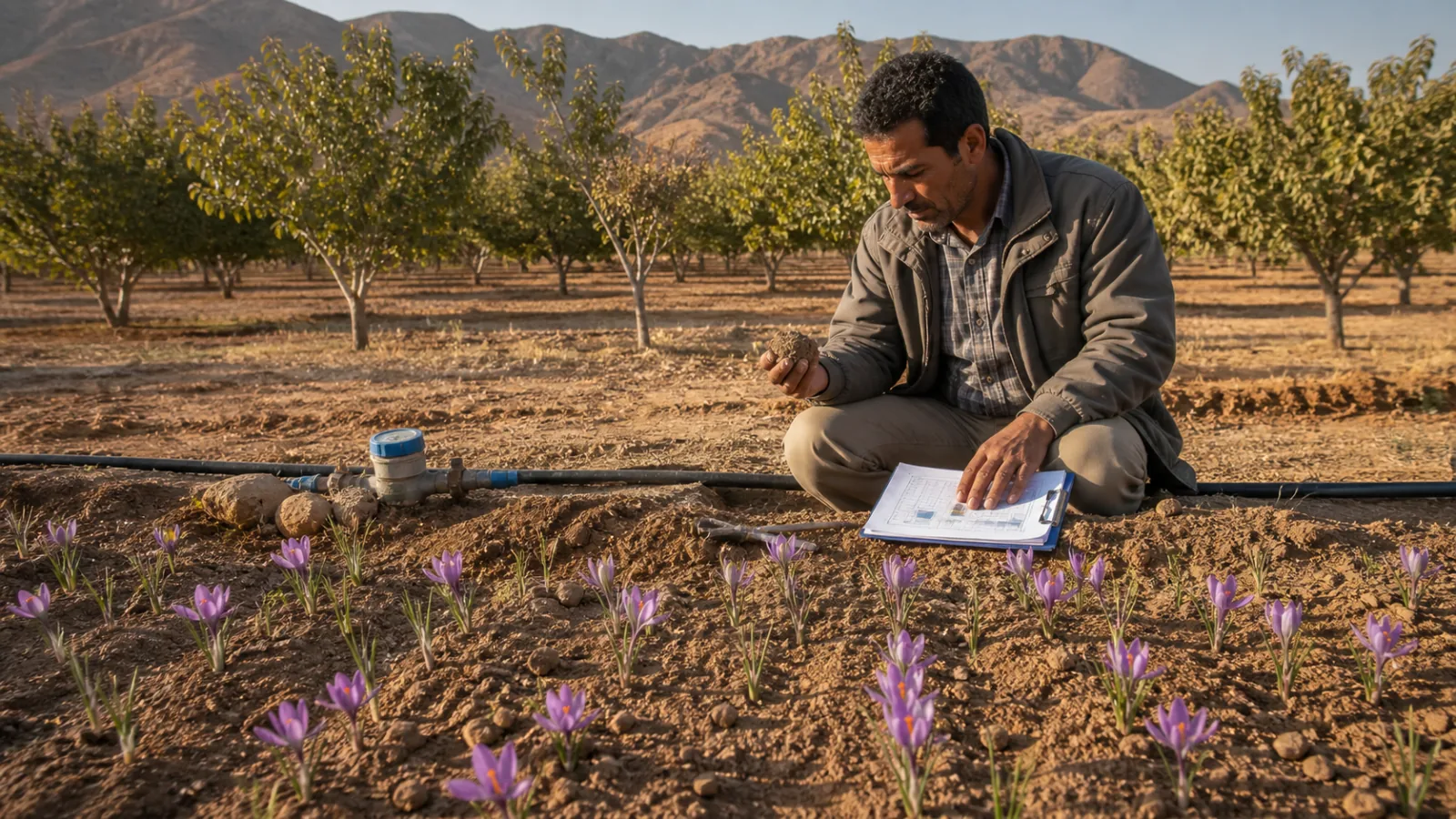
Should farmers plant saffron instead of pistachios in Kerman? In some water-stressed fields, saffron may be a sensible alternative to a new or failing orchard. It is not a universal replacement for Kerman’s pistachio industry. The decision depends on the water and soil at the exact site, the condition of existing trees, local winter temperatures, labour, expected yield and a realistic market plan.
This page began as a historical report on Kerman’s long drought and an official effort to change cultivation patterns. Its title is preserved because the page currently earns search impressions around this subject. The stronger reading of the evidence is not “remove every pistachio tree.” It is “compare crops field by field before scarce groundwater is committed for another season.”
Why saffron was proposed as an alternative in Kerman
The report described a 17-year drought, falling groundwater, dry qanats and seasonal rivers, and close to 1,000 villages receiving tanker water. It linked those pressures to lower agricultural output and to rural workers leaving farming for work around larger cities. Those claims belong to the article’s reporting period; they should not be treated as a current count of villages or wells.
Provincial measures mentioned in the account included meters on agricultural wells, action on unauthorised wells, changes in crop choice and more efficient irrigation. Saffron attracted attention because its active growth and water demand fall mainly in the cooler part of the year, and because dried stigmas can carry high value at very low physical weight.
That combination can improve value per unit of water in a suitable production system. It does not make saffron a crop that needs no water, nor does a high retail price become farm profit automatically.
What the historical Kerman saffron figures said
Abbas Saeedi, identified as head of Kerman’s Agricultural Jihad organisation, reported 2,900 kilograms of saffron harvested in the province during the stated year. He put the saffron area at 822 hectares after an increase of more than 242 hectares and described Kerman as seventh nationally by cultivation area at the time.
Mehdi Lotfalizadeh, the provincial horticulture director, named Zarand as the leading county. The report gave Zarand 210 hectares of saffron, 160 of them productive. Zarand, Kerman, Ravar, Kohbanan and Baft were all discussed as producing or promising areas, with Dasht-e Khak singled out for quality.
The reported provincial average was about five kilograms of dried saffron per hectare, reaching seven kilograms under the best conditions. Harvest was said to continue until late December, and the article estimated 20 workers per hectare during a cultivation or harvest period. Each number is historical and attributed. Farm age, productive area, labour-days and measurement method are not detailed well enough to turn them into a modern budget.
Saffron uses less water—but the comparison needs numbers
A fair comparison uses actual seasonal irrigation volume, not labels such as “low-water” and “water-intensive.” Pistachio is a deep-rooted perennial tree. Its water requirement and drought response change with tree age, crop load, climate, rootstock, soil and irrigation system. A mature orchard also contains years of invested capital that cannot be recreated quickly.
Saffron is a perennial corm crop with a different calendar. It normally receives strategically timed irrigations around emergence, flowering and vegetative growth. Yield can still fall when water timing is poor, and unsuitable summer irrigation or poor drainage can damage corms.
Research in Kerman has found that declining groundwater quantity and increasing salinity affect crop yield, cultivated area and farm margins, including pistachio systems. That makes water quality as important as volume. Replacing one crop without testing salinity, drainage and seasonal supply can simply exchange one production problem for another.
Five checks before changing a Kerman field
1. Measure the water source
Record legal allocation, pump discharge, seasonal reliability, salinity and the energy cost of lifting water. Compare cubic metres per hectare under the irrigation system actually available—not a national average copied into a farm plan.
2. Test the soil and local climate
Texture, salinity, pH, drainage and prior crop history affect both crops. Saffron also needs a temperature cycle that permits flower initiation and emergence. An upland site in Zarand or Baft should not be treated as climatically identical to every plain in the province.
3. Separate an established orchard from bare land
The economics of planting bare land differ sharply from removing living pistachio trees. An orchard with manageable salinity, sound trees and efficient irrigation may deserve rehabilitation. Dead or chronically unproductive blocks may justify a staged alternative-crop trial.
4. Budget several years, not one headline price
Saffron requires corms, preparation, irrigation, weed control, rapid flower picking, stigma separation, drying, testing and sale. Young fields may not produce their mature yield immediately. Price changes by grade and channel, while labour demand is concentrated into a brief harvest window.
5. Start with a measured pilot
A representative plot gives the farm its own evidence. Track corm size and source, flowers, dried stigma, labour-hours, water, quality results, saleable grade and net return. At least several seasons are more informative than one exceptional harvest.
What about existing pistachio orchards?
The title’s word “instead” can hide the hardest part of the decision. Removing mature trees is irreversible in the short term, and saffron cannot instantly replace the orchard’s income, buyer relationships or processing chain. Before clearing a block, growers should examine irrigation uniformity, leaks, soil salinity patterns, tree water status, pruning, nutrition, alternate bearing and the condition of the water source.
Where a partial conversion is justified, phased planting reduces risk. A grower can test saffron on bare or failed sections while monitoring the remaining orchard. The result may be complete replacement, rehabilitation of pistachios, a mixed farm with crops on separate blocks or withdrawal of land when neither crop can be supported sustainably.
The FAO’s technical review of pistachio response to water shows why crop load and irrigation timing complicate simple annual comparisons. For the saffron side, our saffron irrigation timing guide explains the crop’s seasonal stages.
Market value is not the same as farm income
The historical report repeatedly describes saffron as highly profitable and exportable. That may be true for a well-run farm with saleable quality, but it is not guaranteed by planting area. Dried yield is tiny relative to the volume of flowers handled, and quality can be lost through delayed separation, uncontrolled drying, moisture or poor storage.
A proper comparison uses net margin and water productivity: income from saleable grades minus corm, orchard-removal, water, power, labour, drying, testing, packaging, finance and marketing costs. It should include a conservative price and yield, not only the best figures quoted in the old report.
Employment also needs a clear unit. The article’s “20 people per hectare” statement could mean workers at peak harvest, jobs over a period or labour inputs translated into people. Without that definition it should not be advertised as 20 permanent jobs.
A better interpretation of “plant saffron instead of pistachios”
Kerman’s historic figures show that saffron was no longer a novelty: hundreds of hectares had been planted, several northern counties were producing it, and provincial officials were supporting expansion during a water crisis. They do not show that saffron is suitable for every pistachio property.
The useful recommendation is conditional. Consider saffron where measured water supply, quality, soil, temperature and labour fit the crop; compare it with repairing the existing orchard; and prove the case on a pilot plot before making an irreversible change. That approach protects both groundwater and farm livelihoods better than treating either saffron or pistachio as the automatic answer.

![Exporting Saffron to Turkey + Price Guide [Complete 0 to 100]](https://img.rowhanisaffron.com/20260827003933/saffron-export-turkey-quality-inspection.webp)



