


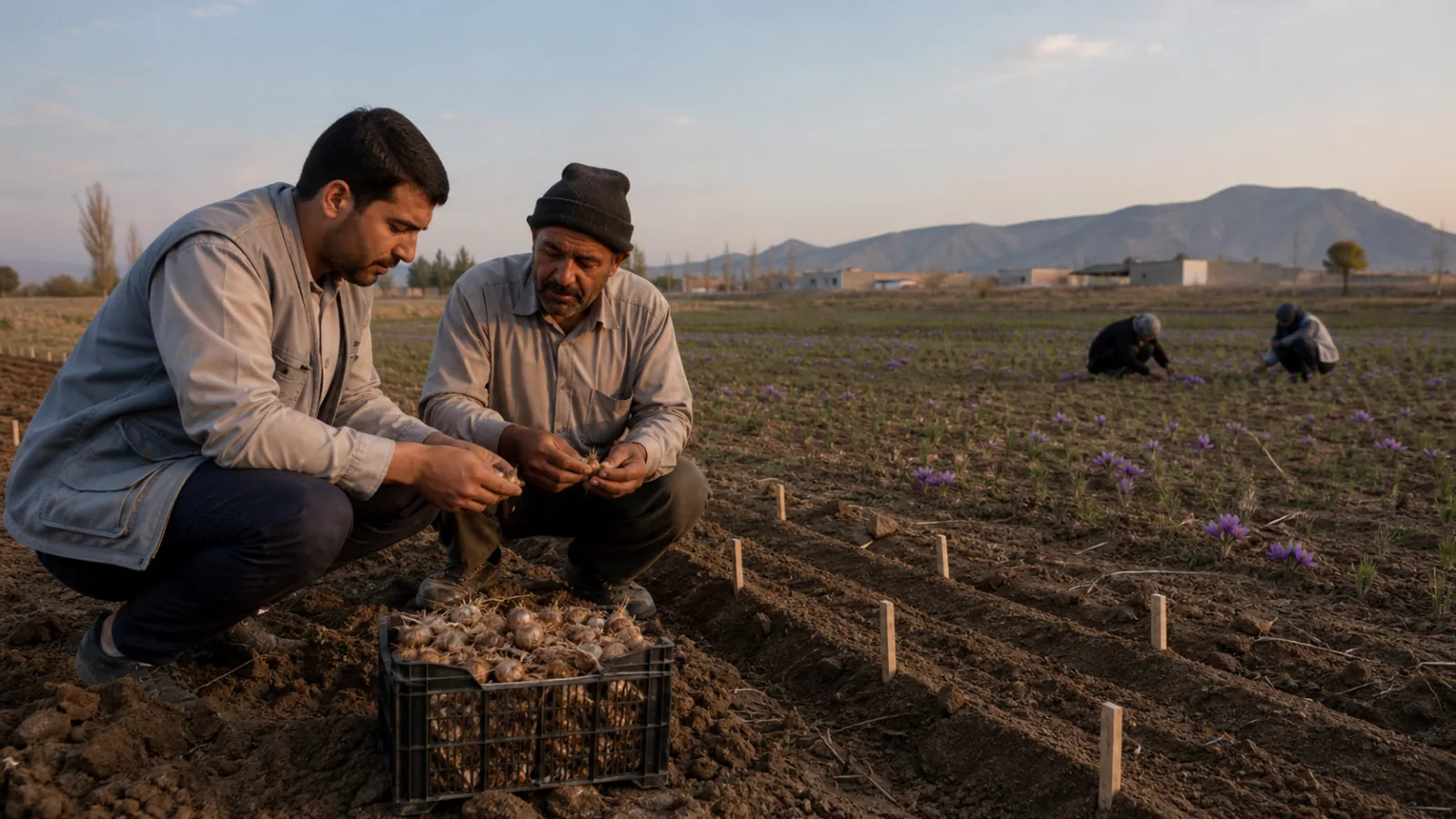
Increasing the planting of saffron in Khomein was reported as a five-hectare expansion, from 12 hectares to 17. Ahmad Oruji, then responsible for horticultural improvement at the local Agricultural Jihad office, forecast more than 70 kilograms of dried saffron from the district’s fields. The figures describe that reporting year, not Khomein’s current planted area or harvest.
The numbers are internally plausible. Fifty kilograms from 12 hectares in the previous year equals about 4.17 kilograms per hectare. A 70-kilogram forecast from 17 hectares equals about 4.12 kilograms per hectare, close to Oruji’s stated average of more than four kilograms. The planted area rose by roughly 42 percent, while forecast output rose by 40 percent.
What the Khomein expansion meant
Oruji described Khomein as the leading saffron-producing district in Markazi Province at the time. He connected the crop’s performance with local soil and climate and praised the essential-oil profile of its saffron. That last point is a regional quality claim, not a laboratory result for every farm or lot.
The account also linked cultivation and harvest to seasonal work for 60 people, directly and indirectly. It does not define whether that means 60 individual workers, full-time-equivalent jobs or people employed only during the short flower harvest. The safest reading is that saffron created concentrated seasonal labour demand around the district’s 17 hectares.
Expansion on this scale is more than an isolated trial but still small enough for field differences to matter. A five-hectare increase can perform well only if growers have healthy planting material, suitable land, reliable autumn irrigation, enough pickers and a clean process for separating and drying stigmas.
Saffron is planted from corms, not onions
The translated report calls saffron planting material a tuber or onion. Botanically, it is a corm: a short underground stem that stores reserves. After flowering, the mother corm supports leaves and produces replacement corms for the next cycle. Crocus sativus is propagated through these corms rather than ordinary seed.
Oruji advised growers to choose large, healthy planting material without wounds or disease. That principle is sound. Corm size can affect early flowering and daughter-corm development, while damaged or decayed material can spread problems through a new field.
The translation says corm age should not exceed seven years, but it does not explain whether that refers to the field, a planting cycle or the source stock. Individual corms are replaced biologically as daughter corms form; they are not labelled and kept as the same onion for seven years. Field age is the more useful measure.
What changes as a saffron field gets older?
A saffron field may remain in place for several years, but yield does not stay fixed. Young plantings often produce fewer flowers while the corm population develops. Flowering can rise as replacement corms multiply, then fall when crowding, smaller corms, soil conditions or management limit performance.
Research from several Iranian regions has found a meaningful relationship between field age and stigma yield, although the peak year differs by site and method. That is why “saffron is a ten-year plant” should be treated as a possible management horizon, not a promise of ten equally productive harvests.
Useful annual records include productive hectares, field age, corm source and size, flowers per sampling area, dried yield, irrigation, labour and daughter-corm condition. They reveal whether Khomein’s growth came from new hectares, better yield in established fields or both.
Planting material needs careful preparation
Healthy corms should be firm and free of soft rot, deep wounds and obvious pest damage. Loose outer tunics and old debris can be removed carefully for inspection, but aggressive peeling can injure the corm. A grower should reject suspect material rather than trying to hide damage with a treatment.
Planting depth, spacing and density should match soil texture, machinery, climate and the planned life of the field. Dense planting may bring more corms into a hectare, yet crowding can become a management problem as daughter corms multiply. A measured local trial is more reliable than copying one spacing from a different region.
Our guide to saffron cultivation and growing conditions follows corm selection, the seasonal cycle and field care in more detail.
Flower handling determines whether yield becomes quality
The old translation gives a confused account of workers placing flowers in shade, removing the red parts, holding or tying them and spreading them on cloth. The useful principles are simpler: collect fresh flowers carefully, protect them from direct sun and compression, separate the red stigmas in a clean workspace and begin a controlled drying process promptly.
Tying wet stigmas into a bundle is not a general quality recommendation. It can slow uniform drying and makes the final form depend on handling rather than a clear grade specification. Producers need clean food-contact surfaces, consistent stigma separation, controlled heat and airflow, and protection from dust, moisture and strong odours.
Dry weight alone cannot establish quality. Colouring strength, aroma, bitterness, moisture, cleanliness and foreign matter require defined methods and representative sampling. That is the evidence needed to support a claim about Khomein saffron in a particular season.
How to judge future increases in Khomein saffron
A meaningful update should report total and productive hectares separately. It should also state new planting, average field age, dried yield per productive hectare, water use, number of growers, labour-days and the share of the crop meeting each saleable grade.
Those measures prevent a larger planted area from being mistaken automatically for higher farm income. New fields require corm investment and may yield less at first. A harvest forecast can also change with autumn weather, flowering duration, labour availability and drying loss.
The historical Khomein figures nevertheless record a clear expansion: 12 to 17 hectares and 50 kilograms in one completed season followed by a forecast above 70 kilograms. Preserving that evidence—and separating it from unsupported modern claims—gives readers a useful baseline for understanding the increasing planting of saffron in Khomein.

![Exporting Saffron to Turkey + Price Guide [Complete 0 to 100]](https://img.rowhanisaffron.com/20260827003933/saffron-export-turkey-quality-inspection.webp)



