


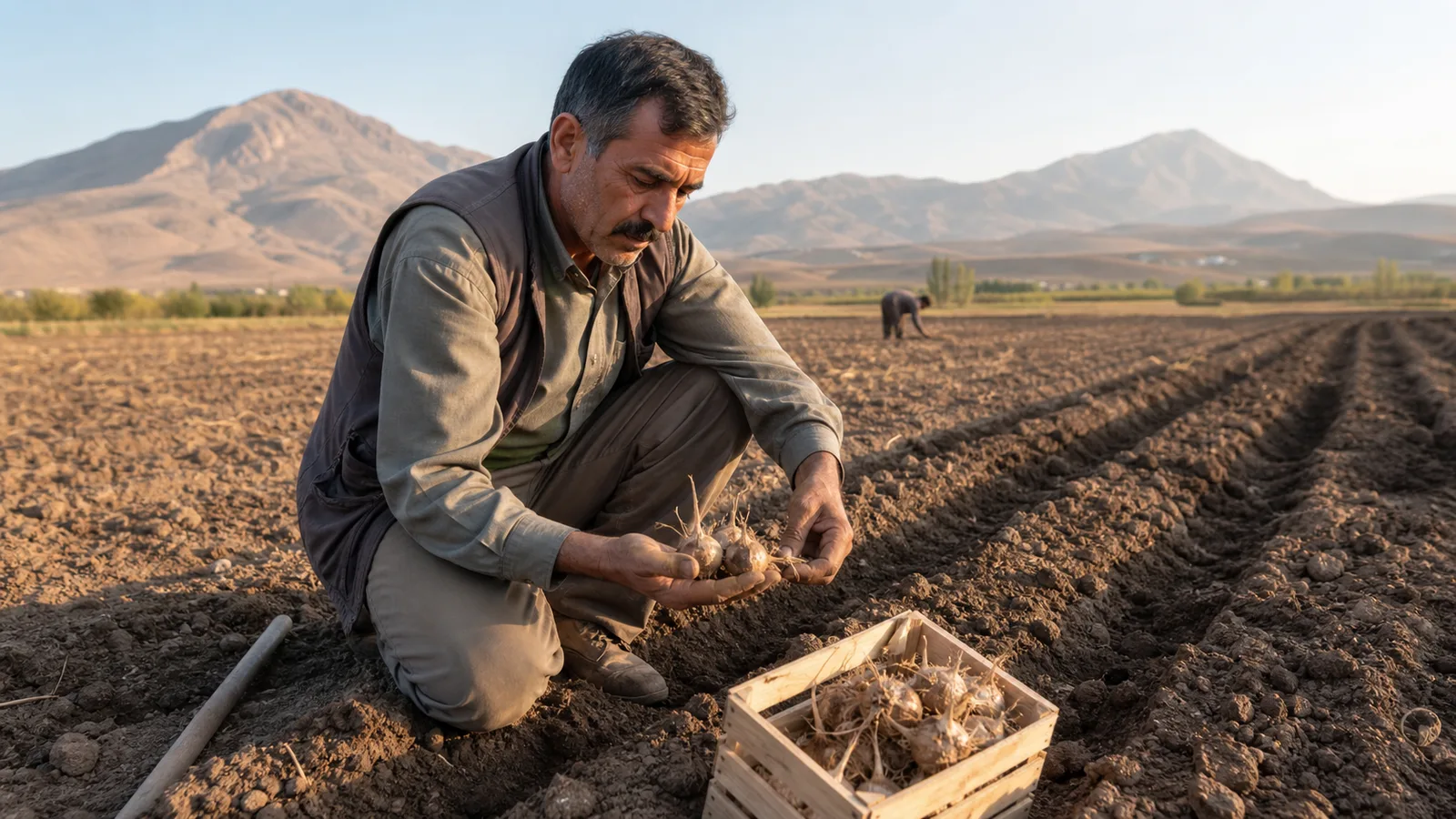
Planting saffron in Hamedan province became part of a broader effort to use dryland farms more carefully and give growers a high-value autumn crop. Archived agricultural reports from the period describe an industry that was still small, but expanding: one report recorded 60 hectares and about 200 kilograms of dried saffron, while a later provincial update put the cultivated area at 63 hectares.
Those figures are historical snapshots, not a statement of Hamedan’s current acreage. They are useful because they show both the opportunity and the practical constraint that shaped the expansion. Hamedan had suitable cold-season conditions, but growers still needed healthy corms, a suitable field, reliable technical advice and a realistic plan for several years of cultivation.
What the Hamedan planting records show
The earlier report, attributed to provincial agriculture official Rahim Bayat, compared two seasons. It recorded roughly 54 hectares producing 178 kilograms in the previous season, followed by about 60 hectares and 200 kilograms. That works out to a little over three kilograms per hectare across the reported area. Officials considered four to five kilograms per hectare possible in suitable fields, but that was a production expectation rather than a guarantee for every farm.
A separate update from Shahram Parvaresh recorded 63 hectares and said the cultivated area had grown from 17 hectares. At that point, Hamedan was described as ranking tenth among the 28 Iranian provinces then reporting saffron cultivation. The same provincial program also promoted Mohammadi rose, another crop considered for its market and processing potential.
The numbers differ slightly because the reports captured different dates and administrative updates. Read together, they describe gradual expansion rather than a single final total.
Why saffron was considered for Hamedan
Saffron’s active growth falls mainly in the cooler part of the year, while the corm remains dormant through much of the hot summer. That seasonal pattern can suit parts of Hamedan, where cold winters and pressure on irrigation water make crop choice important. The Food and Agriculture Organization also describes Iranian saffron as a crop adapted to arid and semi-arid farming systems, while emphasizing the value of local knowledge and water management.
“Low water requirement” should not be read as “no water requirement.” Establishment, flowering and spring corm growth still depend on soil moisture, and the right schedule changes with soil texture, rainfall, elevation and field history. A field also needs good drainage: a location that stays waterlogged around the corms is not made suitable simply because the regional climate is cold and dry.
The corm-supply problem behind slow expansion
The main obstacle in the archived Hamedan report was not enthusiasm for the crop. It was access to planting material. At the time, local production of saffron corms was limited, while movement from the established Khorasan production areas was restricted unless it followed the required licensing and plant-health controls.
The report estimated that establishing one hectare could require roughly three to five tonnes of corms. That made corm quality, transport and price major parts of the investment. It also helps explain why the report said only about five hectares a year were being added across some non-Khorasan provinces.
For a grower, the practical lesson is still sound: the cheapest available corms are not necessarily the least expensive choice over the life of a field. Planting stock should come from a traceable source and be checked for rot, pests, injury and uneven size before it enters clean land. The planting rate and depth should then be set for the field and production plan, not copied from a news estimate.
A Hamedan saffron calendar needs local adjustment
The historical report described September planting, followed by irrigation after planting and another irrigation in October before flowering began in early November. That is a useful account of the program used at the time, but it is not a universal prescription. Rainfall, soil moisture and planting date can change when irrigation is needed.
A sensible establishment plan includes these steps:
- test the soil and confirm that the field drains freely;
- buy sound, traceable corms and keep damaged or diseased material out of the lot;
- prepare a level, weed-controlled seedbed before planting;
- set planting density and depth with local agricultural guidance;
- schedule irrigation from actual soil and weather conditions;
- prepare labour and drying space before the short flowering period begins.
The last step matters because saffron flowers must be collected and the stigmas separated within a narrow harvest window. Good field yield can still lose value if flowers wait too long, handling is unhygienic or drying is uneven.
First-year expectations and the productive life of a field
The source report said growers should not expect a commercial crop in the first year and described harvests continuing for as long as six years. In practice, first-season flowering and the useful life of a saffron plot vary with corm size, planting density, soil health, climate and management. Corms multiply below ground, so crowding and disease pressure can increase as a field ages.
That makes saffron a multi-year decision. Before planting, the budget should cover corms, land preparation, irrigation, hand harvesting, stigma separation, drying and packaging—not only the first crop. Farmers also need a plan for maintaining the plot and eventually lifting, sorting or renewing the corm stock.
What the historical expansion does and does not prove
The rise from roughly 54 to 60–63 hectares showed that planting saffron in Hamedan province was technically possible and attracting interest. It did not prove that every Hamedan field would achieve four or five kilograms per hectare, or that saffron would automatically be more profitable than another crop.
For today’s grower, the archived figures are a starting point rather than a current business forecast. Current corm prices, labour availability, water quality, local licensing, drying capacity and access to buyers should be checked before planting. The strongest plan combines Hamedan’s climatic potential with field-specific agronomy and careful post-harvest handling.
Reference: FAO: Qanat-based Saffron Farming System in Gonabad, Iran. The Hamedan acreage, production and program details above are identified as historical figures preserved from the two original local-news reports consolidated into this article.

![Exporting Saffron to Turkey + Price Guide [Complete 0 to 100]](https://img.rowhanisaffron.com/20260827003933/saffron-export-turkey-quality-inspection.webp)



