


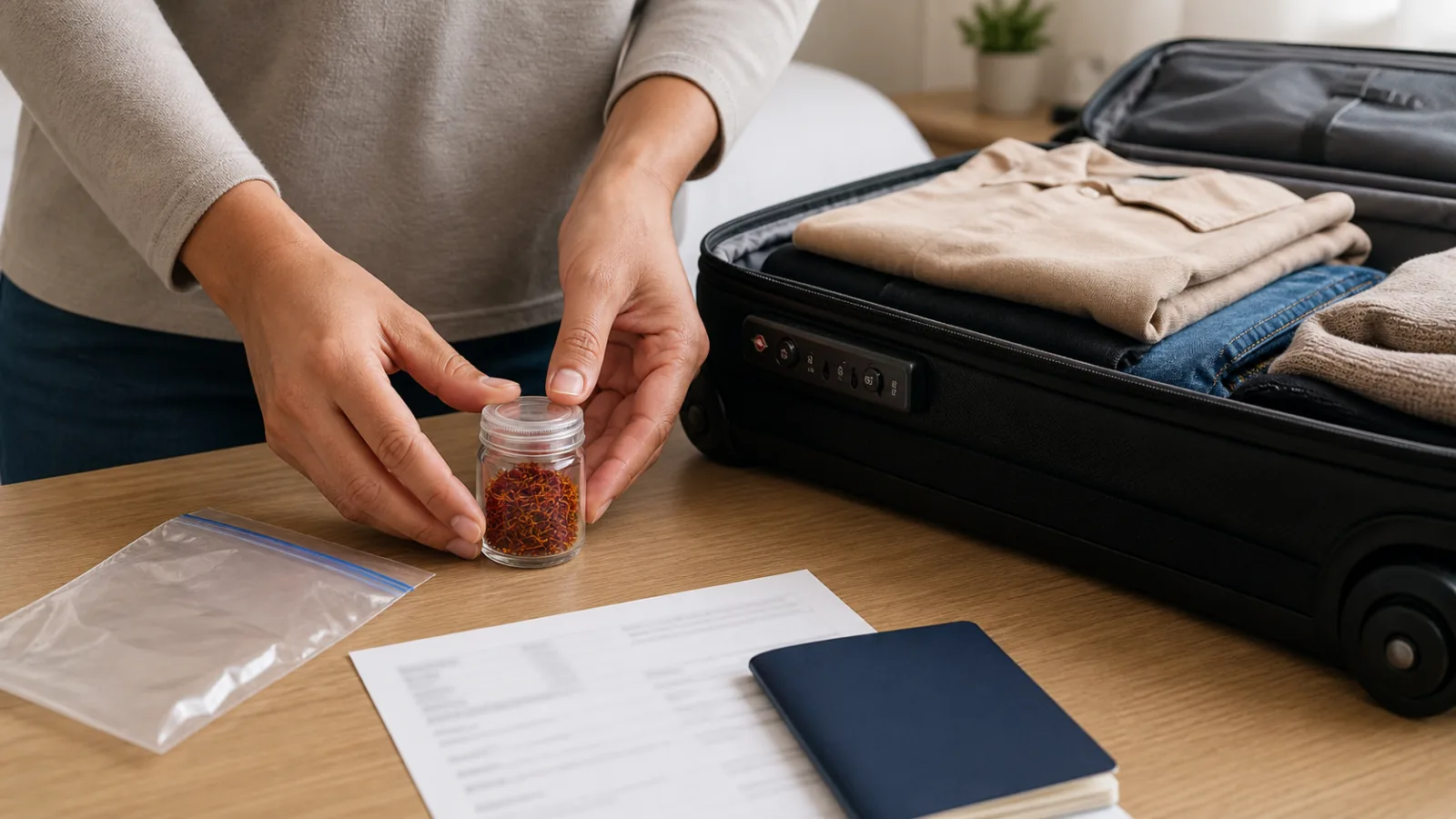
The headline “Saffron is banished to Hajj in Saudi Arabia” preserves a poor translation of an old airport-police warning: for that Hajj operation, Iranian pilgrims were told not to carry saffron to Saudi Arabia. It does not establish that saffron is permanently illegal in Saudi Arabia or on every flight.
Current official Saudi passenger guidance reviewed on 30 August 2026 does not name ordinary culinary saffron in its general list of commonly prohibited passenger goods. That still is not a personal customs clearance. Rules can differ by origin, quantity, packaging, airline, pilgrimage programme and whether goods appear commercial. A traveller should verify the current instructions for the specific trip before packing it.
What the historical Hajj warning actually said
Colonel Hassan Mehri, then identified as Iran’s airport police chief, advised pilgrims not to carry saffron, precious stones, certain medicines or other restricted objects during the Hajj operation covered by the report. The article also named codeine-containing tablets, tramadol and methadone and stressed Saudi Arabia’s strict narcotics laws.
The same warning told passengers not to accept another person’s bag or parcel. That advice remains sensible on any international journey: the named passenger is responsible for what is found in their luggage, even if somebody else packed it.
Mehri said the year’s Hajj flights were due to begin on 14 August and were planned through Imam Khomeini International Airport. He referred to a previous Umrah operation that began on 26 December across 20 flight stations and involved checks connected with 799,000 pilgrims. Those dates and operational numbers are historical.
Is saffron allowed on flights?
Saffron threads are a dry food spice, not an aviation hazard by themselves. The harder question is whether customs and pilgrimage rules allow a traveller to take them into the destination in the proposed amount.
For Saudi Arabia, the current Zakat, Tax and Customs Authority (ZATCA) traveller pages say personal luggage must not contain prohibited or restricted goods and must be personal rather than commercial in character. The authority provides a traveller declaration service and instructs passengers to disclose restricted or declarable items.
ZATCA’s current prohibited-passenger list includes narcotics, weapons, counterfeit currency and various other controlled products. It also addresses unregistered pills, creams, herbs and preparations under Saudi Food and Drug Authority rules. Ordinary saffron spice is not specifically named on that general list. Because a list and a particular border decision are not the same thing, travellers should not use this page as permission to carry an unspecified quantity.
How much saffron can a passenger carry?
No current official Saudi page reviewed for this article states a universal passenger allowance in grams or kilograms for saffron. It would therefore be unsafe to invent one.
A small, sealed amount for personal culinary use presents a different customs profile from dozens of identical packets or several kilograms intended for sale. Customs may consider quantity, value, packaging, origin, labelling and travel frequency when deciding whether goods are genuinely personal. Commercial food imports follow additional requirements.
Before travel, ask the airline, the Hajj or Umrah organiser and ZATCA about the exact product and amount. Keep saffron in its original labelled packaging and retain the purchase invoice. If an officer instructs you to declare it, declare it; if the pilgrimage organiser prohibits it, leave it at home.
Medicine warnings are separate from saffron
The old report places saffron beside codeine, tramadol and methadone, which can make the spice sound narcotic. It is not. They appeared together because the airport police briefing covered several kinds of baggage restriction.
Prescription and controlled medicines require their own check. A medicine allowed in one country may be restricted in another, and brand names do not reliably reveal every active ingredient. Travellers should consult current Saudi health/customs guidance, carry only a legitimate personal supply and bring the required prescription or medical documentation.
Never transfer tablets into an unlabelled container to save space, and do not carry medicine for another passenger. A shop receipt is not a substitute for a prescription where one is required.
Other items in the airport-police briefing
The translated article also mentions toy weapons, gas canisters, sharp items and pickled foods. Some wording is damaged, but the practical distinction is clear: aviation-security restrictions, customs restrictions, food controls and pilgrimage-operator rules are different systems. Passing airport security does not guarantee customs entry, and customs eligibility does not override an airline’s cabin-baggage rules.
Mehri stated that a pilgrim found in Iran with even one gram of opium could be stopped from travelling and face a multi-year pilgrimage ban. The article reported no Saudi narcotics arrest among pilgrims during the earlier Umrah operation because passengers carrying drugs had been intercepted before departure. These are historical enforcement claims, not current penalty advice.
Why the report mentioned 48 kilograms of saffron
The airport police chief also listed goods seized as smuggling cases during the year. These included 48 kilograms of saffron valued in the report at 1.9 billion rials, alongside mobile devices, gold and coins, foreign currency, clothing, bags, watches and glasses.
A 48-kilogram seizure is commercial-scale evidence; it does not define the limit for one pilgrim. Nor does it prove that every saffron package was forbidden for the same reason. Quantity, declaration, documentation and export rules may all have been relevant, but the translated report does not provide the individual case files.
A safe pre-flight checklist for saffron
- Check the current Saudi customs handbook for travellers and prohibited/restricted lists.
- Ask the airline and pilgrimage organiser whether their Hajj baggage instructions are stricter.
- State the exact form, quantity, value, country of origin and purpose when asking.
- Use sealed, accurately labelled packaging and keep the invoice.
- Do not carry another person’s food, medicine, parcel or suitcase.
- When uncertain, declare the item or leave it behind.
What travellers should take from the old headline
The old police briefing is evidence that saffron was prohibited for a particular Iranian Hajj operation and that enforcement included a large saffron seizure. It is not evidence that saffron remains generally illegal in Saudi Arabia today.
For anyone asking “is saffron allowed in flights?”, the reliable answer has two parts: the spice is not inherently barred from aircraft, but destination customs and programme rules decide whether your package is permitted. Check the official rules close to departure and use the exact trip details. That is safer than relying on either a 2018 headline or an undated answer online.

![Exporting Saffron to Turkey + Price Guide [Complete 0 to 100]](https://img.rowhanisaffron.com/20260827003933/saffron-export-turkey-quality-inspection.webp)



