


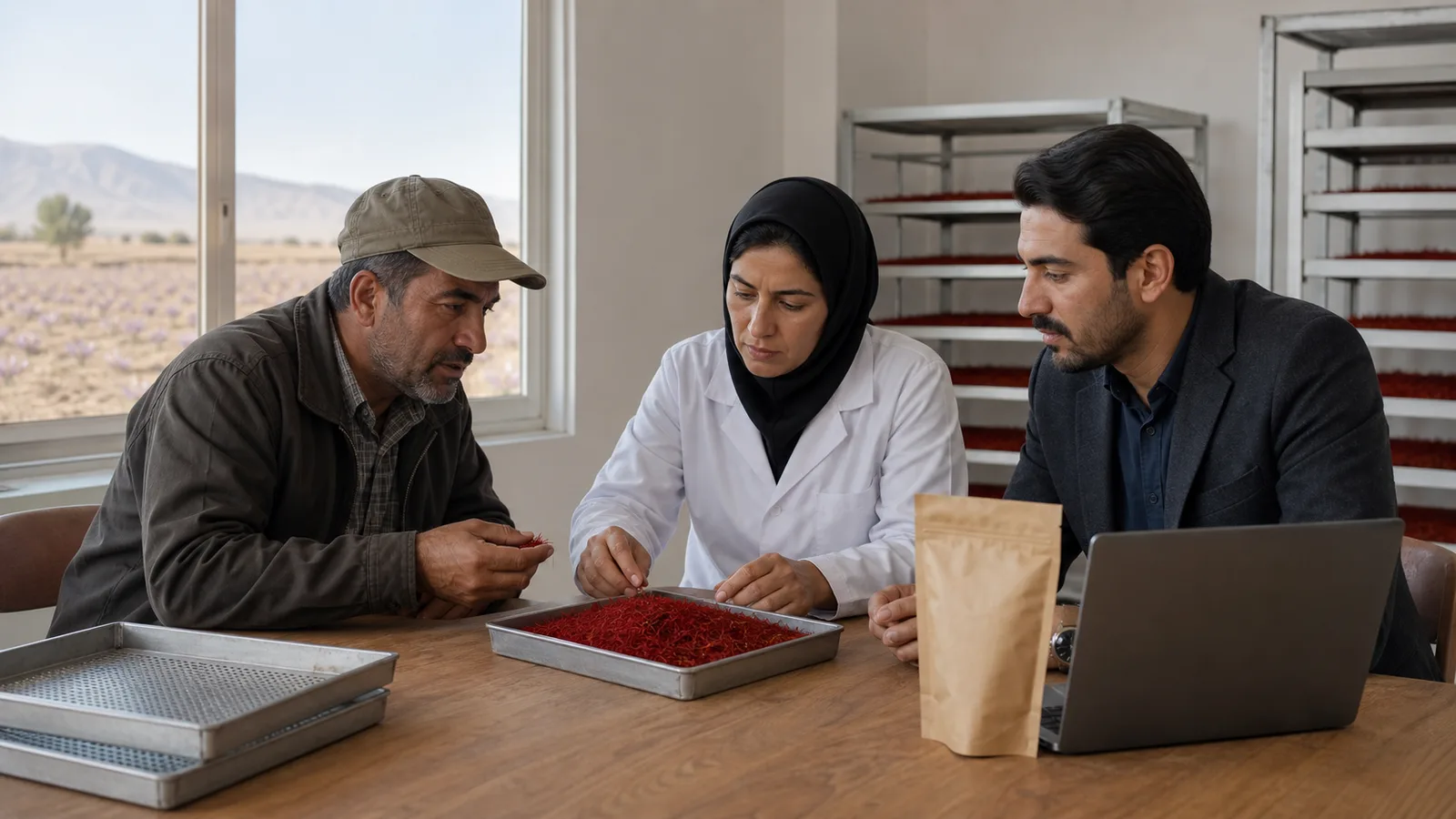
Is any change in saffron status in Khorasan Razavi? The question came from a speech at the third national conference on saffron research in Mashhad. Abbas Rajaee, then chair of parliament’s Agriculture Committee, argued that a higher price alone would not strengthen the sector. He called for scientific production, better water management, cooperation across the supply chain, processing and stronger brands.
That intervention was made years ago, so its budget and trade figures are historical claims, not current statistics. The structural questions are still useful: who carries the production risk, how is quality documented, where is value added, and can growers, processors and traders work from the same plan?
The conference argument: farmers were not being heard
The event was held at the Khorasan Razavi Chamber of Commerce, Industries, Mines and Agriculture. Rajaee opened by saying agriculture was treated unfairly and that farmers’ voices were difficult to hear in policy decisions.
He used several large figures to support that case. The surviving translation reported fixed agricultural capital of more than 100,000 trillion tomans, said over 60% of Iranians derived a living from the sector, and claimed only 8% of the province’s budget went to agriculture. It also attributed a threefold return to each rial invested.
Those figures are reproduced as statements from the speech. The imported article did not provide a budget document, statistical year or calculation, and the fixed-capital number may have been distorted in translation. It would be unsafe to quote any of them as a verified current measure.
Agriculture, water and an oil-dependent economy
Rajaee presented agriculture as a route to a less oil-dependent economy. He objected to what he called “agriculture-phobia”: assigning every water problem to farming while ignoring management failures. He also referred to agricultural imports worth 36 trillion tomans and argued that investing the same scale of money across three years could reduce import dependence.
His larger point was that national food and crop policy had to cover all of Iran rather than rely mainly on northern and western border regions. Strategic products such as wheat, region-specific crops and high-value products required different policy treatment. He placed saffron in the high-value category that merited protection and development.
A modern reading needs balance. Agriculture accounts for a major share of water use in Iran, and management choices do matter. Improving farm efficiency cannot be separated from basin limits, groundwater condition, crop selection and what happens to water saved. Saffron’s lower irrigation demand relative to many crops is an advantage, not permission to expand without a water budget.
What the irrigation and compact-production examples meant
The speech described a subsurface-irrigation project for Khorasan Razavi and South Khorasan and attached a figure of 95% efficiency. Without the project specification, that number cannot be treated as a measured saving or a result that every saffron farm could reproduce. Irrigation efficiency depends on design, pressure, filtration, soil, salinity, maintenance and scheduling.
The old English text then merged this with a second compact-production example: a 600-square-metre unit said to produce fortified feed for 1,000 cattle. It later called the concept a “single” greenhouse and appeared to apply it to shortening saffron production time. These passages are too garbled to support a technical recommendation for greenhouse or soilless saffron.
Protected cultivation can control temperature and timing, but that does not automatically reduce total water, energy or cost. A field or greenhouse system should be assessed through measured yield, corm replacement, energy, cooling, labour, food safety and marketable quality rather than a headline efficiency percentage.
Why price rises are not a complete policy
Rajaee warned that simply pushing the saffron price upward could make production more attractive to competitors and create more incentive for counterfeit goods. He named China and India as countries considering expansion and said pricing should rest on a scientific view of costs and comparative advantage.
A healthy farm-gate price is essential, but a durable market needs more than scarcity. Buyers also compare quality consistency, delivery, traceability, testing, packaging and the risk of fraud. If a higher price is unsupported by those features, competing origins or substitute products have room to enter.
Price volatility creates a separate problem. A grower makes planting and field-care decisions well before knowing the final harvest price. Transparent lot trading, credible grades, storage options and contracts can reduce some uncertainty; none can remove weather, demand or currency risk.
The three links in the saffron chain
The speech identified three groups that needed to work together: producers, converters or processors, and traders. Rajaee described their internal competition as negative and called for a coherent organisation instead.
That idea is more useful when translated into responsibilities:
- Growers manage corm health, field inputs, harvest hygiene and the first lot identity.
- Processors control separation, drying, sorting, testing, storage and any food or cosmetic transformation.
- Traders and brands preserve documentation, match specifications to buyers and make only claims the lot can support.
If one link loses the harvest record or mixes material without control, the next link cannot reconstruct origin and quality later. Coordination therefore begins with shared data, not a slogan or a single umbrella label.
Cooperation without taking ownership away from farmers
Rajaee described production as fragmented and proposed cooperative organisation: integrate management while keeping ownership separate. Small farms can remain independently owned while sharing services that are expensive or inconsistent at individual scale.
A functioning cooperative might coordinate:
- healthy corm procurement and plant-health controls;
- soil, water and residue testing;
- harvest labour and clean separation rooms;
- standardised drying and calibrated equipment;
- lot coding, storage and laboratory sampling;
- buyer specifications, contracts and export documentation; and
- the sale or processing of petals and other by-products where safe and lawful.
FAO’s recent work with Iran on the saffron value chain brings the same participants together—farmers, processors, cooperatives, traders and technical experts—with emphasis on post-harvest management, safety, traceability, marketing and quality integrity.
Processing and branding: where the speech wanted change
The conference speech urged Iran to move beyond bulk saffron and develop products for food, pharmaceutical, health and other conversion industries. It associated those industries with very large potential revenue. That possibility should not be turned into an automatic market forecast: every product needs its own evidence, regulation, formulation, manufacturing controls and demand.
Processing adds value only when the output is safe, compliant and wanted. A weak extract or decorative pack does not become more valuable simply because it contains saffron. The best starting point is a documented raw lot whose moisture, purity, grade and origin can be followed into the finished product.
Rajaee also criticised the lack of large agricultural brands and called for producers to enter global markets under stronger identities. A brand can reduce fragmentation, but only if it becomes a reliable promise. Consistent specifications, honest origin, responsive service and traceable batches matter more than the size of the logo.
So, has the status changed?
The old speech did not provide a scorecard, and this page should not pretend that one conference settled Khorasan Razavi’s saffron policy. It did identify a practical agenda: invest with evidence, measure water honestly, coordinate the three parts of the chain, protect farmers’ interests, process only where value is real and build brands on verifiable quality.
Change can be measured at lot and institution level. Are growers paid against a transparent specification? Can a buyer trace the pack to its harvest? Do processors reduce contamination and preserve aroma? Does irrigation reporting include actual water and yield? Can a cooperative negotiate without hiding costs from members?
Those answers reveal more about the status of saffron in Khorasan Razavi than a price rise by itself. Scientific production and a connected value chain were Rajaee’s central message, and they remain the standard against which any claimed improvement should be tested.
Sources and context
- All statements and historical figures attributed to Abbas Rajaee are preserved from the Mehr conference report originally stored on this URL; unsupported figures are explicitly bounded.
- FAO and Iran: innovation and quality integrity in the saffron value chain.
- FAO AGRIS record: processing, branding, fraud and cooperative factors in Iranian saffron value.

![Exporting Saffron to Turkey + Price Guide [Complete 0 to 100]](https://img.rowhanisaffron.com/20260827003933/saffron-export-turkey-quality-inspection.webp)



