


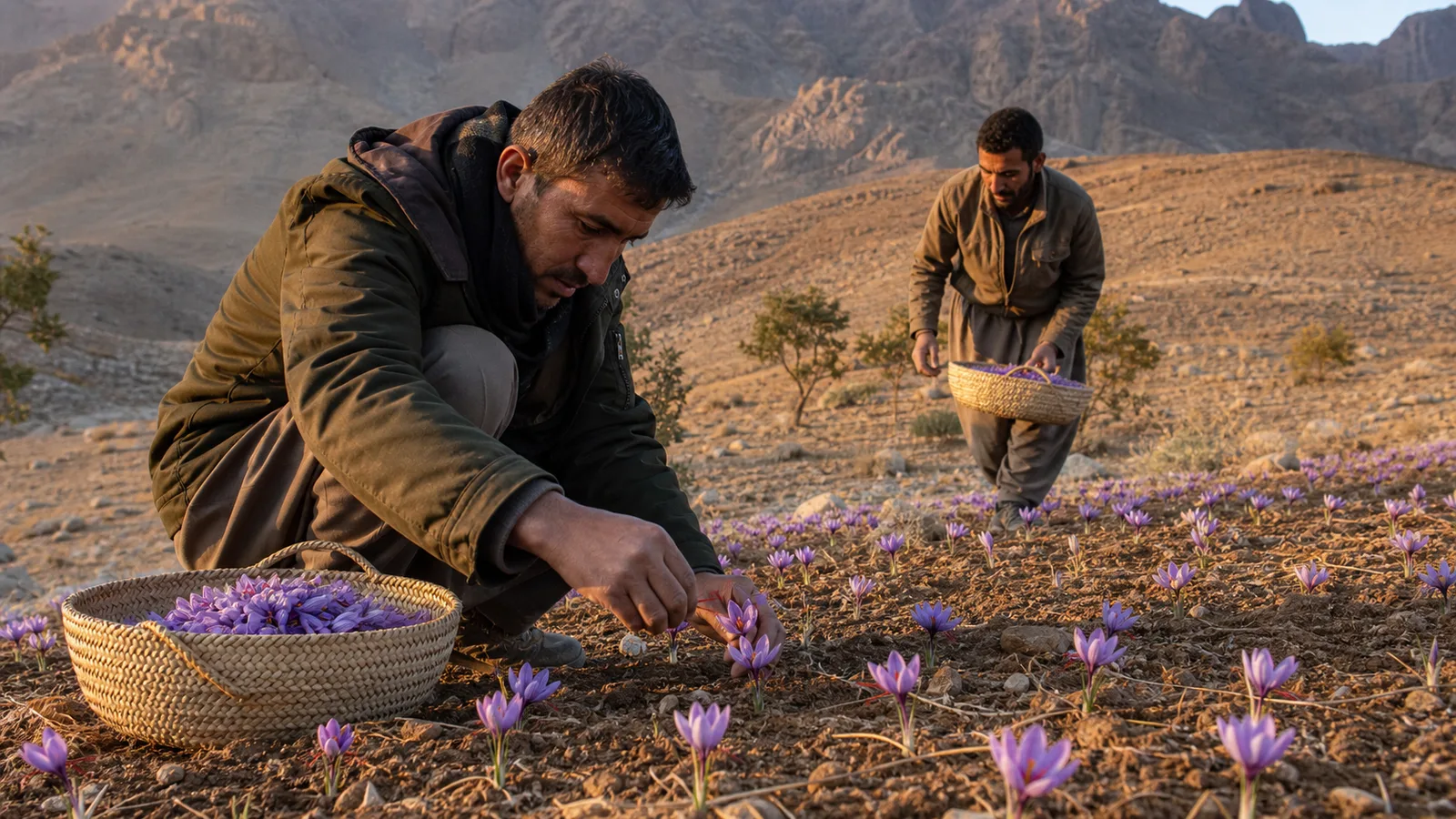
A 2018 report about the Jiroft saffron harvest described a small expansion in Jabal Barez, the higher-elevation part of the county. Local official Ali Salari said five tonnes of saffron corms had been distributed, adding about three hectares and bringing the reported planted area to five hectares. He forecast a 20-kilogram harvest and said flower picking would continue until the middle of the Iranian month of Azar.
Those numbers described a promotion programme and a forecast, not a verified harvest result. The distinction is important because Jiroft contains very different climates. A field in the Jabal Barez highlands cannot be used to claim that saffron will perform the same way in the county’s warmer southern areas.
What the original Jiroft report established
The short article was attributed to the Young Journalists Club’s Kerman provincial desk. It quoted Ali Salari saying that Jabal Barez was suitable for saffron and that farmers might benefit economically by introducing the crop. Its factual sequence was:
- five tonnes of saffron planting corms were distributed during the year;
- the distribution added about three hectares of cultivation;
- the county’s reported saffron area then totalled five hectares;
- a harvest of 20 kilograms was forecast;
- picking in Jabal Barez was expected to continue until mid-Azar.
The machine translation called the planting material “scallops” or bulbs. Saffron is propagated with corms: compact underground storage stems that produce replacement corms as the planting matures. It also shifted the forecast from the county to the province in one sentence. The Persian context named Jiroft county.
A forecast is not a measured yield
If the predicted 20 kilograms referred to the full five hectares, it implied roughly four kilograms of dried saffron per hectare. That calculation helps interpret the announcement, but it still does not prove that the farms produced that amount. A measured yield requires the harvested dry stigma weight and the area actually bearing flowers, not only the area planted.
New saffron fields also change as they establish and produce daughter corms. Comparing one season with an older plot can be misleading unless planting age, corm density, corm size, irrigation, soil, weather and harvested area are recorded. The original news item supplied none of those details.
Why the Jabal Barez location matters
Jiroft is often associated with a warm southern agricultural plain, but the county rises toward mountain and foothill environments. Jabal Barez therefore needs to be assessed on its own elevation, temperature, frost pattern and soil conditions.
A 2022 climatic-zoning study of Kerman Province examined altitude, slope, frost, rainfall and temperature data. It found more favourable saffron zones in several foothill areas, while identifying southern parts of Jiroft as unfavourable. That later research does not verify the 2018 harvest, but it supports the article’s central geographic lesson: suitability is local, and “Jiroft” is too broad to function as a planting recommendation.
Provincial context is also useful. An Iranian agriculture-ministry table submitted to Codex reported 681 hectares of saffron and 2.632 tonnes of production across Kerman Province in 2014–2015. Jiroft’s five hectares were therefore a small trial within an established but much smaller industry than Khorasan’s.
What farmers should verify before expanding
A corm-distribution programme can lower the first barrier to planting, but it does not make the crop profitable by itself. Before increasing the area, a grower needs field evidence for:
- healthy, correctly identified corms of a known size and source;
- well-drained soil without a history of serious corm disease;
- local temperature conditions that support flower initiation and emergence;
- water quality and an irrigation schedule suited to the crop’s growth cycle;
- available labour during the short flower-picking and stigma-separation period;
- clean drying, storage and a realistic route to market;
- multi-year records of dried stigma yield, costs and sale price.
Small trial plots are valuable because they expose problems before a farmer commits a large area. Our guide to planting saffron explains the practical corm, soil, spacing and irrigation decisions in more detail.
How the saffron harvest proceeds
When flowering begins, open and nearly open blooms are collected by hand, usually early in the day. Flowers should be held in shallow, clean containers and moved promptly to the separation area rather than compressed in deep piles.
Processors then open each flower and remove its three red stigmas. The stigmas are dried under controlled conditions and protected from contamination, moisture and excessive light. The weight drops dramatically between fresh flowers and the finished spice, which is why a field can look abundant while producing a comparatively small dry harvest.
The report’s reference to mid-Azar—roughly late November to early December—was a local end point for that season. Flowering dates shift with elevation, weather and irrigation. It should not be converted into a fixed calendar rule for every Jiroft field.
Did the programme prove an economic alternative?
Salari presented saffron as a crop farmers could introduce for economic benefit. The announcement established public support through corm distribution and a planned harvest. It did not publish production costs, labour hours, dry yield by plot, quality-test results, buyer prices or net income.
A fair later assessment would compare several seasons of those records with the crops saffron was intended to replace. It would also separate revenue from profit and count the labour required to pick flowers and remove stigmas. Without that evidence, “economically beneficial” remains the programme’s aim rather than its demonstrated result.
The 2018 Jabal Barez project is still a useful example of how saffron cultivation can spread beyond its traditional centres: begin with a limited area, match the site rather than the county name, record actual dried yield and expand only after the local evidence supports it.
Sources reviewed: the Young Journalists Club/Kerman report cited by the original post; the 2022 Land Management Journal climatic-zoning study indexed by FAO AGRIS; and Iran’s Ministry of Agriculture-Jahad figures reproduced in Codex document CX/SCH 17/3/12.

![Exporting Saffron to Turkey + Price Guide [Complete 0 to 100]](https://img.rowhanisaffron.com/20260827003933/saffron-export-turkey-quality-inspection.webp)



