


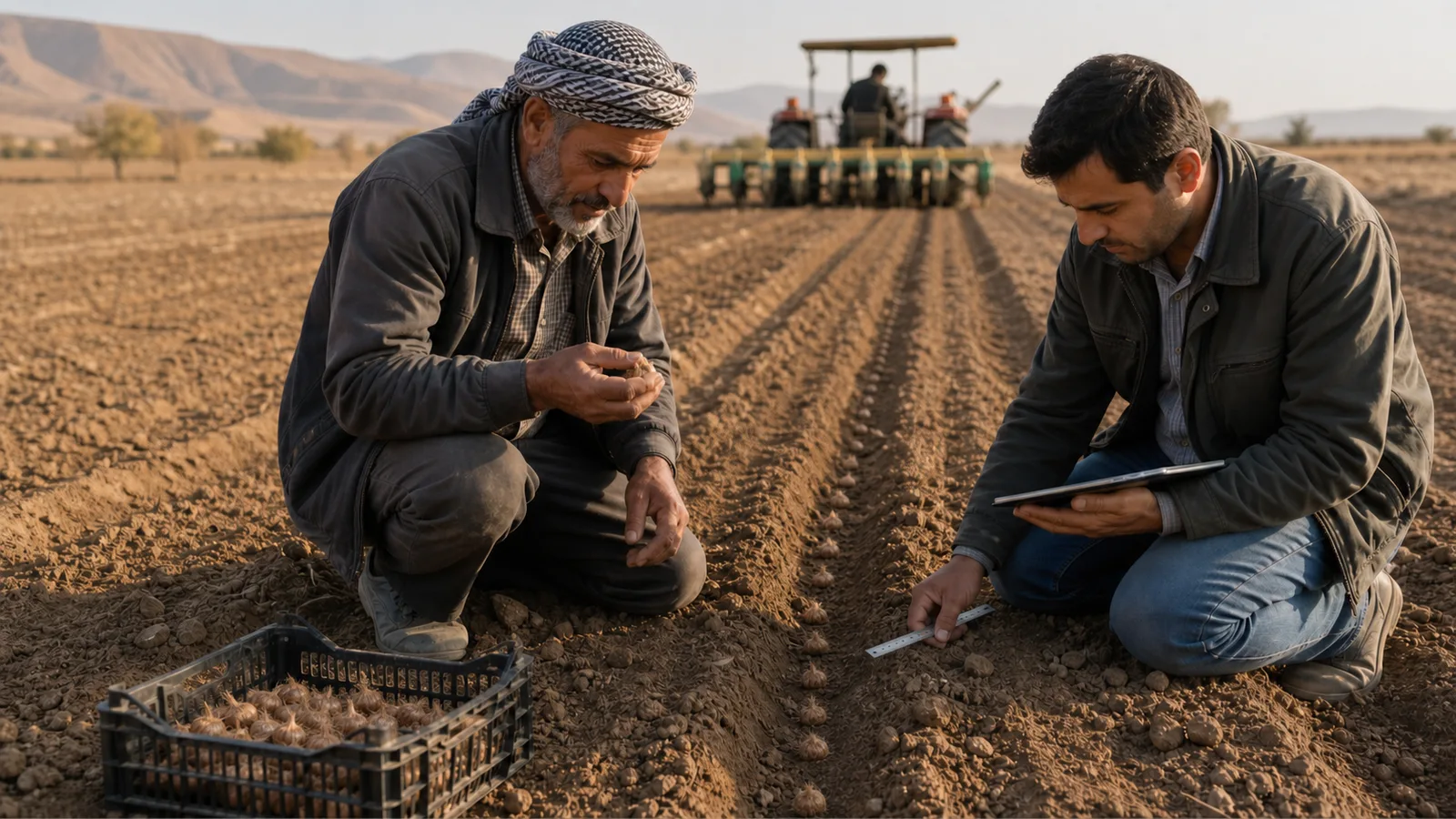
The real difference between traditional and modern saffron planting is not hand labour versus machines. A traditional field can be carefully managed, and a mechanised field can still fail. The modern approach makes each decision measurable: it tests the site, grades healthy corms, sets a repeatable density and depth, matches the planted area to available water and keeps records across several harvests.
The original version of this article did not make that comparison. It quoted Razavi Khorasan horticulture official Hashem Naghibi on water limits and provincial production. His central warning remains sound: do not expand the saffron area beyond the water available for complete, timely irrigation. This guide places that historical advice inside the practical planting decisions a grower can control.
Traditional planting is knowledge built around a place
Traditional saffron systems developed through repeated observation of local soil, autumn temperatures, irrigation turns and family labour. Corms may be placed by hand in pits, trenches or beds, with spacing judged by experience. Hand planting allows a worker to reject a damaged corm and adjust around stones or uneven ground.
Its weakness appears when decisions are not recorded. If corm sizes are mixed, planting depth changes from worker to worker and density is estimated by the sack, it becomes difficult to explain why one plot flowers better than another. Labour needs also rise sharply as the field expands.
Modern practice should preserve the farmer’s local knowledge while adding measurements that another worker can repeat. It does not need to erase a successful layout merely because that layout is old.
Modern planting begins before the field
A modern plan starts with the site rather than the machine. Saffron remains in the same ground for several years, so drainage, soil condition, weeds, salinity, water quality and disease history matter long after planting day. A grower should map areas that stay wet, compacted or uneven and correct them—or leave them unplanted—before valuable corms go into the soil.
The next control is planting material. Corms should be correctly identified, firm and free from obvious rot, wounds and pests. They can be sorted into size classes so neighbouring rows begin with more comparable planting material. Research indexed by FAO AGRIS has repeatedly found that corm weight and planting density affect flower and stigma yield, although the best commercial choice still depends on local conditions, corm cost and the planned life of the field.
Rows, spacing and planting depth
Traditional pit or clump planting can create dense groups with large gaps between them. A measured row system distributes corms more consistently and makes later irrigation, weeding, sampling and mechanical access easier. “Modern,” however, does not mean there is one universal spacing number.
An Iranian meta-analysis of agronomic studies found useful ranges around 50–100 corms per square metre, corm weights of 10–20 grams and planting depths of 15–20 centimetres, while also identifying strong variation by field age and region. Those findings are a research reference, not a prescription for every soil. Heavy soil, frost, machinery, water delivery and the intended field life can all change the practical design.
The important improvement is to specify the plan before work begins: row distance, within-row distance, depth target, corm size class and acceptable deviation. Check the first several metres with a ruler and digging tool, then check again whenever workers, soil or equipment change.
Where mechanised planting helps
Hand placement is flexible but slow. A corm planter can open furrows, meter planting material and cover several rows in one pass. A 2021 Iranian planter study tested a seven-row machine with 25–30 cm row spacing. At one tested speed, it achieved 90% distribution uniformity around the set distance and an effective field capacity of 0.66 hectares per hour.
Those figures describe one machine under study conditions. They do not prove that mechanisation always raises yield or lowers total cost. A planter must be calibrated for the actual corm size and density, and the operator must watch for missed drops, doubles, corm damage and changes in depth. Poor calibration simply makes inconsistency faster.
Small or irregular fields may still suit careful hand planting. Larger, prepared fields with suitable access are more likely to benefit from a planter. The right comparison includes labour, fuel, equipment cost, corm injury, uniformity and the value of completing the work at the intended time.
Irrigation capacity sets the field size
Naghibi’s warning addressed a common expansion error: calculating how many hectares can be planted without confirming how many can be irrigated properly when the crop needs water. Saffron is associated with dry regions and uses water differently from many summer crops, but “low water use” does not mean “no water requirement.”
A modern water plan records the source, available volume, salinity, application method, field uniformity and timing for each irrigation. It also allows for competing farm and household needs. Increasing the planted area while delaying or unevenly applying critical irrigations can reduce the value of the entire investment.
What the historical Razavi Khorasan figures meant
In the report cited by the old post, Naghibi said more than 80% of Iran’s saffron cultivation and production occurred in Razavi Khorasan. For the preceding year he reported:
- 75,000 hectares under saffron, up by more than 5,000 hectares;
- 280 tonnes harvested;
- a 28.8% increase in production compared with the previous year;
- 117,000 households engaged in saffron cultivation;
- an average yield of about four kilograms per hectare.
These are historical provincial statements attributed to the Razavi Khorasan Agriculture-Jahad organisation, not current statistics. Dividing 280 tonnes by 75,000 hectares gives about 3.7 kg per hectare, broadly consistent with the rounded four-kilogram figure. The numbers illustrate scale and why uncontrolled expansion concerned officials; they do not tell an individual grower which method will be profitable.
Modern management continues after planting
A field becomes evidence only when it is measured. Assign each plot an identifier and record corm source, size, planting date, density, depth, soil amendments, irrigation, weed and disease observations, flower count, fresh flower weight and dried stigma yield. Keep labour and input costs with the same plot record.
During harvest, record the actual bearing area rather than the whole farm boundary. During drying, link the finished lot back to its field and harvest date. That traceability helps diagnose quality differences and prevents an attractive total production figure from hiding a weak per-hectare result.
Which method should a grower choose?
Choose the least complex method that can meet the field’s quality and timing requirements consistently. Hand planting remains reasonable for a small plot, difficult terrain or a trial where each corm is inspected and placed carefully. Mechanised planting becomes attractive when the land is prepared, the corms can be graded, the machine can be calibrated and labour or planting time is a constraint.
The most useful approach is often a combination: local experience for site and seasonal judgement, research for density and depth ranges, simple measurement tools for quality control, and machinery where it removes a genuine bottleneck. For the full sequence from site selection through harvest, see how to plant saffron.
Modern saffron planting is not a promise of higher yield. It is a system that makes the outcome explainable. When water, corms, layout, work quality and harvest are recorded, a farmer can improve the next field without discarding the traditional knowledge that already works.
Sources reviewed: the Young Journalists Club/Razavi Khorasan report cited by the original post; the Iranian meta-analysis of saffron agronomic practices indexed by FAO AGRIS; the 2021 University of Tehran corm-planter study; and related corm-weight/density research indexed by AGRIS.

![Exporting Saffron to Turkey + Price Guide [Complete 0 to 100]](https://img.rowhanisaffron.com/20260827003933/saffron-export-turkey-quality-inspection.webp)



