


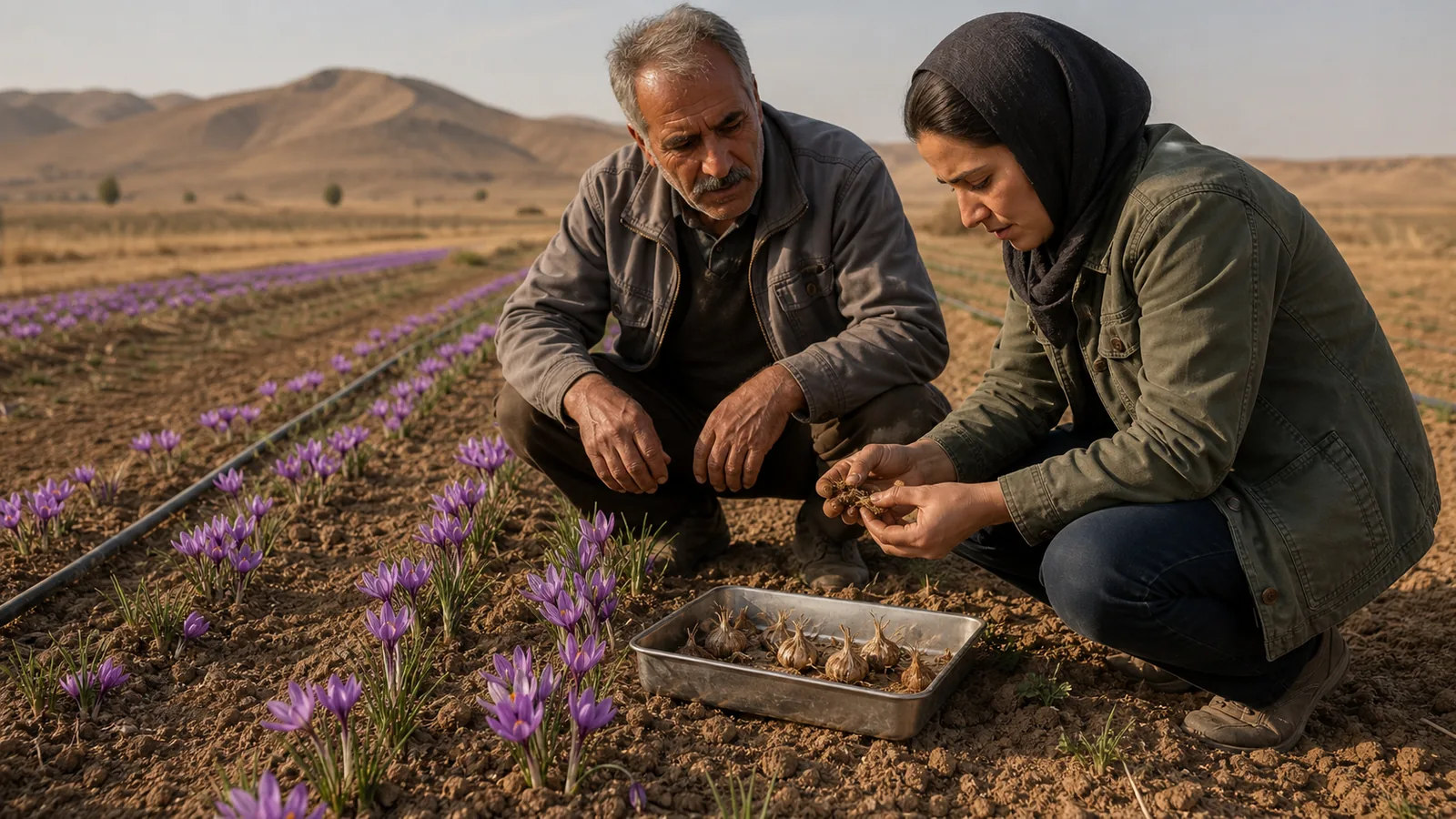
The best conditions for organic Iranian saffron begin with the same essentials as any healthy saffron crop: a site that drains quickly, sound corms, enough light, well-timed water and a climate that lets the plant grow through its cool season. The word “organic” adds a separate requirement. It describes a verified production system, not a special saffron variety and not a claim that a dry field has never encountered a pesticide.
That distinction matters for growers and buyers. Good soil and careful cultivation can produce excellent saffron, but a product should be sold as certified organic only when the farm and handling chain meet the rules of the destination market.
What saffron needs from the site
Crocus sativus follows an unusual calendar. The corm is dormant through much of the warm season, flowers in autumn and develops leaves and replacement corms during the cooler months. This is why many established production areas have dry summers and cool winters. Khorasan’s arid and semi-arid landscapes are a well-known example, but climate labels alone do not decide whether a field will work.
The most important physical test is drainage. Standing water deprives the corm of oxygen and creates conditions in which rot can spread. The University of Vermont’s saffron planting guidance recommends light- to medium-textured soil, relatively high organic matter and a well-drained site. A heavy soil is not automatically unusable, but its structure, slope and drainage have to be corrected before valuable corms go into it.
The old version of this article described a mixture of sand, clay and lime and gave pH 7 to 8 as the ideal range. Those figures reflect one familiar production setting, not a universal formula. Saffron tolerates a range of soils. A laboratory soil test is more useful than copying one recipe because it shows texture, pH, salinity, organic matter and nutrient status in the actual field.
Sunlight, altitude and temperature are connected
An open, sunny position helps the leaves build reserves for the next generation of corms. The old article called eleven hours of daylight the best condition. Day length changes with latitude and season, so eleven hours should not be used as a pass-or-fail rule. What the field needs is good solar exposure without persistent shade from buildings, trees or an unsuitable aspect.
Altitude is also a proxy rather than a target by itself. The earlier text recommended 1,300 to 2,300 metres and suggested that sites below 2,000 metres produce fewer flowers. Elevation influences temperature, frost dates and water loss, but successful cultivation also occurs outside that band. A grower should compare the field’s autumn temperatures, winter extremes, drainage and flowering weather—not reject a site because one number falls outside a historical Khorasan range.
Established corms can survive substantial cold when soil conditions and dormancy are suitable. The old claim of resistance to minus 20°C may describe observations under particular conditions; it is not a guarantee for every corm, soil or cold event. Freezing rain or hard frost during flowering can damage exposed flowers even when the underground corm survives.
The opposite extreme can be troublesome too. Very hot, humid conditions can increase disease pressure and disrupt the cool-season growth cycle. The original article therefore treated humid northern Iran and hot Khuzestan as impossible or unsuitable. That conclusion is too absolute. Local trials, soil drainage, water quality, temperature records and disease history are better evidence. A sunny site protected from damaging wind may help, but shelter must not trap stagnant humid air.
Rainfall totals do not replace a water plan
The old guidance named annual rainfall of 300 to 400 millimetres. A yearly total cannot show when the rain arrives, how quickly the soil drains or how much water the crop can actually use. Two places with the same total may offer very different conditions.
Saffron is associated with water-scarce regions because irrigation can be concentrated around important growth stages. FAO’s profile of the qanat-based saffron system in Gonabad shows how growers matched a reliable, limited water source to an arid landscape. Low water demand does not mean no water, and it does not justify one calendar for every field.
In many Iranian systems, the first autumn irrigation helps initiate the flowering sequence. The old article reported flowering about 15 to 20 days after that irrigation, followed by a two- to three-week bloom period. These are useful planning observations, not fixed biological deadlines. Soil temperature, corm size, location, weather and irrigation timing can shift both intervals.
The practical rule is to keep records. Note the irrigation date, soil moisture, first emergence, peak flowering, leaf growth and weather. Those records turn a general recommendation into a field-specific schedule. Water should reach the active root zone without leaving the corm bed saturated.
Organic fertility starts with a soil test
The previous article advised 15 to 22 tonnes of animal manure per hectare before planting, followed by two fertiliser applications of about 50 kilograms per hectare, including phosphorus. Applying those numbers without testing would be poor practice. Manure composition varies, phosphorus can accumulate, and neither a nutrient source nor a rate becomes suitable merely because it is described as natural.
Under the USDA organic crop standard, growers manage fertility through cultivation, crop rotations, cover crops, plant and animal materials and permitted inputs. The standard also requires protection of soil and water. USDA guidance on compost and vermicompost explains that raw manure, composted materials and uncomposted plant materials do not all have the same handling requirements.
A sensible programme begins with soil and, where appropriate, manure or compost analysis. It accounts for the nutrients already present, the previous crop and the expected removal from flowers and daughter corms. Compost can improve organic matter and structure, but the grower must use a source and process accepted by the certifier. A familiar farm input may still be prohibited, contaminated or applied incorrectly.
Healthy corms matter for several seasons
Saffron is propagated by corms rather than commercial seed. The old article described the planting material as “bulbs” with a field life of five to seven years. Corm is the more accurate botanical term. A planting may remain in place for several seasons, but the useful interval depends on spacing, daughter-corm crowding, disease, soil condition and the grower’s production plan.
Start with firm, healthy, correctly identified corms from a traceable source. Keep lots separate and record where each one is planted. Crowding can eventually reduce the space and resources available to each new corm, while moving infected material can carry a problem into clean ground. Our overview of saffron farming operations follows those decisions from field preparation through drying and storage.
Organic management does not mean waiting for pests or rot to become severe. It relies heavily on prevention: clean planting material, drainage, rotation, sanitation, balanced fertility, monitoring and timely removal of affected material where appropriate. Any treatment has to comply with the farm’s applicable organic standard and approved organic system plan.
How organic Iranian saffron is verified
A field’s appearance cannot prove organic status. In the United States, the USDA Organic Standards describe organic as a labelling term for food produced under approved methods and verified by an accredited certifying agent. The crop standard generally requires three years without prohibited substances before an organic harvest, along with an organic system plan, records and inspections.
Rules are market-specific. For an Iranian product sold as organic in the European Union, the European Commission’s organic-import guidance says the product must meet EU organic legislation and arrive through the recognised control system with the appropriate electronic certificate of inspection. A certificate number, issuing control body, scope, operator and lot trail are more meaningful than green packaging or a general claim about traditional farming.
Organic integrity continues after harvest. Flowers, stigmas and dried saffron have to be kept from commingling with conventional material or contacting prohibited substances during separation, drying, storage, transport and packing. Records should connect the finished lot to the certified operation and handling steps. Our article on organic Iranian saffron exports explains why destination-market documents matter alongside the farm method.
A field checklist before planting
- Study several years of temperature, rainfall and frost data, with special attention to autumn flowering.
- Dig inspection pits after rain or irrigation and confirm that the intended corm zone drains promptly.
- Test soil for pH, salinity, organic matter and nutrients instead of importing one fertiliser formula.
- Confirm that the site receives useful seasonal sunlight and is not exposed to damaging waterlogging or stagnant humidity.
- Buy healthy, traceable corms and document each lot.
- Write the organic system plan with the certifier before using inputs, not after harvest.
- Plan separate, recorded handling from flower collection through the final pack.
The best organic saffron field is therefore not defined by one altitude, one rainfall total or one manure rate. It is a well-understood site managed with evidence, clean planting material and records that survive inspection. Khorasan offers generations of practical knowledge, while certification supplies the proof that lets a buyer distinguish an organic product from an unsupported claim.
Agronomy and organic-market requirements reviewed 28 August 2026. Growers should use local soil and climate evidence and confirm every input and certification step with the relevant accredited control body.

![Exporting Saffron to Turkey + Price Guide [Complete 0 to 100]](https://img.rowhanisaffron.com/20260827003933/saffron-export-turkey-quality-inspection.webp)



