


A 2021 agricultural report said that most saffron produced in Lorestan was exported, while local growers captured too little of the final value because the province lacked enough packaging and branding capacity. The same report placed Khorramabad’s saffron area at 72 hectares, with roughly 300 kilograms expected from the season and about 400 people involved in cultivation.
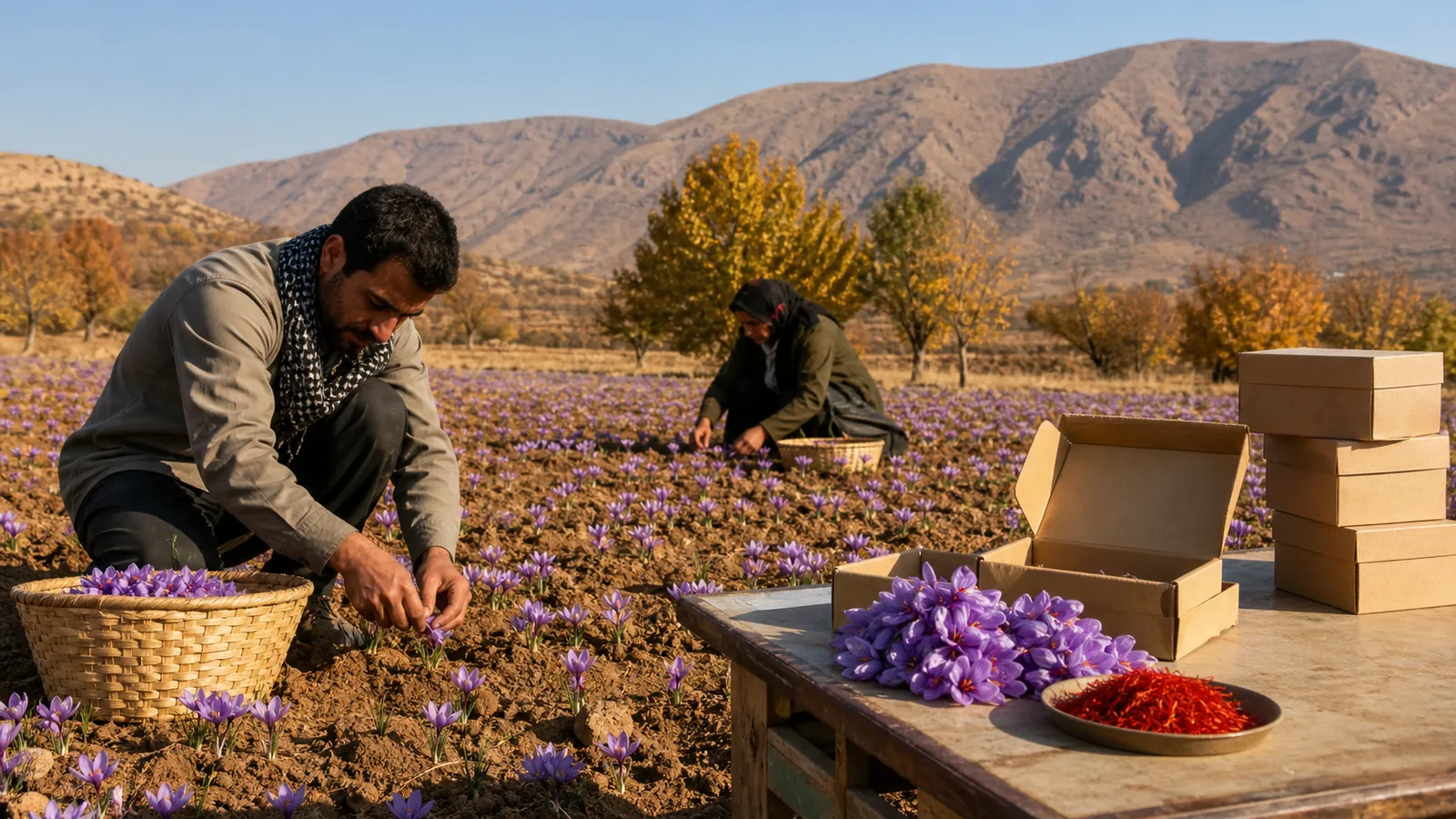
These are historical figures attributed to Khorramabad Agricultural Jihad director Murad Biranvand, not current production statistics. Read together with an earlier report from the same official, they show how saffron became part of a deliberate crop-pattern change in response to water pressure.
The 2021 Lorestan saffron snapshot
The later report compared 72 hectares under saffron in Khorramabad with 40 hectares in the preceding season. Its forecast of about 300 kilograms across the reported area works out to an average near 4.2 kilograms per hectare, although actual yield can vary considerably with field age, corm density, weather, irrigation, soil, harvest timing, and post-harvest handling.
Biranvand said saffron was performing on lower-yield and rainfed land and that growers were satisfied with quality, output, and income. Around 400 people were reported to be cultivating the crop. Some growers packaged their own saffron and sold it under their own brands, while officials were considering a growers’ cooperative.
The headline export point came with a qualification: the report said much of Lorestan’s saffron went abroad, yet insufficient local packaging meant some product left under brands associated with other provinces. The article did not publish customs records, shipment tonnage, destination countries, or a measured export share, so “most” should be understood as the official’s statement for that period rather than a verified current percentage.
The earlier expansion from 45 to 72 hectares
An earlier Khorramabad report, published on the site in 2017, described 45 hectares already planted and another 27 hectares added. Those figures total 72 hectares and therefore appear to document an earlier stage of the expansion later summarized by the destination article.
The source translation was grammatically unclear, but its numerical meaning is coherent: growers had expanded saffron acreage, participating farmers reported useful income, and local agricultural policy was encouraging a shift toward crops suited to constrained water conditions.
The same official connected saffron with rapeseed, also called canola. Khorramabad’s rapeseed area was reported at 704 hectares and ranked first within Lorestan at the time. Saffron and canola were not presented as substitutes for one another; they were two parts of a broader effort to change the city’s cropping pattern.
Why water scarcity shaped the crop decision
Saffron is often chosen in dry regions because its growth cycle and high value can fit water-constrained farming better than some conventional crops. The plant is dormant through much of the hottest summer period, and important water demand occurs around autumn flowering and later vegetative growth.
That does not make saffron a no-water crop. A scientific review of saffron water requirements notes its drought tolerance and high water productivity, while also explaining that appropriate irrigation timing remains important to satisfactory yields in dry Iranian conditions. A field can perform poorly if “drought tolerant” is taken to mean that irrigation, drainage, or soil management no longer matters.
The broader logic has official recognition. The UN Food and Agriculture Organization’s description of Iran’s qanat-based saffron farming system identifies water scarcity, crop value, livelihoods, and careful water use as connected features of saffron agriculture. That example is in Gonabad rather than Lorestan, so it supports the agronomic principle, not the local acreage figures.
What the production estimate does and does not tell us
A forecast of 300 kilograms from 72 hectares is useful as a period snapshot, but it is not a quality grade or a sales result. Fresh flowers must be picked quickly, the stigmas separated carefully, and the product dried and stored under controlled conditions. Small losses or inconsistent drying can affect both weight and market quality.
The estimate also does not show how production was distributed among roughly 400 participants. Some may have managed established fields while others worked new plantings or provided seasonal labor. Saffron is highly labor-intensive during its short flowering and separation window, so acreage alone understates its role in rural employment.
Packaging is an economic issue, not decoration
The lack of local packaging capacity described in the report affects more than the appearance of a box. Cleaning, grading, moisture control, traceability, tamper evidence, labeling, batch records, and consistent pack sizes all influence whether growers can sell a recognizable product instead of an anonymous raw commodity.
When saffron leaves a producing area in bulk and is packaged elsewhere, the originating farmers may receive the farm-gate price while another business captures part of the branding and retail margin. A functioning cooperative can help aggregate small lots, coordinate quality checks, share equipment, and negotiate with buyers. It only works, however, when governance, payment rules, quality standards, and market access are clear.
The packaging concern also connects with the local market problems discussed in our article on saffron production and market power in Lorestan. Together, the reports show that adding hectares is only one stage; processing, identity, finance, and reliable sales channels determine how much value remains with growers.
Does Lorestan saffron have an export advantage?
Lorestan can offer a distinct production story, but an export claim needs evidence at shipment level. Buyers generally need consistent grade, laboratory or specification data where required, safe handling, traceability, commercial documentation, and dependable delivery. Provincial pride does not replace those controls.
A 2025 FAO and Iranian Ministry of Agriculture workshop emphasized authenticity, quality assurance, post-harvest handling, traceability, marketing, and value-chain governance across Iran’s saffron sector. Those priorities closely match the gap identified in the older Lorestan report.
How to read the historical figures today
- 40 to 72 hectares: a reported year-on-year expansion in the later account.
- 45 plus 27 hectares: the earlier account’s path to the same 72-hectare total.
- About 300 kilograms: a forecast for the 72-hectare season, not a permanent annual average.
- About 400 participants: the reported cultivation community, without a published breakdown of farm owners and workers.
- 704 hectares of canola: a separate crop-diversification figure and provincial first-place claim from the earlier report.
- Most product exported: an attributed statement without a customs percentage in the article.
No item in that list should be silently converted into a 2026 statistic. Current acreage, harvest, export destinations, and grower numbers would require a new dated dataset from provincial agriculture authorities or customs.
The lasting lesson from Khorramabad
The two reports document a coherent agricultural transition: Khorramabad expanded saffron from roughly 45 to 72 hectares, promoted canola alongside it, and used both crops in a response to water constraints. Growers reported income and quality benefits, but local packaging and branding remained the weak link.
For Lorestan saffron to retain more value, production growth needs to be matched by careful agronomy, transparent current statistics, shared post-harvest infrastructure, quality verification, traceability, and sales channels that preserve the province’s identity. That is more durable than repeating an undated export claim on its own.

![Exporting Saffron to Turkey + Price Guide [Complete 0 to 100]](https://img.rowhanisaffron.com/20260827003933/saffron-export-turkey-quality-inspection.webp)



