


The “saffron mafia” in Lorestan was the phrase a Khorramabad agricultural official used for buyers who paid growers a low farm-gate price and resold their saffron at a much higher one. The reports reviewed here do not establish organized criminal activity. They document a bargaining-power problem: small growers lacked coordinated sales, processing, packaging and insurance while production was expanding.
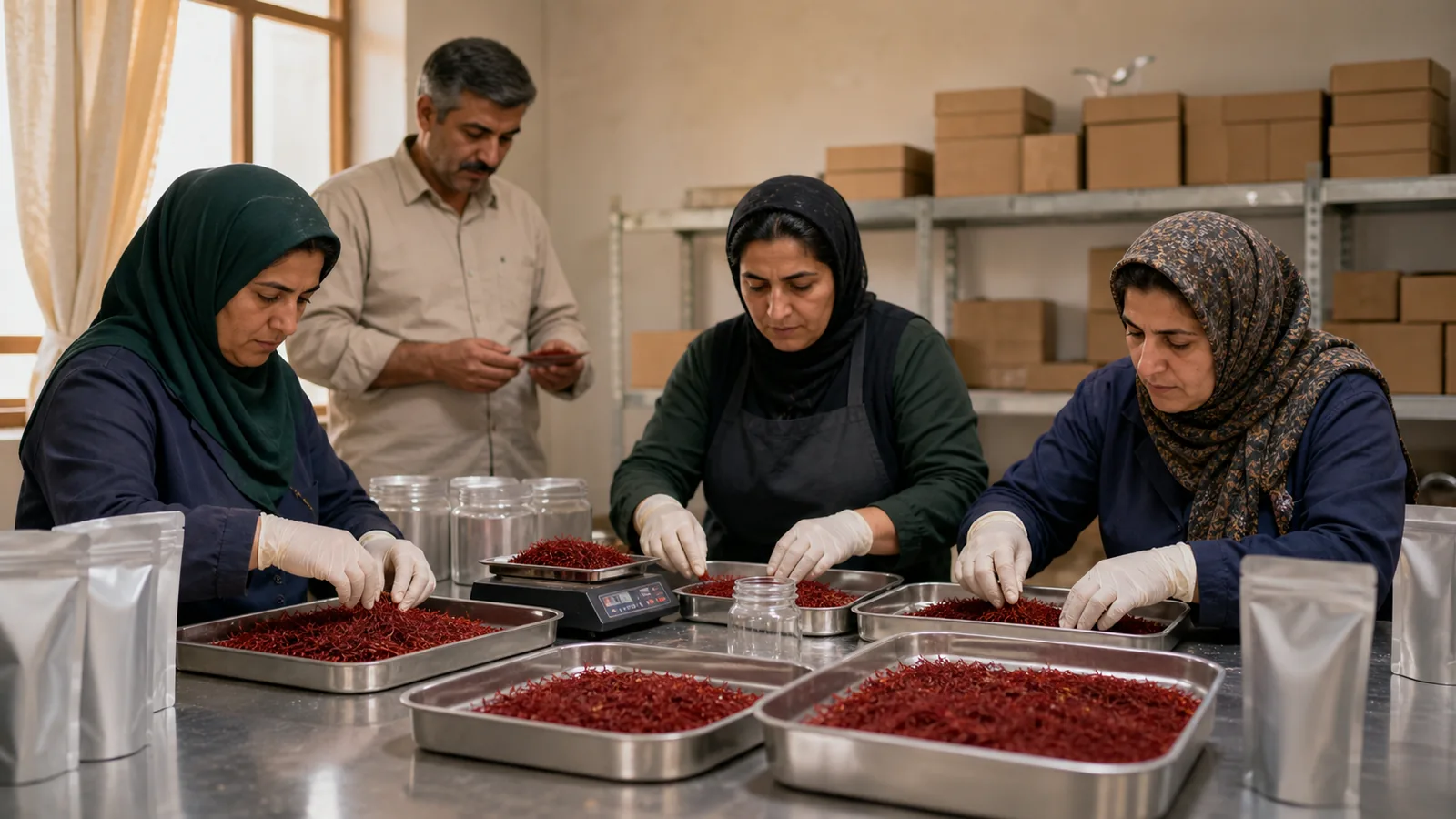
Murad Biranvand, director of Khorramabad’s Agricultural Jihad office, argued that cooperatives could help farmers aggregate their crop, improve packaging and sell with more control. Later harvest reports from the same official show the sector growing from tens of hectares to more than 160, alongside new rural jobs and proposed market-support measures.
What “saffron mafia” meant in the Lorestan report
Biranvand said some intermediaries bought saffron cheaply from growers and then sold it at a high price. His use of “mafia” was political and economic language, not a court finding or a named allegation against a particular person or company. The defensible issue is the price gap and the farmer’s weak negotiating position.
A price difference is not automatically exploitation. Traders may pay for collection, testing, drying risk, storage, packaging, finance and access to buyers. The problem arises when farmers cannot see prevailing prices, verify their grade, store safely, combine small lots or reach competing purchasers. Under those conditions, they may have little choice but to accept an immediate offer.
How Khorramabad’s saffron area expanded
The oldest snapshot in the destination said planted area had risen from 45 hectares in one year to 72 hectares the next. Another report put the area at about 75 hectares, including 25 hectares newly devoted to saffron, and forecast more than 200 kg of finished saffron.
That earlier expansion was supported by distribution of 100 tonnes of planting corms in two rounds. The stored translation labels the dates as June and September 1395, corresponding roughly to 2016–2017 in the Gregorian calendar. Because the source does not give a clean calendar conversion or distribution record, the timing and volume remain attributed local figures.
A later update described 132 hectares of fields at least two years old plus roughly 30 hectares added during the current year—about 162 hectares, although its headline rounded the area to 160. The sequence shows substantial growth, but the reports are historical snapshots rather than a current land survey.
Reading the yield estimates without forcing the numbers
The later report gave an average yield of about 3 kg per hectare and expected more than 550 kg from Khorramabad, described as roughly half of Lorestan’s production. Those figures do not reconcile exactly: 162 hectares multiplied by 3 kg is about 486 kg.
The difference could reflect productive area, field age, rounding or a higher yield on mature farms, but the article does not explain it. The responsible approach is to preserve the three reported measures separately rather than manufacture a precise total:
- 132 hectares of fields two or more years old;
- about 30 hectares newly added;
- approximately 3 kg per hectare as an average; and
- more than 550 kg as the official’s separate citywide forecast.
Future reporting would be stronger if it distinguished planted area, harvestable area, field age, dried-stigma yield and actual marketed weight.
The labour behind Lorestan’s saffron harvest
Biranvand said more than 400 rural households were involved in saffron around Khorramabad. Family members took part in picking, flower cleaning, stigma separation and processing, while more than 1,000 skilled workers were described as participating through women’s micro-cooperatives.
The same account said about 100 seasonal workers were involved per hectare during a two-month period covering harvest, cleaning, drying and packaging. It is not clear whether that means unique people, recurring labour positions or worker-days, so multiplying the figure by every hectare would create an unsupported employment total.
What is clear is that saffron concentrates a great deal of manual work into a short season. Rural cooperatives can help organize training and market access, but they should also document hours, pay, member roles, food-safety responsibilities and who owns the finished product. The International Labour Organization notes that collective enterprises can improve rural women’s access to skills, resources and markets when membership and governance are meaningful.
Why a cooperative can improve growers’ bargaining position
A functioning producer cooperative can aggregate small lots, purchase shared equipment, commission testing, compare offers and negotiate with a larger volume. IFAD identifies market access and member services as central roles of producer organizations. That supports Biranvand’s proposed response to the farm-gate price problem.
The legal structure alone is not enough. Members need transparent grading, published fees, auditable weights, clear payment dates and democratic control. A cooperative that hides its own deductions or favours a small group would recreate the same information imbalance under a different name.
Processing and packaging must protect quality
The original destination blamed the absence of local processing capacity for lost value. The later report said many growers had received support for home packaging, while larger producers were developing brands and improving pack quality.
Packaging closer to the farm can retain more value only when the workflow is hygienic and compliant. Saffron must be separated and dried consistently, protected from moisture, light, contamination and odour, and packed in traceable lots. Home-based work is not exempt from food-safety, labelling or destination-market rules.
FAO’s current Iran saffron work focuses on authenticity testing, post-harvest guidance, traceability and consistent quality from farm to market. Those safeguards make branding credible. A logo alone cannot turn an untested lot into a premium product. Our guide to Iranian saffron standards explains the measurements behind a defensible grade.
Guaranteed purchase was proposed, not confirmed
The later Khorramabad report said the Rural Cooperative Organization had prepared instructions for guaranteed purchase if need required it. The stored material does not show a launch date, purchase price, eligibility rule, budget or volume actually bought.
A purchase guarantee can provide a floor during a weak market, but design matters. The quality basis, payment timing, funding and disposal of purchased stock must be transparent, or the scheme can distort incentives and favour participants who know the rules first. The article therefore treats this as a proposed safeguard, not an operating promise to current growers.
Insurance was another missing protection
In the earliest report, Biranvand said roughly 15% of Khorramabad’s saffron area had been damaged during the preceding year and that saffron lacked suitable agricultural-insurance coverage. He encouraged growers to ask the Agricultural Insurance Fund to include it.
The 15% figure is dated and does not identify the hazard, loss-assessment method or indemnity value. It does show why higher acreage alone is not enough. A durable sector needs documented production risk, suitable coverage where available, healthy planting material and extension advice—not only a sales plan after harvest.
What would make the Lorestan saffron market fairer?
The three reports point to a practical set of reforms:
- Publish comparable prices. Show farm-gate offers by grade, moisture, lot size and payment terms.
- Test before negotiating. Give growers evidence of the quality they are selling.
- Aggregate transparently. Use member-controlled cooperatives with auditable weights, fees and payments.
- Improve post-harvest work. Train workers in separation, drying, storage, traceability and safe packaging.
- Build direct market links. Compare processors, retailers and export buyers instead of relying on one purchaser.
- Define public support. Publish any guaranteed-purchase or insurance rules before growers make planting decisions.
- Report outcomes consistently. Separate planted area, mature area, actual dried yield, households, unique workers and worker-days.
Has Khorramabad solved the saffron middleman problem?
The sources show progress in acreage, training, worker organization and packaging, but they do not prove that the price imbalance has been solved. The city grew from a reported 45 hectares to more than 160, yet the key protections—strong cooperatives, transparent prices, reliable quality systems, insurance and a documented purchase programme—still determine how much value reaches growers.
Calling the problem a “mafia” made a sharp headline. Building a fair market requires more precise work: trace every lot, publish every deduction, let growers compare buyers and give the people who pick and process the flowers a real voice in the organization that sells them.

![Exporting Saffron to Turkey + Price Guide [Complete 0 to 100]](https://img.rowhanisaffron.com/20260827003933/saffron-export-turkey-quality-inspection.webp)



