


Natanz had the highest area under saffron cultivation in Isfahan province when a local agricultural report put its total at 220 hectares. The same account described rapid growth, a strong regional reputation and an export plan, but each claim belongs to a particular point in the crop’s development rather than to the present day.
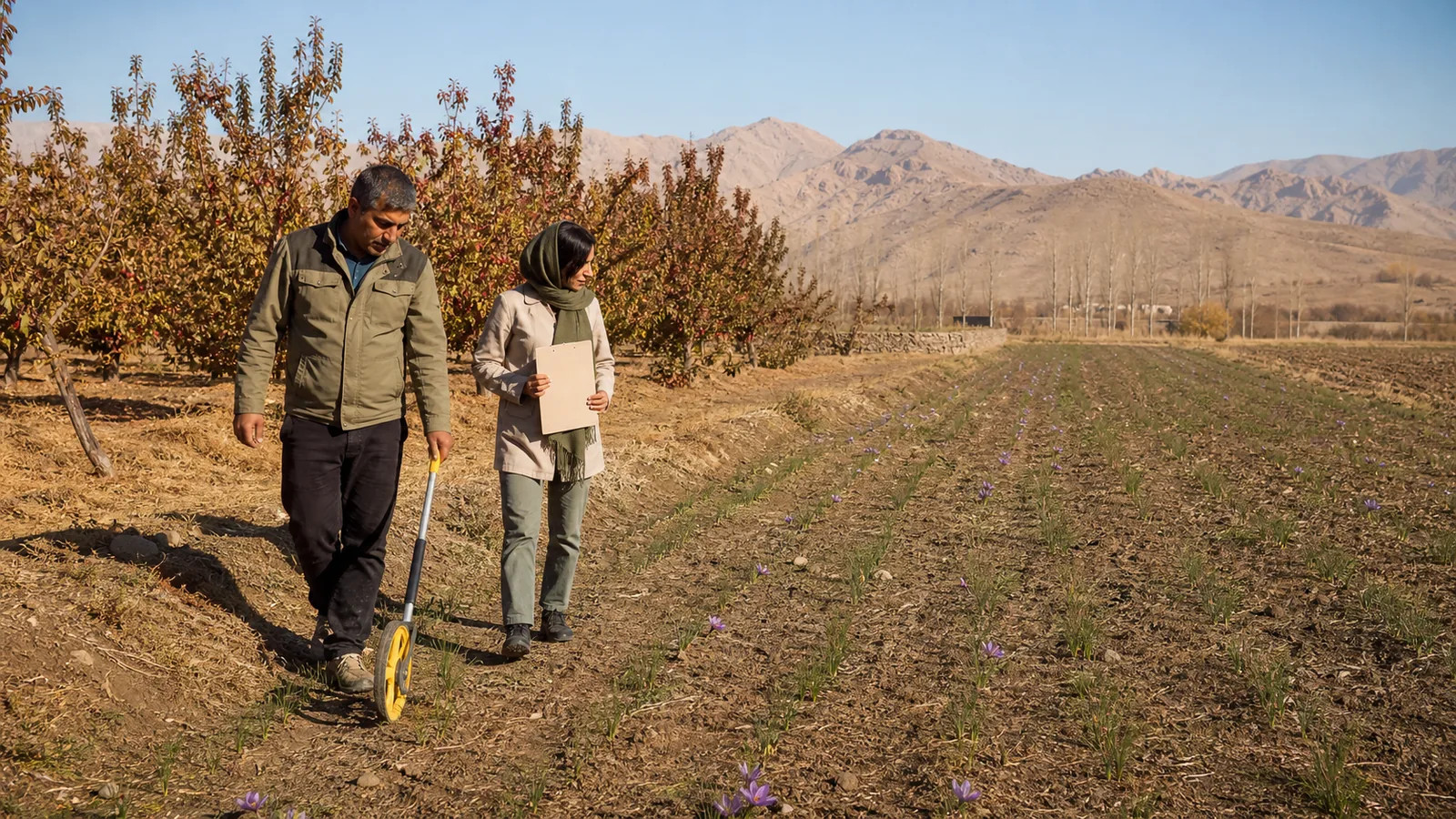
How saffron cultivation in Natanz reached 220 hectares
Abdolreza Mehdi, identified in the stored translation as director of the Natanz Agricultural Jihad office, said the city’s saffron area had increased from 50 hectares to 220 hectares over ten years. He attributed that expansion to the crop’s good yield under local conditions.
The increase was substantial. The final area was 4.4 times the starting area, equivalent to growth of 170 hectares or 340 percent. Those are calculations from the reported figures, not a separate official estimate.
The old statement ranked Natanz first among Isfahan province’s counties for land under saffron. It also said the quality of Natanz saffron had helped the product become recognised as a brand within the province and elsewhere in Iran.
The “highest area” claim needs a date
A ranking based on cultivated area can change from one season to the next. The archived Rowhani Saffron page was published in December 2021, but it does not provide the date of the original Persian report behind the 220-hectare statement.
An official Iranian Agriculture News Agency report from November 2020 listed both Natanz and Tiran-o-Karvan at 240 hectares, followed by Najafabad at 160, Aran-o-Bidgol at 100, Shahin Shahr-o-Meymeh at 95 and Kashan at 94 hectares. On that later snapshot, Natanz shared the largest reported area rather than holding it alone.
Neither historical figure should be presented as a current 2026 total without a fresh provincial crop record. The useful conclusion is that Natanz was one of Isfahan’s leading saffron areas and grew quickly over the period described.
Area is not the same as production
Hectares tell us how much land is planted; they do not tell us how much dried saffron was harvested. Production depends on the harvested share of that land and the dry yield per hectare.
The 2020 IANA account reported an average saffron yield of 6 kg per hectare for Isfahan province. That figure provides regional context, but it cannot be multiplied automatically by Natanz’s area: individual farms differ in age, climate exposure, corm density, irrigation, soil and management.
A transparent Natanz update would report planted area, productive area, dry stigma output and yield for the same harvest year. Keeping those measures separate avoids turning a land-expansion story into an unsupported production claim.
What the Natanz quality claim can support
Mehdi said experts had evaluated Natanz saffron and issued certificates confirming excellent quality. The stored account does not name the laboratory, certificate, sample size, test method or lots assessed, so the conclusion cannot safely be extended to every batch from the county.
Natanz’s reputation and long growing history are meaningful to buyers, but origin is not a substitute for batch evidence. Quality should be documented through representative sampling, a traceable lot and measurements relevant to the form in which the saffron will be sold.
The FAO-WHO Codex list of commodity standards includes CXS 351-2022 for dried floral parts—saffron. Its presence is a useful reminder that commercial quality has a defined product and measurable requirements; a broad claim such as “excellent” should lead to the actual report, not replace it.
The proposal for wet and frozen exports
The Natanz official said packaging companies were intended to export saffron in “wet and frozen” form. The translated wording does not say whether this meant fresh stigmas, whole flowers, another intermediate product or a mistranslation. It also does not name a destination, buyer, cold-chain design or completed shipment.
That distinction matters because the familiar retail spice is dried saffron. A fresh or frozen product has different handling, shelf-life, food-safety, labelling and transport needs. The product form should be defined before an export plan is described as operational.
Packaging is only one step. A credible plan also requires consistent lots, temperature control where applicable, buyer specifications, traceability, customs and destination-market compliance. The historical statement records an intention; it is not evidence that frozen or wet saffron was ultimately exported.
Why Natanz developed a recognisable saffron identity
The 2020 agricultural report said saffron had first been planted in one of the county’s villages roughly 80 years earlier. It described Natanz saffron as well known for quality and aroma, including among buyers familiar with Khorasan saffron.
That history helps explain how a local identity can form. Growers share experience, seasonal labour becomes familiar with flower handling, and buyers learn where to find the crop. None of those advantages removes the need for careful drying, storage and batch testing.
A regional brand becomes stronger when its promise is specific. Named origin, harvest year, product form, documented quality and producer traceability are more durable than an unsupported superlative.
The medicinal-plants festival had a wider purpose
The original account also referred to plans for the Natanz Festival of Medicinal Plants and Traditional Medicine, beginning on 27 July. Agricultural Jihad intended the event to educate growers and promote the planting of medicinal plants.
The stored translation does not include the festival year, programme, venue or attendance. Those details would be needed before treating it as a current event listing. Its policy purpose remains relevant: a festival can connect cultivation advice, post-harvest practice, local identity and buyers when it is built around useful information rather than promotion alone.
How to report Natanz saffron today
The historical numbers show a clear trajectory from 50 to 220 hectares, followed by a later official report of 240 hectares. They establish Natanz as a major Isfahan saffron district, but not its current rank or area.
A current report should identify the crop year, planted and productive hectares, dried output, yield range, main growing areas within the county and the number of growers. Quality claims should point to representative tests, while any export statement should name the product form and completed market route.
Read that way, the original headline retains its value. Natanz’s expansion was real enough to place it at or near the top of the province, and the county developed a recognised saffron identity. Dating the ranking and testing the product make that story stronger, not smaller.

![Exporting Saffron to Turkey + Price Guide [Complete 0 to 100]](https://img.rowhanisaffron.com/20260827003933/saffron-export-turkey-quality-inspection.webp)



