


Darmiyan’s archived saffron report described 298 hectares producing about 970 kilograms, yet no active local company exporting the crop abroad. Most saffron moved through the provincial centre and Khorasan Razavi. Reaching international buyers would require more than forming a company: growers need consistent lots, testing, traceability, compliant packing and a reliable sales channel.
The exact title—“The necessity of Darmiyan saffron presence in the international market”—has received search impressions, so it remains unchanged. The figures are historical and the source gives no year; they must not be mistaken for current area, output or export status.
What the Darmiyan report said
Vahid Ziaeian Ahmadi, identified as Director of Jihad-e-Keshavarzi in Darmiyan, said the city had 298 hectares under saffron and produced approximately 970 kilograms. That implies an average of about 3.26 kilograms of dried saffron per hectare if both figures refer to the same season and harvested area.
The article does not provide a final weigh-in, field ages or quality distribution. An average also hides differences between new, mature and declining fields.
When Darmiyan saffron is planted and harvested
Ziaeian Ahmadi said major growers planted saffron in September and began picking flowers in November, with harvest usually lasting about one month.
An earlier sentence in the translation says harvest begins in early November and continues until the end of October—an impossible sequence. The later one-month description is internally coherent, so the event should be understood as a November harvest period rather than a year-long cycle.
Planting time can affect establishment, but September should not be treated as the only valid date. Research in Mashhad found an early-summer window performed best under its conditions. Local soil temperature, corm dormancy, irrigation and field readiness determine whether that result transfers to Darmiyan.
Where the saffron was sold
The main market was reported as Khorasan Razavi, with additional sales through the centre of South Khorasan province. That route can give growers access to established traders, processors and exporters, but it can also leave the producing district distant from the final customer and the value created after bulk sale.
Ziaeian Ahmadi repeated that Darmiyan had no active company exporting saffron abroad. The statement does not mean none of its saffron reached foreign markets; product sold to another province could be processed or exported later. It means the article identified no direct local exporter at that time.
Why a direct export company is not enough
Creating a legal exporter can shorten the route to market, but only if the operation can perform the work international trade requires:
- Aggregate consistent lots: combine grower output without losing field and batch identity.
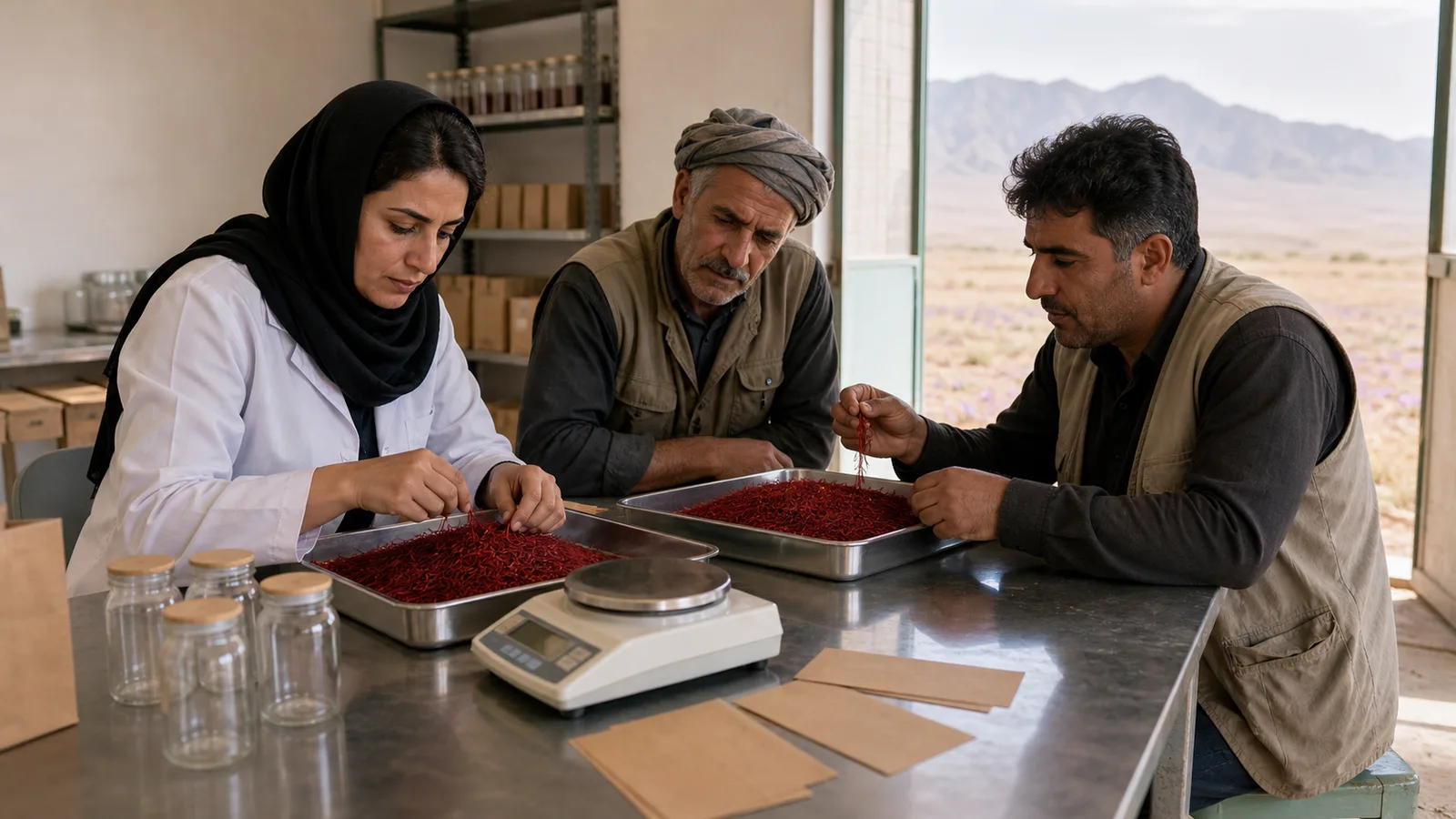
- Protect quality: control picking, separation, drying, moisture, storage and contamination.
- Verify the product: use competent testing for authenticity and the buyer’s required quality measures.
- Document traceability: connect each shipment to suppliers, processing and test records.
- Meet destination rules: comply with food-safety, labelling, packaging, customs and residue requirements.
- Find and retain buyers: sell a defined grade and deliver it consistently, not merely attend an exhibition.
A local cooperative, specialist processor or partnership with an established exporter may be more realistic than expecting every grower to export independently.
Quality must be measurable
Darmiyan’s origin can support a market story only when the lot itself supports the promise. “High quality” should resolve into testable characteristics such as colouring strength, aroma-related compounds, bitterness, moisture, floral waste and absence of adulteration.
Official work now treats this as a value-chain issue. A 2025 FAO and Iranian Ministry of Agriculture-Jahad saffron programme connected improved production and post-harvest handling with safety, traceability, modern marketing and digital branding. International presence begins in the field and drying room, not at the border.
What 970 kilograms could mean for market organisation
Approximately 970 kilograms is meaningful enough to consider shared infrastructure, but total output is not automatically one exportable lot. Buyers may require uniform grade, packaging size, delivery schedule and documentation. Small quantities from different farms must be sampled and combined carefully.
Before investing, producers need to know how much of the reported output meets each grade, how much is already committed to existing buyers, what price difference direct export could realistically earn, and whether that difference covers testing, packing, finance, freight and sales risk.
The traditional and medical claims need separation
The archived article describes saffron as “hot and dry” in ancient Iranian medicine and as a seasoning and food colourant. The first phrase belongs to a traditional medical framework; the culinary uses are everyday product functions. Neither is an export-quality specification.
It then calls saffron sedative, appetising, antispasmodic and memory-strengthening, says it lowers blood pressure and helps digestion, and claims treatment uses for asthma, skin and eye diseases, urinary tract infections, jaundice, anaemia, stomach weakness and pain including gum pain.
That list is not supported by evidence in the report. Clinical studies have investigated standardised saffron preparations for selected outcomes, but results cannot be generalised to all conditions or ordinary culinary use. Saffron should not replace treatment for asthma, infection, eye disease, jaundice, anaemia, high blood pressure or pain.
A practical route to international presence
The strongest case for a Darmiyan saffron market initiative is economic and operational, not medicinal. First establish current production and grower participation. Then define grades, standardise post-harvest handling, build lot-level traceability, test representative batches and compare possible market routes.
If direct export offers a sustainable return, a shared business can be built around verified product and committed buyers. If it does not, improving quality and bargaining power within the existing Khorasan Razavi route may create more value with less risk. International presence is useful only when it improves the position of Darmiyan growers.

![Exporting Saffron to Turkey + Price Guide [Complete 0 to 100]](https://img.rowhanisaffron.com/20260827003933/saffron-export-turkey-quality-inspection.webp)



