


The predicted supply of 10,000 tankers to saffron farms in Sarayan was an emergency response to drought and failing qanats in foothill villages. The old plan equated those deliveries with 140,000 cubic metres of water, and its own figures show both the scale of the effort and the limits of tanker irrigation.
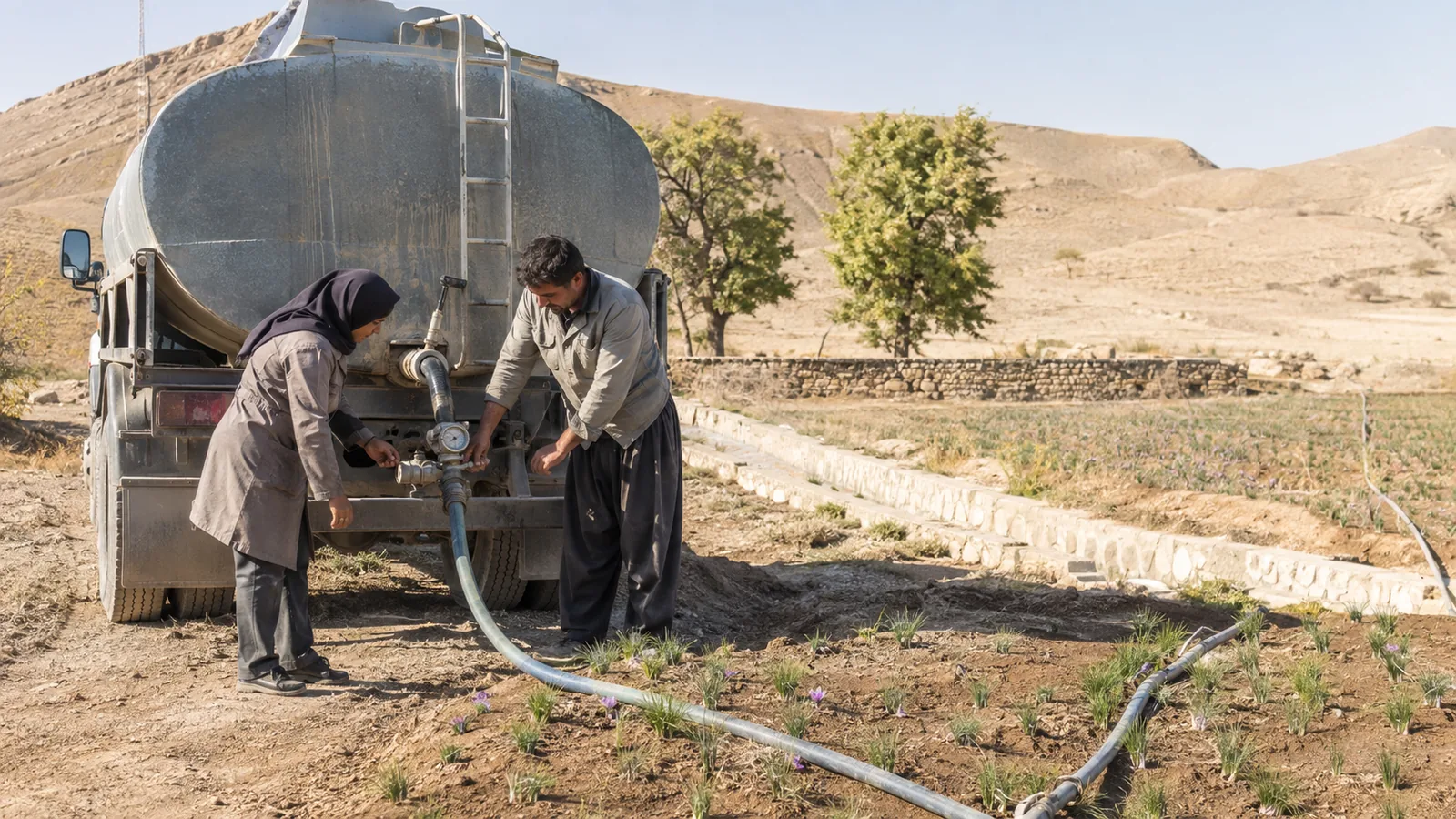
What Sarayan’s 10,000-tanker plan involved
Musa Soleimani, then director of Sarayan Agricultural Jihad, discussed the plan at a meeting on water supply for saffron farms. He expected roughly 10,000 tanker loads to be delivered by the end of the harvest season, carrying a combined 140,000 cubic metres of water.
The wording “10,000 tankers” describes deliveries or loads, not a fleet of 10,000 separate vehicles. Dividing the stated water volume by the delivery count gives an average of 14 cubic metres, or 14,000 litres, per tanker load.
The archived Rowhani Saffron page was published on 31 December 2021, but it does not identify the date of the original Persian report. The water volume, cost and farm figures are therefore historical planning numbers, not a current Sarayan programme.
Why the foothill farms needed mobile water
Soleimani connected the emergency with continuing drought, regional climate change and the depletion or drying of qanats, especially in foothill areas. In the stored translation, tanker supply was described as the remaining “window of hope” for thirsty saffron fields.
Qanats are not simply pipes that can be replaced load for load. When their flow declines, farmers lose a predictable local source and become dependent on water availability, road access, hauling distance and payment for each delivery.
The FAO AQUASTAT explanation of irrigation water requirements notes that irrigation demand depends on the deficit between crop needs and effective precipitation, together with changes in stored soil moisture. That principle helps explain why a delivery count alone cannot show whether a field received enough water at the right time.
The 525-hectare foothill problem
The report put Sarayan’s saffron area at 2,625 hectares and its production at 10 tonnes, ranking the county second in the province. It said 525 hectares—20 percent of the stated total—were in mountainous or foothill locations.
According to Soleimani, 25 percent of those 525 hectares needed tanker irrigation. That equals 131.25 hectares if both percentages and areas are exact. He also said one tanker load irrigated 120 square metres.
Ten thousand deliveries at 120 square metres each would cover 1.2 million square metres, or 120 hectares, for one application. That is about 11.25 hectares short of the calculated 131.25-hectare need. The gap may reflect rounding, changing eligibility or different delivery requirements, but the archived text does not resolve it.
What the water volume means at field level
Spreading 140,000 cubic metres over 120 hectares is equivalent to about 1,167 cubic metres per hectare, or a water depth of roughly 117 millimetres. If the same volume covered the full calculated 131.25 hectares, the equivalent depth would be about 107 millimetres.
These are arithmetic conversions, not irrigation recommendations. Actual distribution would vary with tanker capacity, field size, losses, soil condition and whether a plot received more than one delivery.
A sound delivery record would identify the vehicle or load, water source and volume, destination plot, date and receiving farmer. Without that information, a headline count cannot confirm how evenly the water reached eligible farms.
The farmers and livelihoods behind the plan
The historical account said 780 farmers directly earned a living from planting and harvesting saffron. Soleimani warned that foothill villages depended heavily on the crop and that a failure to support irrigation could contribute to migration.
That concern should remain attributed to the official rather than treated as a measured migration forecast. The report does not provide household-income data, alternative water sources or records of families who left.
A later official Iranian Agriculture News Agency report described 3,000 hectares under saffron in Sarayan and 6,000 people engaged in saffron growing. Those numbers use a broader “people engaged” definition than the old count of direct farmers, so they should not be read as a simple like-for-like increase.
Why incomplete irrigation was a concern
Soleimani said high hauling costs caused farmers to economise and irrigate incompletely. He warned that failing to irrigate, or applying too little water, could damage corms and reduce saffron yield per unit area.
The statement reflects the urgency officials saw, but the stored report does not include soil-moisture readings, field trials or a damage assessment. It should not be converted into a universal watering schedule.
For an emergency programme, prioritisation should be based on observed field need, crop stage and the absence of another viable source. Recording the response after delivery—rather than only the number of tanker trips—would show whether the intervention protected the crop.
Cost, credit and the funding gap
The average mobile-water cost was stated as 500,000 rials per tanker, varying with the distance to each farm. Multiplying that rate by 10,000 deliveries produces the report’s minimum credit estimate of 5 billion rials.
The budget appears to cover the average delivery charge. It does not say whether water purchase, loading infrastructure, administration, road access, testing or losses were included. Nor does it record the amount ultimately funded or delivered.
Soleimani said the Crisis Management Headquarters had not allocated credit for saffron-field water supply in the preceding years, leaving farmers to pay the cost themselves. That historical funding gap is central to the story: the forecast described what was thought necessary, not a completed publicly financed project.
Schedule and translation cautions
The report said mobile water supply would begin at the end of September and continue until the end of the saffron harvest and another crop’s harvest. The stored English translation renders that crop as “alum,” which is too damaged to identify confidently without the Persian source.
The old image metadata was also written in Spanish and included the search phrase cisterna 10000. It referred to the same 10,000-tanker forecast, not a separate scheme. The present image description uses clear English while this note preserves the legacy query context.
Calendar year matters as much as wording. A schedule from one drought season should not be reused as a current delivery announcement without a new official notice.
Tanker delivery is emergency relief, not water security
Mobile supply can keep selected fields from missing a critical irrigation when a qanat fails. It is also expensive, dependent on roads and vehicles, and difficult to distribute evenly across a large area.
A longer-term plan would begin with a field and qanat inventory, water-quality and soil-moisture records, transparent eligibility rules and verified delivery logs. It would also compare the recurring cost of hauling with feasible work on local water infrastructure and farm-level efficiency.
Sarayan’s forecast captured a real emergency: a major saffron district faced drought, weakened qanats and high delivery costs. Its arithmetic makes the lesson clearer. Ten thousand tanker loads could provide meaningful temporary relief, but the planned coverage did not fully reconcile with the stated eligible area, and the archived report does not prove that the water or funding ultimately arrived.

![Exporting Saffron to Turkey + Price Guide [Complete 0 to 100]](https://img.rowhanisaffron.com/20260827003933/saffron-export-turkey-quality-inspection.webp)



