


Crocin and ovarian follicles have been studied in a small experiment involving female rats. The researchers observed fewer atretic Graafian follicles at one injected dose, alongside changes in estrogen, progesterone and hypothalamic Kiss-1 expression. Those findings are interesting laboratory evidence, but they do not show that eating saffron protects human fertility or treats an ovarian condition.
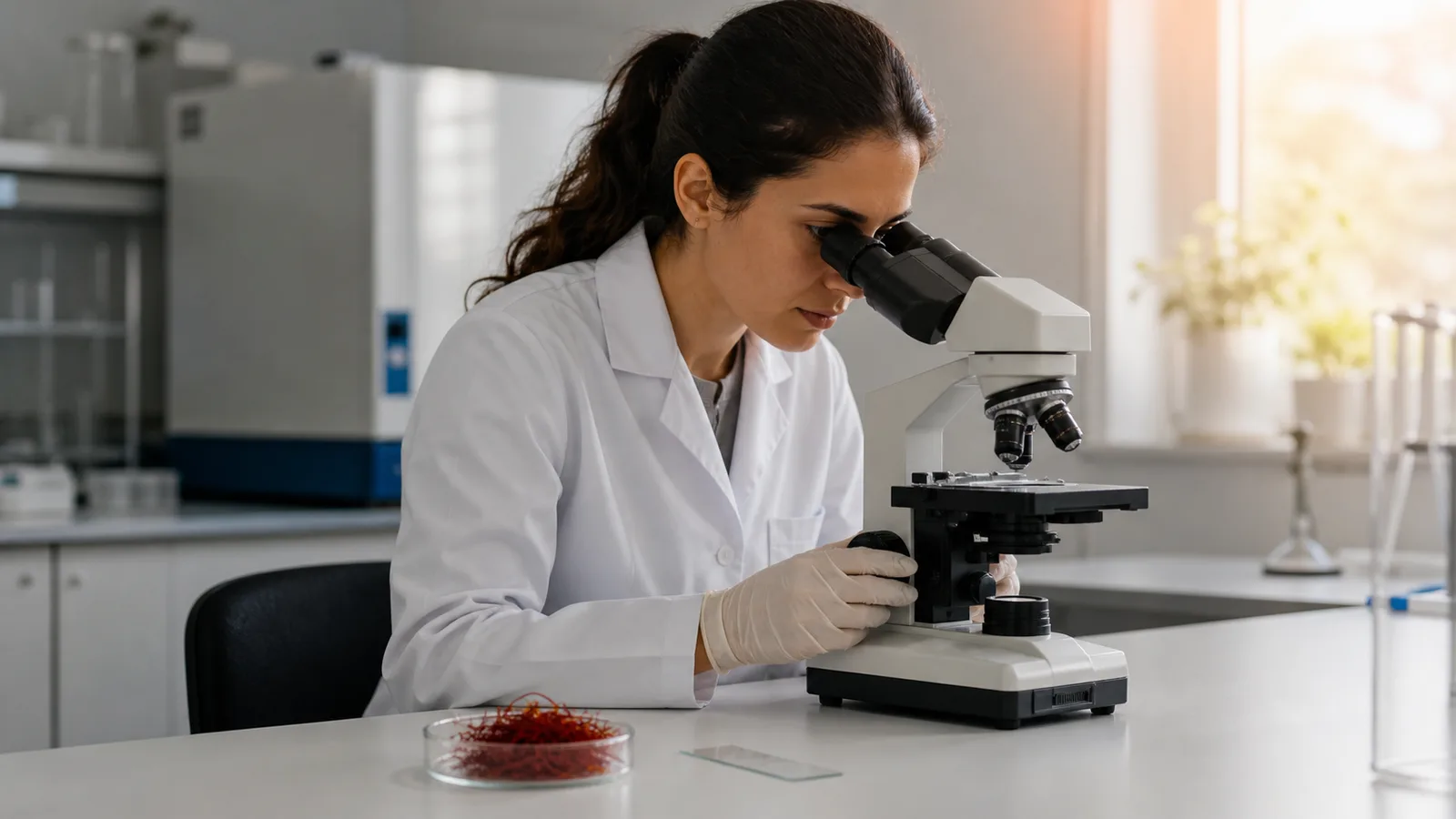
The original headline, “Saffron is a barrier against the destruction of ovarian follicles,” goes further than the evidence allows. The experiment tested purified crocin by intraperitoneal injection in 18 rats. It did not test saffron as food, measure pregnancy or live birth, or include human participants.
What the crocin and ovarian follicles study tested
Dr Kazem Parivar and colleagues at the Science and Research Branch of Islamic Azad University in Tehran investigated how crocin affected the pituitary–gonadal axis, ovarian tissue and expression of the hypothalamic Kiss-1 gene. Their paper appeared in the International Journal of Fertility & Sterility.
Crocin is a water-soluble carotenoid responsible for much of saffron’s colour. A purified compound delivered by injection is not equivalent to using saffron in a meal or drinking saffron tea: the dose, route of administration and amount reaching the body are different.
The researchers randomly divided 18 adult female Wistar rats into three groups of six. The control group received saline. The other two groups received 100 or 200 milligrams of crocin per kilogram of body weight by intraperitoneal injection. The methods describe administration every two days for 30 days.
After treatment, the team measured serum follicle-stimulating hormone (FSH), luteinizing hormone (LH), estrogen and progesterone. They examined ovarian sections under a microscope, used real-time PCR to measure Kiss-1 gene expression in the hypothalamus, and analysed the data with one-way analysis of variance (ANOVA).
What the researchers found
The main tissue finding concerned atretic Graafian follicles—mature follicles undergoing degeneration. Rats in the 200 mg/kg group had a reported mean of 0.5 atretic Graafian follicles in the sampled sections, compared with 1.33 in the control group. The difference was statistically significant in this experiment.
The study did not find statistically significant differences in the reported mean numbers of primordial, primary, growing or non-atretic Graafian follicles, or in corpora lutea. That distinction matters: the result was not a general increase in every follicle type.
FSH and LH levels did not differ significantly between groups. Estrogen was lower in both crocin groups than in the control group, while progesterone was lower in the 200 mg/kg group. Hypothalamic Kiss-1 messenger RNA expression was also lower in both treatment groups.
Why Kiss-1 and the pituitary–gonadal axis matter
Kiss-1 encodes kisspeptin, a signalling peptide involved in reproductive hormone regulation. Kisspeptin helps regulate gonadotropin-releasing hormone, which in turn influences release of FSH and LH from the pituitary gland. Those hormones participate in ovarian follicle development and ovulation.
The archived version called this peptide “case peptin” or “metastin.” The accepted term in this reproductive context is kisspeptin. Metastin is an older name associated with the same gene product’s discovery in cancer biology.
Although crocin reduced hypothalamic Kiss-1 expression in the experiment, FSH and LH did not change significantly. The authors suggested that other mechanisms may have offset the change. This mixed hormonal pattern is another reason not to reduce the paper to a simple claim that crocin “improves hormonal balance.”
What the study does not establish
- It does not prove an effect in humans. Rat physiology can inform research, but animal results require clinical testing before they can support medical advice.
- It does not show that saffron improves fertility. The researchers did not measure mating, pregnancy, live birth, ovarian reserve or infertility treatment outcomes.
- It does not provide a safe human dose. The doses were injections of purified crocin calculated by rat body weight. They should not be converted into a home dose of saffron or supplements.
- It does not show protection against every cause of follicle loss. The experiment involved otherwise healthy laboratory rats and did not model chemotherapy, ageing, polycystic ovary syndrome or another diagnosed human condition.
- It does not prove the proposed mechanism. The authors linked the tissue finding to a possible anti-apoptotic action of carotenoids, but this study did not directly measure follicular apoptosis or the suggested molecular pathway.
A closer look at the limits
Six animals per group is a small sample. Follicles were counted in selected ovarian sections rather than throughout the entire ovary, and the treatment lasted 30 days. The paper reports a difference in one follicle category at one dose; most of the other follicle counts were not significantly different.
The published table labels the crocin groups “100 mg/kg/72 hours” and “200 mg/kg/72 hours,” while the methods say injections occurred every two days. That internal inconsistency should be resolved from the original study records before anyone relies on the schedule in a replication.
The hormone changes also need careful interpretation. Lower estrogen and progesterone are measurements, not automatically benefits. Their significance depends on timing in the reproductive cycle, the biological context and whether the change leads to a meaningful health outcome.
How to read the result responsibly
The most accurate summary is narrow: in this small rat study, injected crocin at 200 mg/kg was associated with fewer atretic Graafian follicles in sampled ovarian tissue. Crocin also changed estrogen, progesterone and hypothalamic Kiss-1 expression under the study conditions. Further work is needed to understand the mechanism and whether any clinically useful effect exists.
The full peer-reviewed study is available through PubMed Central, including its methods, numerical results and limitations. Reading the paper is preferable to treating a headline as medical guidance.
Anyone concerned about ovarian function, hormone levels or fertility should speak with a qualified clinician. Saffron and crocin supplements can interact with individual health circumstances, and an experimental animal dose is not a treatment plan.

![Exporting Saffron to Turkey + Price Guide [Complete 0 to 100]](https://img.rowhanisaffron.com/20260827003933/saffron-export-turkey-quality-inspection.webp)



