


Increasing saffron exports by the method of the country’s researchers was the goal behind a machine-vision separator described by project manager Mehrdad Karami. The semi-industrial device was intended to accept mixed saffron flowers, identify them, cut them and separate their components at greater speed, but its export value depended on performance that still needed to be demonstrated.
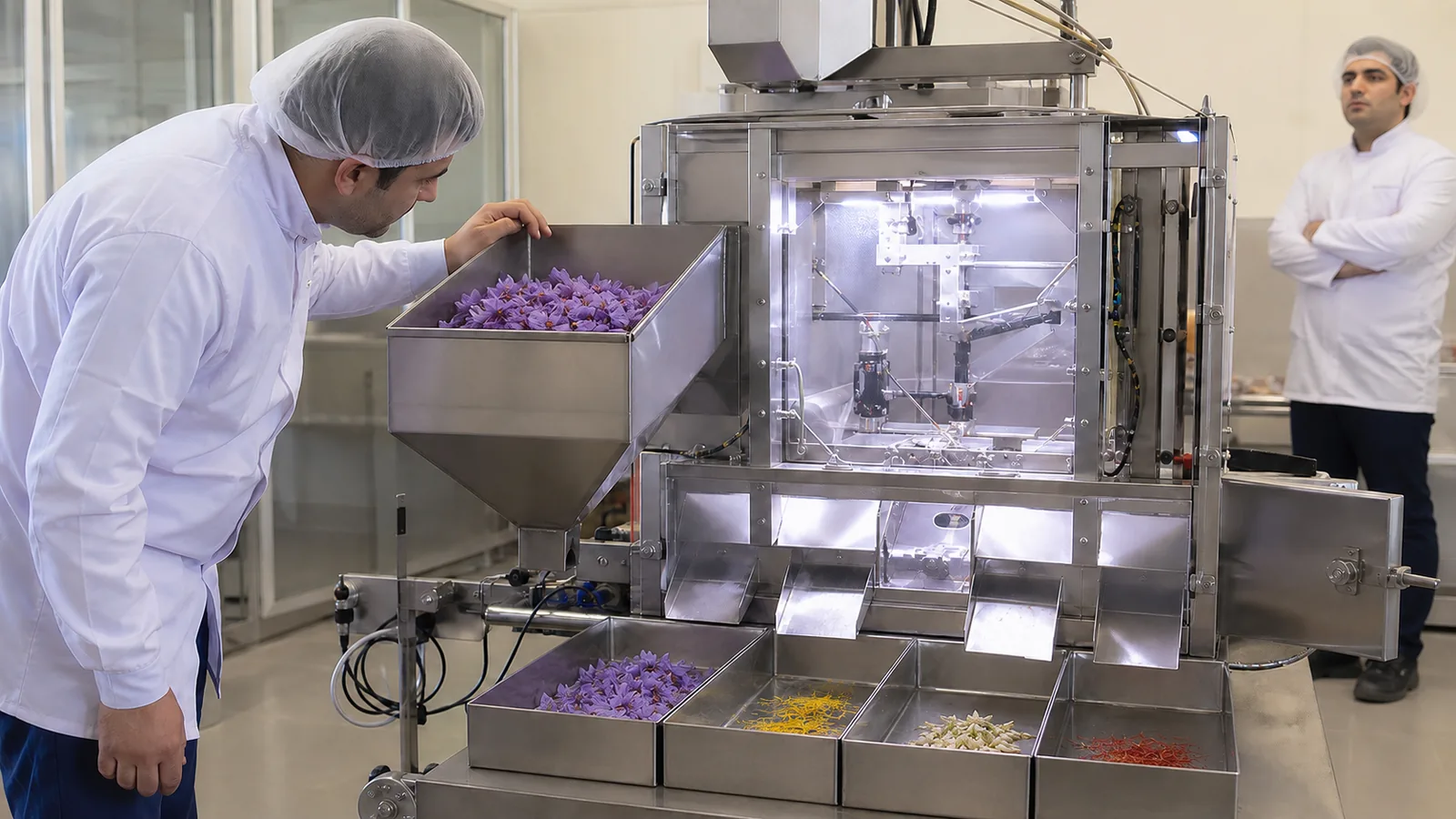
The saffron processing machine in the report
Karami described a saffron processing machine designed to automate one of the most demanding postharvest tasks: separating the red stigmas from the rest of each flower. In the traditional process, people open and clean flowers by hand during a short harvest period.
He was identified as manager of the Deba project. At the time, he said Iran produced more than 90 percent of the world’s saffron and argued that faster, cleaner separation could strengthen the country’s position as an exporter of saffron.
Those production-share and market statements belong to the historical report. The Rowhani Saffron page was published in January 2022, while an external repost of Karami’s comments is dated 2017. The stored article does not establish when the prototype was tested, whether the planned industrial model was completed or whether any exporter adopted it.
How the image-processing system was meant to work
Earlier saffron separators often required a person to feed flowers individually and place each one in a fixed direction. Karami said that manual orientation slowed the process and created another point at which the product could be handled or contaminated.
His proposed system was intended to receive flowers in bulk, without sorting them by orientation or size. Buds and open flowers could enter together. Machine vision would identify each flower and guide it to a cutting stage, after which the cut material would move into a separation section.
The report says four flower components were separated automatically. It does not name all four output streams, specify the cutting position or explain how the system protected the three red stigmas from damage. Those details would be essential to evaluate recovery and grade.
What a 200 kg daily capacity means
Karami said a semi-industrial model had been built and that an industrial version was on the agenda for release by the following summer. The stated target for the industrial sample was 200 kilograms of fresh saffron flowers per day.
That is an input capacity, not 200 kilograms of dried saffron. Fresh flowers consist mostly of petals and other material; only the stigmas become the commercial spice. A manufacturer would need to state operating hours, usable throughput per hour, downtime and the quantity of saleable stigma recovered from each batch.
Capacity also has to match the harvest. Saffron flowers deteriorate quickly after picking, so a machine that processes a large batch too slowly, crushes flowers in its feed system or creates a queue before drying may shift the quality problem rather than solve it.
Why separation matters to saffron export
Manual separation is skilled work, not automatically an unsafe method. Clean hands or gloves, sanitary surfaces, suitable containers and prompt drying can produce excellent saffron. The concern is that repeated contact, crowded work areas and delays create opportunities for foreign matter or microorganisms to enter the product.
A peer-reviewed review of saffron’s commercial quality describes careful harvesting, protected transport, stigma separation and drying as connected postharvest stages. It also explains that colour, aroma and taste depend on compounds that can be harmed by poor handling or drying.
Automation could reduce direct handling and make output more consistent. It could also cut stigmas too short, leave floral waste attached, bruise wet material or spread contamination through difficult-to-clean surfaces. The relevant question is not whether a process is manual or automatic, but whether the final batch meets the buyer’s specification and food-safety requirements.
A separator cannot guarantee export quality by itself
The old headline connected cleaner separation directly with higher saffron exports and export prices. That is a possibility, not a proven result. An exporter still needs traceable lots, controlled drying, hygienic storage, suitable packaging, laboratory testing and compliance with the destination market’s rules.
Current ISO 3632 specifications apply to dried saffron in filaments, cut filaments and powder, while test methods assess the finished spice. A machine that handles fresh flowers would sit near the beginning of that quality chain; it would not replace sampling or laboratory verification.
Microbial control also requires measured evidence. A 2024 saffron-safety study notes that contamination can arise during cultivation and postharvest handling, and it measured both microbial reduction and changes in crocin, picrocrocin and safranal. That balance matters because a treatment can reduce contamination while affecting the qualities buyers value.
What the prototype would need to prove
A credible test should use representative flowers: different sizes, buds and open blooms, several orientations, and material from more than one field and harvest day. The results should report more than the fastest successful run.
Useful performance measures would include:
- kilograms of fresh flowers processed per hour and per shift;
- percentage of stigmas recovered intact and at the intended cut length;
- floral waste or foreign matter remaining in the stigma stream;
- product lost or sent to the wrong output stream;
- microbial results before and after processing;
- cleaning time, water use, downtime and changeover between batches; and
- labour, energy and maintenance cost per kilogram of usable output.
Independent comparison with a well-managed manual line would show whether automation actually improved hygiene, recovery and cost. Without a control, a claim such as “eliminates contaminants” is too absolute.
Machine vision is only one part of the engineering
Image processing can locate a flower or distinguish colours and shapes, but detection accuracy is not the same as complete processing performance. Lighting changes, overlapping flowers, petals folded around the stigma and plant debris can affect what a camera sees.
The mechanical stages are equally important. Feeders must separate or present flowers without crushing them; cutting equipment must work at the correct point; and the separation system must keep stigma, petal and other fractions apart. Food-contact surfaces need to be accessible for cleaning and made from appropriate materials.
Karami’s report said flowers could enter in a mass, in any direction and at any size. That was the central advance claimed for the Deba machine. It is also the claim that would need the strongest test across a full shift, not only a small demonstration batch.
How a machine could affect growers and processors
The report suggested that automation could increase cultivated area and the export price. A separator alone cannot produce either outcome. Growers expand only when corms, land, water, labour, finance and demand support the decision, while export prices depend on grade, origin, contracts, competition, packaging and market conditions.
A reliable machine could still remove a real bottleneck. If it processed flowers promptly with high stigma recovery, it might help a processor handle peak-day volume, document repeatable procedures and reduce inconsistent contact. The economic case would be strongest where daily flower supply is large enough to keep the equipment in use.
Smaller growers might need a shared service rather than individual ownership. Any business plan should account for transport time from field to machine, batch identity, cleaning between suppliers and who bears the loss if recovery falls below the agreed level.
What remains unknown about the Deba device
The archived report preserves an interesting research proposal and a clear 200-kilogram daily target. It does not provide test data, photographs of the internal mechanism, laboratory results, patent details, price, energy demand, operator requirements, an industrial installation or a later commercial status.
It would therefore be misleading to present the device as an available machine or a confirmed reason that saffron export increased. A current update would need evidence from the project team or an operating processor, together with measured throughput, recovery, hygiene and finished-product results.
The idea remains valuable because it identifies a genuine pressure point in saffron production. Machine vision may help processors move flowers through separation faster and with less direct handling. For an exporter of saffron, however, the decisive output is not the machine’s headline capacity. It is a traceable batch of dried stigmas that retains its colour, aroma and taste, passes the required tests and reaches the buyer in the promised condition.

![Exporting Saffron to Turkey + Price Guide [Complete 0 to 100]](https://img.rowhanisaffron.com/20260827003933/saffron-export-turkey-quality-inspection.webp)



