


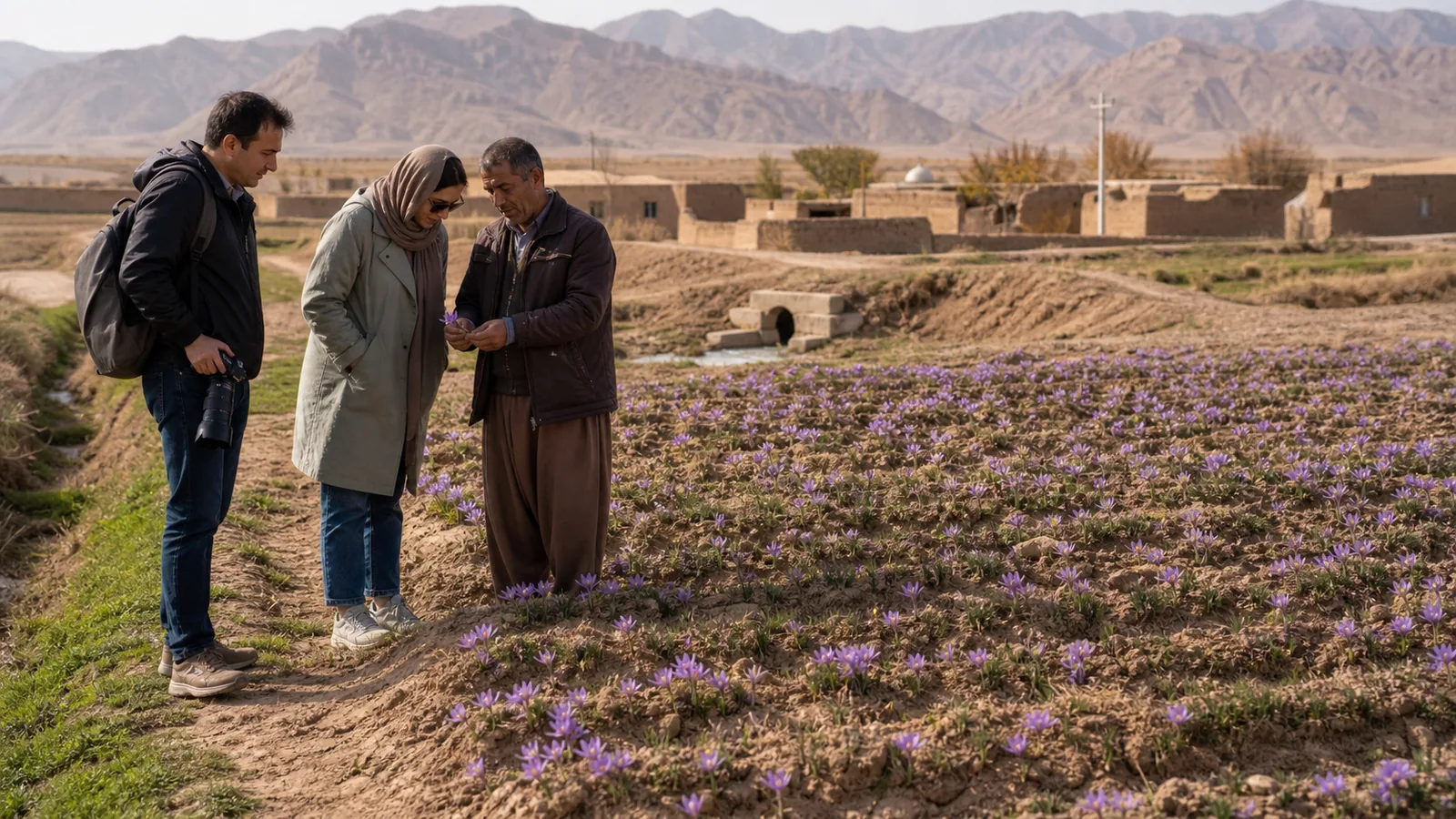
Saffron tourism is a new idea in the development of southern Khorasan because the harvest brings farming, food, landscape and local tradition together in one short season. In Gonabad, that experience can also be connected to the Qasabeh Qanat and the villages whose livelihoods have grown around scarce water.
Where this saffron-tourism idea belongs
The phrase “southern Khorasan” in the original title refers to the south of Khorasan Razavi, especially Gonabad. It should not be confused with South Khorasan Province, which is a separate province to the south.
Gonabad is both an agricultural district and a place with a distinctive water heritage. Saffron is an important part of the local economy, while the Qasabeh Qanat is one component of the Persian Qanat property inscribed on UNESCO’s World Heritage List in 2016.
The combination gives a visitor more than a photograph of purple flowers. It offers a way to understand why a valuable, relatively low-water crop became important in an arid landscape and how families organise work during the brief flowering period.
The original proposal from Gonabad
Abolghasem Shafiei, described in the archived report as a faculty member at Islamic Azad University of Gonabad and a member of the Gonabad Cultural Heritage Association, proposed treating the saffron harvest as a recurring tourism event.
He argued that introducing the region’s attractions could bring more visitors and support sustainable job opportunities. His idea linked field visits and saffron processing with the globally recognised Qasabeh Qanat, rural accommodation, religious sites, local bread and regional food. Put together carefully, he suggested, those elements could support a two- or three-day stay rather than a quick stop.
The Rowhani Saffron article was published in January 2022, but its stored English text does not date Shafiei’s statement or describe an operating tour. It records a development idea, not a current booking offer, festival schedule or guarantee of access to farms.
What a visitor can learn during harvest
Saffron flowers open for a limited period, and much of the work happens early in the day. A well-planned visit could show the sequence from flower to spice without turning a working farm into a staged display:
- how growers recognise flowers ready to pick and move through the rows without damaging plants;
- how the three red stigmas are separated from each flower;
- why clean handling and controlled drying matter to the finished spice;
- how families divide time and labour during a compressed harvest window; and
- how local water, soil and farming knowledge shape the crop.
Shafiei described the harvest as a beautiful event worth documenting and visiting. The old translation calls the inherited practices “traditional mirrors,” but the intended Persian expression is more likely traditions, customs or rituals. The important meaning is that harvest has a social and cultural dimension, not merely a production target.
Why the qanat belongs in the story
The FAO’s account of Gonabad’s qanat-based saffron farming system connects dependable qanat irrigation with food security, livelihoods, biodiversity and tourism. It also notes the appeal of the saffron fields, nearby fruit trees and the architecture of local settlements.
A qanat carries groundwater by gravity through a gently sloping underground tunnel. That system helped settlements and farms endure where surface water is limited. Pairing the Qasabeh Qanat with a saffron visit can therefore explain the relationship between water management and the crop instead of presenting the qanat as an unrelated monument.
The original article described saffron as consuming little water and treated its selection as evidence of adaptation to local conditions. That is a sensible broad connection, but “low water” should not be read as “no irrigation.” Field needs still vary with soil, rainfall, temperature and the stage of the crop.
A harvest visit needs permission and timing
Saffron tourism is seasonal. Flowering dates shift with the weather, so an old publication date cannot tell a traveller when fields will be in bloom in a later year. Visitors need a current local organiser who can confirm conditions and obtain the grower’s permission.
A farm is a workplace. Group size, walking routes and photography should be agreed in advance. Guests should keep out of planted rows unless invited, follow hygiene instructions around separated stigmas and avoid interrupting the early-morning work on which product quality and family income depend.
Payment also matters. If the purpose is rural development, growers, guides, hosts and food producers should know what they are providing and how they will be compensated. Free labour disguised as an “experience,” uninvited photography and damage to a field would undermine the very community the visit is meant to support.
From a field visit to a two-day local experience
A coherent short stay could begin with a small, pre-arranged morning field visit, followed by a demonstration of stigma separation and drying. Later, a guide could explain the qanat, local water-sharing traditions and the way saffron fits the area’s agriculture.
Local bread or a regional meal can show how saffron is used, provided the food is part of a genuine host offering rather than a generic performance. An overnight stay in an appropriately licensed rural or eco-lodge would keep more of the visitor’s spending in the area and allow time for other cultural or religious attractions mentioned in Shafiei’s proposal.
Not every element has to appear in every itinerary. A good programme is shaped by the host community, current access, the harvest workload and what can be offered honestly. The goal is a connected account of place, not a checklist that sends people racing between unrelated stops.
How saffron tourism can support rural work
Harvest tourism can create work beyond the direct sale of saffron. Local guides, drivers, accommodation providers, cooks and craftspeople may all take part. It can also give growers a chance to explain why authentic saffron commands a high price and how much skilled handwork lies behind a small quantity of dried spice.
Those benefits are possibilities, not automatic outcomes. Visitor numbers alone do not prove sustainable development. A useful programme would track income retained locally, participation by farming households, repeat demand, damage or disruption, visitor satisfaction and whether the event remains manageable during peak agricultural work.
Shafiei described saffron as a way for families to earn a lawful living. In practical terms, tourism should add a fair source of income without taking control of the story away from the people who cultivate, process and cook with the crop.
What responsible development would require
Before advertising a seasonal event, organisers would need confirmed flowering dates, participating farms, safe visitor capacity, transport, guide training, insurance where required and clear rules for photography and food handling. Information should be updated each season rather than copied from an old calendar.
The cultural material needs the same care. Customs should be explained by people who know them, and a working practice should not be invented or exaggerated to entertain visitors. Documentation can preserve knowledge, but only with consent and accurate context.
Gonabad’s strongest saffron-tourism idea is also the simplest: let a visitor see how crop, water, household work and place fit together. The harvest supplies the seasonal focus; the Qasabeh Qanat supplies historical context; local food and accommodation make a longer visit possible. When growers remain at the centre, the result can feel like an invitation into a living agricultural landscape rather than a festival built around a commodity.

![Exporting Saffron to Turkey + Price Guide [Complete 0 to 100]](https://img.rowhanisaffron.com/20260827003933/saffron-export-turkey-quality-inspection.webp)



