


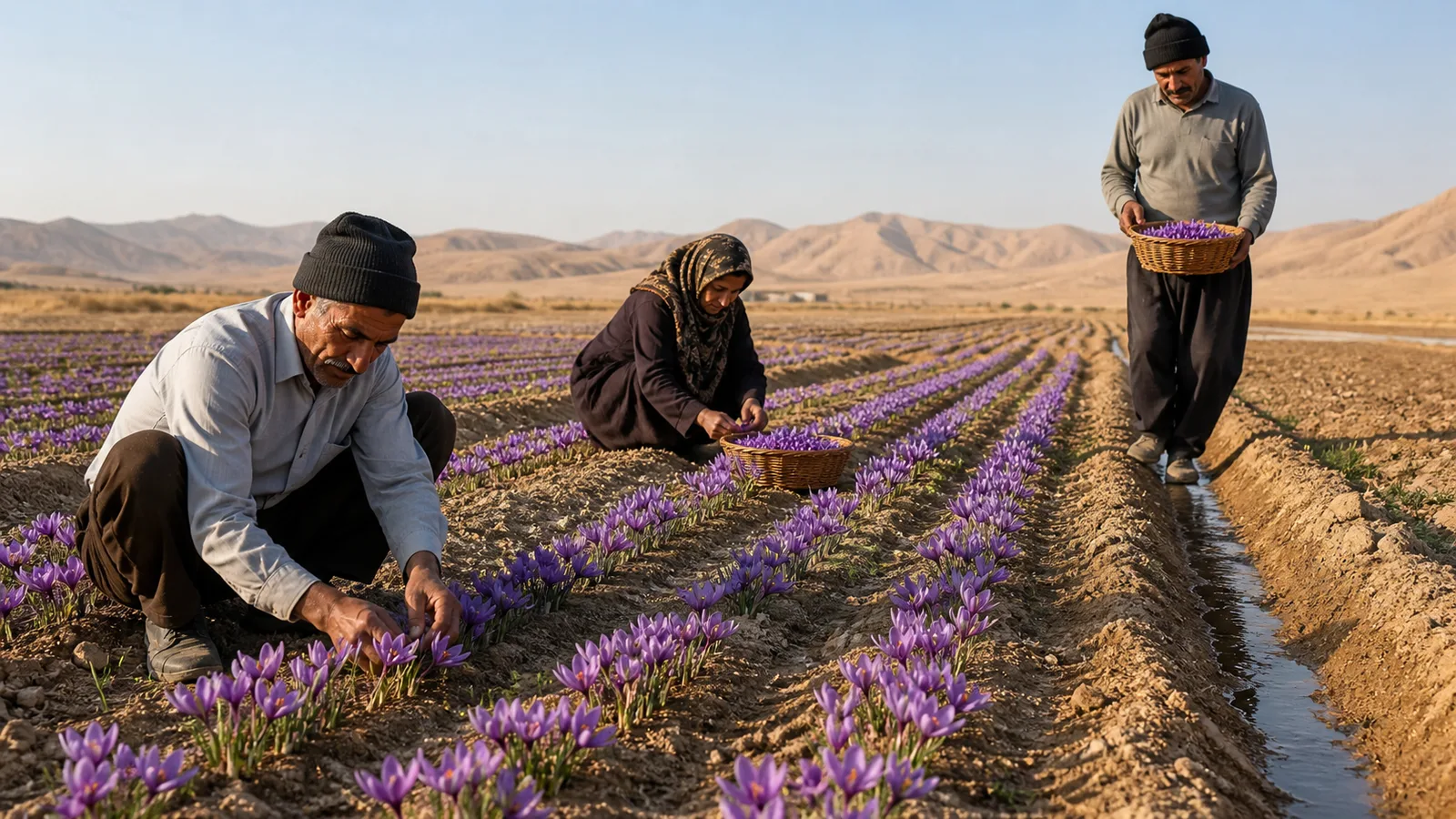
Two historical reports show saffron production in Yazd expanding from a 1,500-kilogram forecast on 420 hectares to a later three-tonne forecast on 935 hectares. They also show why regional figures need a crop year: cultivated area, city rankings and expected yield changed between the two accounts.
These are dated forecasts and programme figures, not current production statistics. They remain useful for understanding where Yazd’s saffron was grown, how drought shaped crop planning and what the expansion was expected to support.
The 1,500-kilogram Yazd saffron forecast
Seyed Jamal Sajjadipour, then head of the provincial agricultural organisation, forecast 1,500 kilograms of saffron from 420 hectares. Bahabad accounted for the largest share, with 265 hectares, followed by Bafgh, Mehriz and Abarkooh.
The official said another 50 hectares would be added and placed Yazd seventh among Iran’s saffron-producing provinces in that reporting period. He gave an average yield of 4.5 kilograms per hectare and said about 4,000 people were involved in production and harvest.
The forecast divided by total cultivated area is lower than the stated 4.5-kilogram average, which suggests that the figures may use different bases—for example, mature versus newly planted fields. The archived report does not explain the difference, so the values should not be combined into a corrected total.
Expansion to 935 hectares
A second account quoted provincial horticulture official Akbar Sheikh Alishahi. It expected cultivated area to reach 935 hectares and production to reach three tonnes in that crop year. The previous year was reported at 835 hectares and 2.5 tonnes of dried saffron.
That report ranked Yazd sixth nationally, one place higher than the earlier account. Bahabad’s reported area had risen to 400 hectares, while Yazd city itself had the smallest area at six hectares. About 100 hectares in Abarkooh were allocated to saffron.
Alishahi stated a five-kilogram-per-hectare average. As with the earlier report, this does not match the simple province-wide output-to-area calculation. Newly established fields, non-bearing area or a differently defined average may account for the gap, but the source does not say which.
Abarkooh, Khatam and Bahabad
Agriculture provided an important part of household income in Abarkooh, Khatam and Bahabad. Officials promoted saffron and other medicinal or aromatic crops as part of a revised planting pattern after roughly two decades of drought and reduced rainfall.
Abarkooh was identified as climatically suitable for saffron, with about 100 hectares allocated by farmers. Allocation is not the same as harvested area, and the report did not provide a separate final output for the city.
The broader provincial context was 170,000 hectares of agricultural land, of which about 114,000 hectares were then cultivated. The source divided that active area into 69 percent orchards and 31 percent arable land and cited about 70,000 agricultural operators. It also reported 1.724 million tonnes of agricultural products under increasingly modern irrigation. Those totals cover all agriculture, not saffron alone.
Water scarcity and crop choice
Both reports called saffron a relatively low-water crop and recommended it in response to Yazd’s water shortage. “Low-water” is comparative, not absolute. Establishment, seasonal growth and corm health still require water at suitable times, and expansion should fit the local water budget rather than rely on the crop’s reputation.
The seven-year productive life mentioned in both sources is also a planning rule rather than a fixed biological deadline. Field performance depends on planting density, corm health, disease, soil, irrigation and management. A grower should monitor yield and field condition before deciding when to lift and replant corms.
Employment claims need a clear definition
The later report said each hectare directly employed 25 people. Saffron does create concentrated hand-work during flower picking and stigma separation, but the source does not define whether “25” means permanent jobs, seasonal workers, people engaged at peak harvest or a labour equivalent. It should not be multiplied by 935 hectares to claim a permanent-job total.
The earlier count of 4,000 people working across production and harvest is likewise a dated provincial estimate. A useful employment measure would separate full-time roles, farm households, seasonal workers and paid workdays.
Quality and production are different measurements
Both officials described Yazd saffron as high quality because of local climate and soil. Regional conditions can influence production, but a province-wide reputation does not prove the grade of an individual lot. Harvest timing, stigma separation, drying, moisture, storage and adulteration control all affect the finished product.
ISO 3632-1:2025 covers dried saffron in filament, cut-filament and powder forms. Buyers should request traceability and agreed test evidence for the lot rather than infer quality from a production forecast or city name.
For comparison with other historical producing areas, see this regional overview of saffron production in Iran. It separates province, crop year, cultivated area and final dried output—the same distinctions needed to interpret Yazd’s expansion.
Reference: ISO 3632-1:2025 saffron specification. Production, land, employment and drought figures are retained as dated, attributed evidence from the two archived Yazd posts consolidated here.

![Exporting Saffron to Turkey + Price Guide [Complete 0 to 100]](https://img.rowhanisaffron.com/20260827003933/saffron-export-turkey-quality-inspection.webp)



