


The feared loss of saffron cultivation in Razavi and South Khorasan was presented as a threat to rural income, Iranian market leadership and efficient use of scarce water. The warning came with ambitious yield targets, but the archived figures contain inconsistent land areas and should not be treated as current statistics.
Editorial note: this is an archival policy report. “Last year,” employment totals, tomans, cultivated hectares and national market shares refer to the unnamed period of the original statement, not 2026. They are retained and checked for internal consistency below.
Sadeghi’s warning about Khorasan saffron
Sadeghi, identified only as a member of the National Saffron Council, called the decline of saffron farming in Khorasan a major national threat. He compared an irreversible loss of the crop with the drying of Lake Urmia and warned that Afghanistan and China could replace Iran if the regional production base disappeared.
That comparison was advocacy, not a measured environmental equivalence. A lake ecosystem and a cultivated crop face different causes, remedies and consequences. The durable point is that a perennial farming system cannot be rebuilt instantly once experienced growers, healthy corm stocks, processing knowledge and buyer networks have dispersed.
The source also has a geographic inconsistency. Its title names Razavi and South Khorasan, while its opening sentence says Central and South Khorasan. The remaining discussion refers to Torbat Heydariyeh, Birjand and Khorasan generally. Without the original speech or transcript, the safest reading is that the speaker was discussing the established Khorasan production belt; the exact province pair cannot be silently reconstructed.
How many livelihoods did the report connect to saffron?
Sadeghi cited 190,000 saffron farmers. Using an average household size of five, he said about 900,000 people were directly connected to the crop. Multiplying 190,000 by five gives 950,000, so “about 900,000” was plainly a rounded advocacy figure rather than a precise census total.
He also said that, in the preceding year, 2,000 billion tomans of saffron revenue had flowed through the area from Torbat Heydariyeh to Birjand. In a country he described as having six million unemployed people, saffron was said to provide permanent employment for 90,000 people.
Those figures need a year, survey method and definition of farmer, permanent job and household dependency before they can be compared with a modern dataset. They still show what the speech was trying to protect: income distributed across a large number of small farming households rather than only the export value of the final spice.
FAO’s current work in the region supports that broader importance. In a 2025 report from saffron farms around Mashhad and Fariman, FAO described the crop as important for jobs, income and rural development, alongside projects on standardisation, quality control and post-harvest practice.
Liquidity and forced selling at harvest
Lack of liquidity was one of Sadeghi’s central complaints. Growers incur cultivation and harvest costs before their crop is sold. If cash is needed immediately after flowering, they may have little freedom to hold stock, choose a buyer or wait for a better price. In his account, that pressure forced producers to accept prices set by brokers.
The article described the same 2,000-billion-toman regional flow as saffron’s greatest strength and said it gave 190,000 people three to four times “the share of oil.” That phrase is too damaged to calculate: it does not identify the oil-revenue comparison, denominator or period. It is preserved as part of the speaker’s argument, not repeated as a verified economic ratio.
The 3.5 kg-to-10 kg yield target
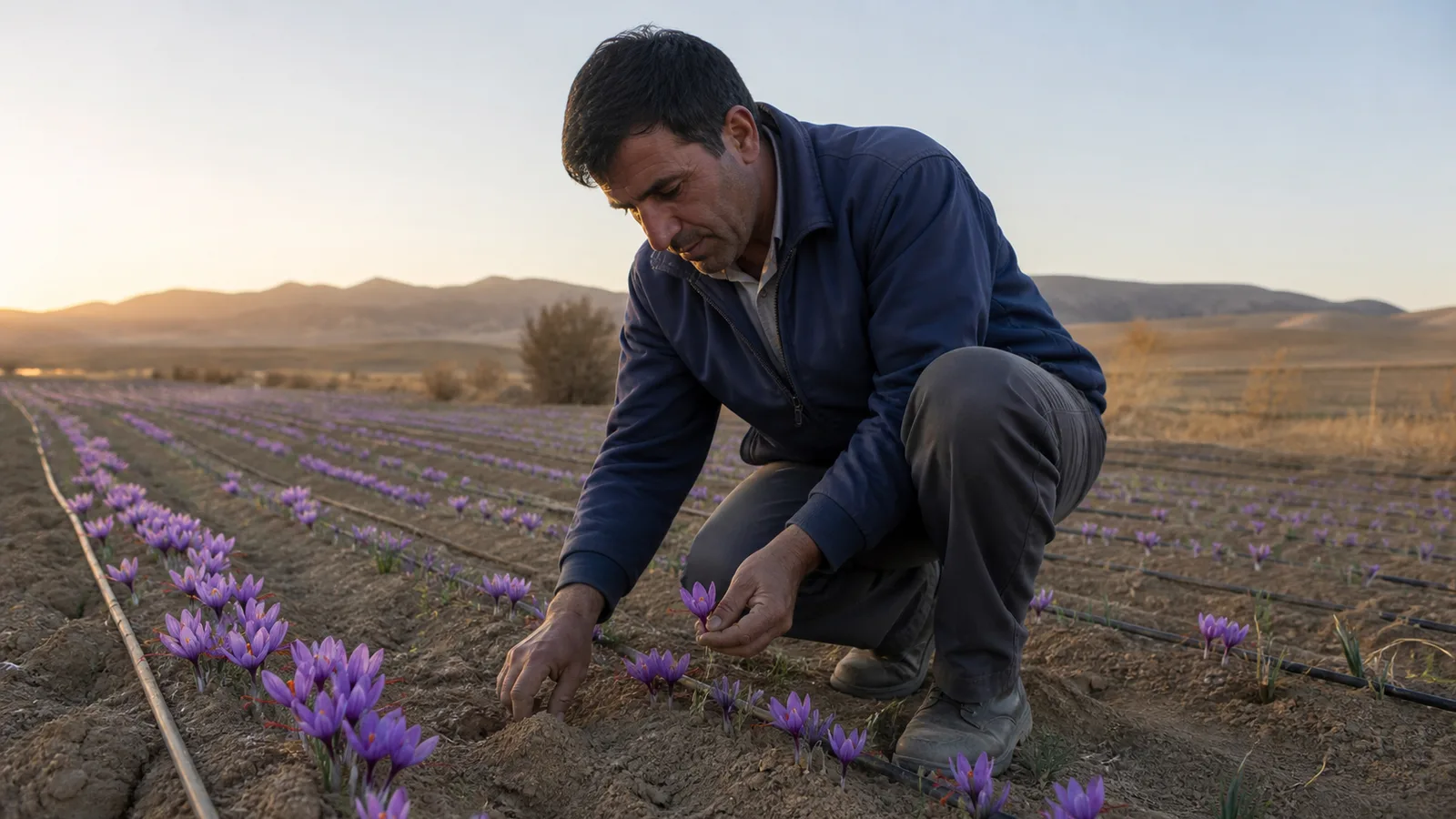
Sadeghi put average Iranian saffron yield at 3,500 grams per hectare—3.5 kg—and proposed a target of 10 kg per hectare. He argued that higher productivity could maintain output on less land, lower cost and help Iran compete with Afghanistan and China.
A 10 kg target is not a guarantee for every field. Saffron stigma yield changes with corm size and health, field age, planting density, soil, temperature, irrigation timing, nutrition, weeds, disease and harvest labour. A target should be evaluated against local trial results and the cost of achieving it, not imposed by arithmetic alone.
Field experiments confirm that management can make a large difference. A Ferdowsi University of Mashhad irrigation and nutrient study recorded treatment-dependent changes in flowers, dry stigma yield, quality compounds and water productivity. Its best result came from one experimental combination at one station; it does not prove that the same input package is optimal across Khorasan.
Why the land-area arithmetic needs correction
The archived statement first said 80,000 hectares were under saffron and should be reduced. It then calculated from 90,000 hectares. Those cannot both describe the same area at the same moment.
Using its second set of numbers, 90,000 hectares at 3.5 kg per hectare would yield 315,000 kg. Producing the same amount at 10 kg per hectare would require 31,500 hectares, not exactly 30,000. The difference is 58,500 hectares, which explains the speech’s rounded reference to 60,000 hectares.
This does not mean that removing saffron from 60,000 hectares automatically “saves” every litre previously used there. Land may move to another crop, irrigation needs vary by site, and yield intensification can require more carefully timed water or other inputs. The useful goal is water productivity—marketable stigma produced per unit of water—alongside soil health and farm income.
Is pressurised irrigation the answer?
Sadeghi named irrigation under pressure as one way to improve saffron production efficiency. Drip or other pressurised systems can improve control and reduce some conveyance losses when they are well designed, maintained and scheduled. They are not automatically the right answer for every field, water source or farm budget.
Timing is especially important because saffron’s water demand changes across corm establishment, flowering and leaf growth. Too little water can reduce flowers and daughter-corm development; excessive or poorly drained irrigation can increase disease risk. The system, soil and local climate need to be evaluated together.
The FAO-recognised qanat-based saffron system in Gonabad is a useful reminder that efficiency is not limited to one technology. It links a lower-water crop with locally adapted water distribution, traditional knowledge and farm livelihoods in an arid region.
Protecting cultivation means more than expanding or shrinking hectares
The choice is not simply between preserving every planted hectare and concentrating the entire crop into a smaller zone. A resilient Khorasan saffron system needs several things at once:
- healthy, appropriately sized corms and field renewal before crowding reduces performance;
- irrigation scheduled for soil, climate and field age rather than a fixed calendar alone;
- practical finance so growers are not forced to sell immediately after harvest;
- training and local trials that measure yield, quality, water and input cost together;
- drying, grading, traceability and packaging that retain regional value; and
- market access that rewards quality rather than only low production cost.
The regional identity issue is not unique to Khorasan. Our archival review of Bonab and Marand saffron production shows how a crop can lose its local name when traceability and processing do not stay connected to the farm.
What remains valid in the warning
The original numbers cannot describe 2026 without new data, and its province names, cultivated areas and employment totals are internally inconsistent. Yet the central warning remains useful: a high-value crop can still become fragile when growers lack cash, yields remain uneven, water is poorly managed and origin value is captured elsewhere.
Preventing the loss of saffron cultivation in Razavi and South Khorasan therefore means protecting a working system, not chasing one headline yield. Productivity, water stewardship, grower bargaining power, quality and regional identity must improve together.

![Exporting Saffron to Turkey + Price Guide [Complete 0 to 100]](https://img.rowhanisaffron.com/20260827003933/saffron-export-turkey-quality-inspection.webp)



