


“Saffron and medicinal plants: a new approach to cultivation in Isfahan” described the province’s 2019/20 response to water pressure, orchard losses and the need for crops with better value per unit of land and water.
The figures came from Ahmad Reza Raeizzadeh, then identified as the director of horticulture for Isfahan’s Agricultural Jihad organization. His comments covered far more than saffron: apples, greenhouse vegetables, pomegranates, nuts, crop insurance and drought all formed part of the same provincial picture. Because the report is historical, its acreage, production totals and forecasts are preserved below as dated statements rather than presented as current statistics.
Why Isfahan was reconsidering its crop pattern
Water was the thread running through the report. Raeizzadeh said Isfahan was not pursuing a general expansion of orchards because water resources could not support it. New planting would instead depend on farmers replacing crops such as wheat and barley or changing the way existing agricultural land was used.
This distinction matters. Calling saffron or medicinal plants “low-water crops” does not mean every species, field or production method has the same water footprint. It means the provincial policy was favouring selected higher-value crops and protected cultivation where they appeared better suited to local limits. Soil, groundwater condition, irrigation efficiency, market access and the life of a perennial planting still have to be assessed at farm level.
Apple production, frost and the Semirom crop
Apples were the largest horticultural product discussed. Raeizzadeh reported a 190,000-tonne apple harvest in Isfahan Province in Iranian year 1398, roughly 2019/20. He said about 90% of the province’s apples came from Semirom, an area known nationally for the fruit.
The preceding year, 1397 or 2018/19, had been marked by frost and drought. The old article gives a figure of 125,000 for that harvest but omits the unit; it should not be silently converted into tonnes without the original statistical table. Raeizzadeh described the following crop as more than 50% larger and remained concerned that frost could damage the new season, although later flowering might reduce the impact.
Those details show why annual output needs context. A sharp increase after a damaged season can be a recovery rather than long-term growth. Weather, flowering dates, insurance coverage and water availability can matter as much as planted area.
Greenhouse cultivation as another part of the strategy
The report placed approximately 2,000 hectares of Isfahan land under greenhouses in 1398. Bell peppers, tomatoes, cucumbers and eggplants were named as the main crops, with combined production reported at 280,000 tonnes.
Provincial support included lower-cost finance and faster licensing. Raeizzadeh said greenhouse area had recently been increasing by around 150 hectares a year and associated the latest expansion with a 12% rise in crop production. He also described a five-year plan to exceed 3,600 hectares and to double production and employment.
That 3,600-hectare figure was a forward target, not a result. The report also presented greenhouse work as steadier than seasonal field employment and said produce was being exported to Russia, Iraq and Persian Gulf countries despite trade restrictions. These claims belong to the period in which the interview was given; they do not establish today’s greenhouse area, workforce or export destinations.
Pomegranates, nuts and uninsured orchards
Pomegranates ranked behind apples and greenhouse produce in the old account, with production put at 70,000 tonnes. Lighter dried-fruit and nut crops, including almonds and pistachios, were grouped at about 5,000 tonnes.
Risk coverage was a serious weakness. Raeizzadeh estimated that only about half of Isfahan’s orchards were insured. He said insured gardens could receive compensation after events such as frost or flooding, while many growers whose land seemed less exposed chose not to buy cover. Poultry insurance was described as compulsory, but horticultural insurance was not.
He also called 1397 the final year of a drought period severe enough to destroy 3,000 hectares of orchards. That loss helps explain why the province was cautious about simply adding more gardens. Insurance can soften a financial shock, but it cannot replace depleted water or restore mature trees immediately.
Why saffron and medicinal plants were singled out
Against that background, Isfahan’s support for saffron and medicinal plants was presented as a change in cultivation pattern. The appeal was not merely that the crops could survive with less water than some alternatives. They also offered value, processing opportunities and a way to diversify farming across the province.
Saffron cultivation in Isfahan
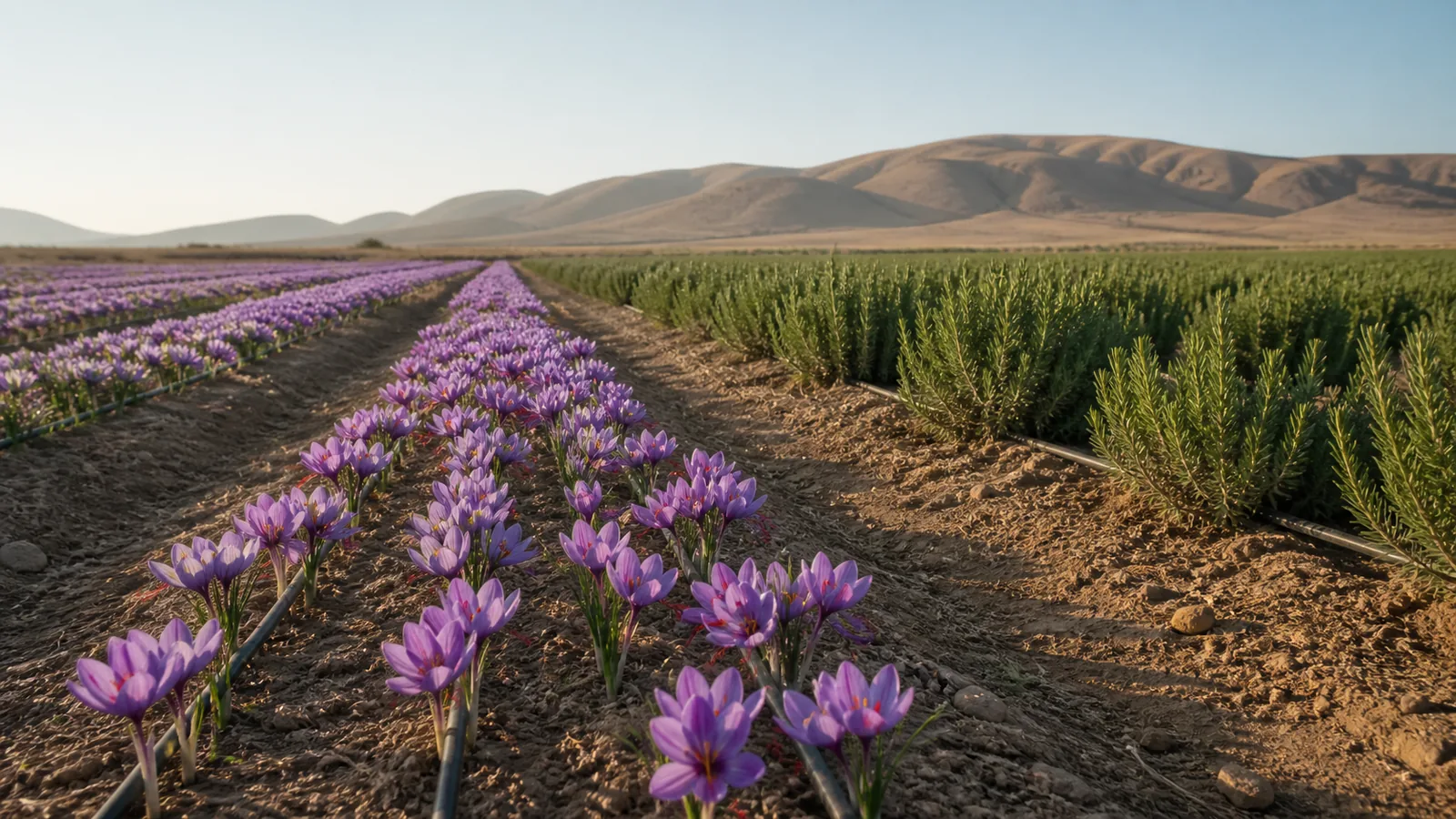
Raeizzadeh put Isfahan’s saffron area at 1,400 hectares and said the province ranked fourth nationally after Razavi Khorasan, South Khorasan and North Khorasan. Natanz, Najafabad, Tiran and Kroon were identified as its main cultivation areas.
A provincial rank is meaningful only when the year and metric are clear. The statement concerned the period of the report and appears to refer to production, while the 1,400-hectare figure concerns planted area. Neither should be treated as a current league table. Readers considering the crop also need to look beyond acreage to corm quality, field age, irrigation timing, harvest labour, drying, grading and a realistic sales route. Our practical saffron cultivation guidance explains those field-level considerations.
Medicinal and aromatic crops
The article reported 3,000 hectares of medicinal plants in Isfahan in 1398, a 30% increase from the previous year. It listed thyme, fenugreek, garlic, mint, rosemary, parsley, tarragon, cumin and shallot among crops grown across 22 counties. Total production was given as 37,000 tonnes, although the old translation calls these “dried plants” without explaining whether the number refers to dried material, harvested crop or a broader administrative category.
Mohammadi flower, commonly known in English as Damask rose, was mentioned separately. That separation is worth retaining because rose cultivation and processing may be counted apart from the other medicinal and aromatic plants in local statistics.
The label “medicinal” describes a crop category; it does not prove that every product made from these plants treats a condition. Cultivation decisions should be based on suitable varieties, water and soil needs, permitted uses, processing capacity, residue and quality requirements, and confirmed buyers—not on unsupported health promises.
What official evidence supports today
FAO’s account of the Qanat Irrigated Agricultural Heritage Systems in Kashan, Isfahan supports the wider agricultural setting. It describes qanat-fed farming in a dry landscape and identifies saffron, pomegranates, pistachios, roses and other locally important crops. It does not verify the interview’s 2019/20 provincial totals.
More recent FAO work on Iran’s saffron sector emphasizes water and climate pressure alongside post-harvest handling, traceability, safety, quality integrity, marketing and branding. That is a useful reminder that changing what farmers grow is only the first step. A durable cultivation policy also needs dependable quality systems and markets able to reward the crop.
How to read the Isfahan figures
The report is best used as a dated snapshot of a policy shift. Its central point survives: after drought and orchard damage, Isfahan was looking toward greenhouses, saffron and medicinal plants while limiting water-intensive expansion. The exact figures—190,000 tonnes of apples, 280,000 tonnes of greenhouse produce, 70,000 tonnes of pomegranates, 3,000 hectares lost to drought, 1,400 hectares of saffron and 3,000 hectares of medicinal crops—should be checked against a current provincial dataset before they guide an investment or planting decision.
For growers, the sensible next question is not simply which crop uses less water. It is which crop fits the specific land, has a workable irrigation plan, can be harvested and processed to an accepted standard, and already has a credible buyer. That is the practical meaning of a new cultivation approach.

![Exporting Saffron to Turkey + Price Guide [Complete 0 to 100]](https://img.rowhanisaffron.com/20260827003933/saffron-export-turkey-quality-inspection.webp)



