


Bonab and Marand were described as saffron production hubs in northwestern Iran, but local growers lacked the drying, packaging and market identity needed to sell the crop under their own names. According to the agricultural account preserved here, much of the harvest entered trade channels as Khorasan saffron.
Editorial context: the production figures, planting dates and institutional conditions below come from an archival interview with medicinal-plants academic Saeedeh Alizadeh Saleteh of Tabriz University. They describe the period of the original report and should not be read as verified 2026 statistics. The named places, methods and figures are retained, while botanical and health claims are clarified.
Why Bonab and Marand saffron lost its regional name
Alizadeh identified Bonab and Marand as important saffron-growing areas in northwestern Iran. The old first sentence said “Bonab and Tabriz,” contradicting both the title and the rest of the report; the interview’s sustained comparison concerns Bonab and Marand.
Flowers were traditionally dried and local access to mechanised packaging was limited. Growers therefore sold the product in bulk, after which traders packaged it under the commercially familiar Khorasan name for domestic and export markets. That account describes a traceability and value-chain problem rather than a defect in the crop.
A regional saffron identity needs more than a place name on a box. Each lot must remain linked to its farm and harvest, then pass through controlled stigma separation, drying, grading, storage and packing. Without that chain, buyers cannot verify where the saffron was cultivated.
A small commercial yield from each hectare
Saffron is a perennial crop. Once a field is established, daughter corms multiply underground and a planting can remain productive for several years before crowding and disease pressure make lifting and replanting useful. Alizadeh put the local production cycle at seven or eight harvest years.
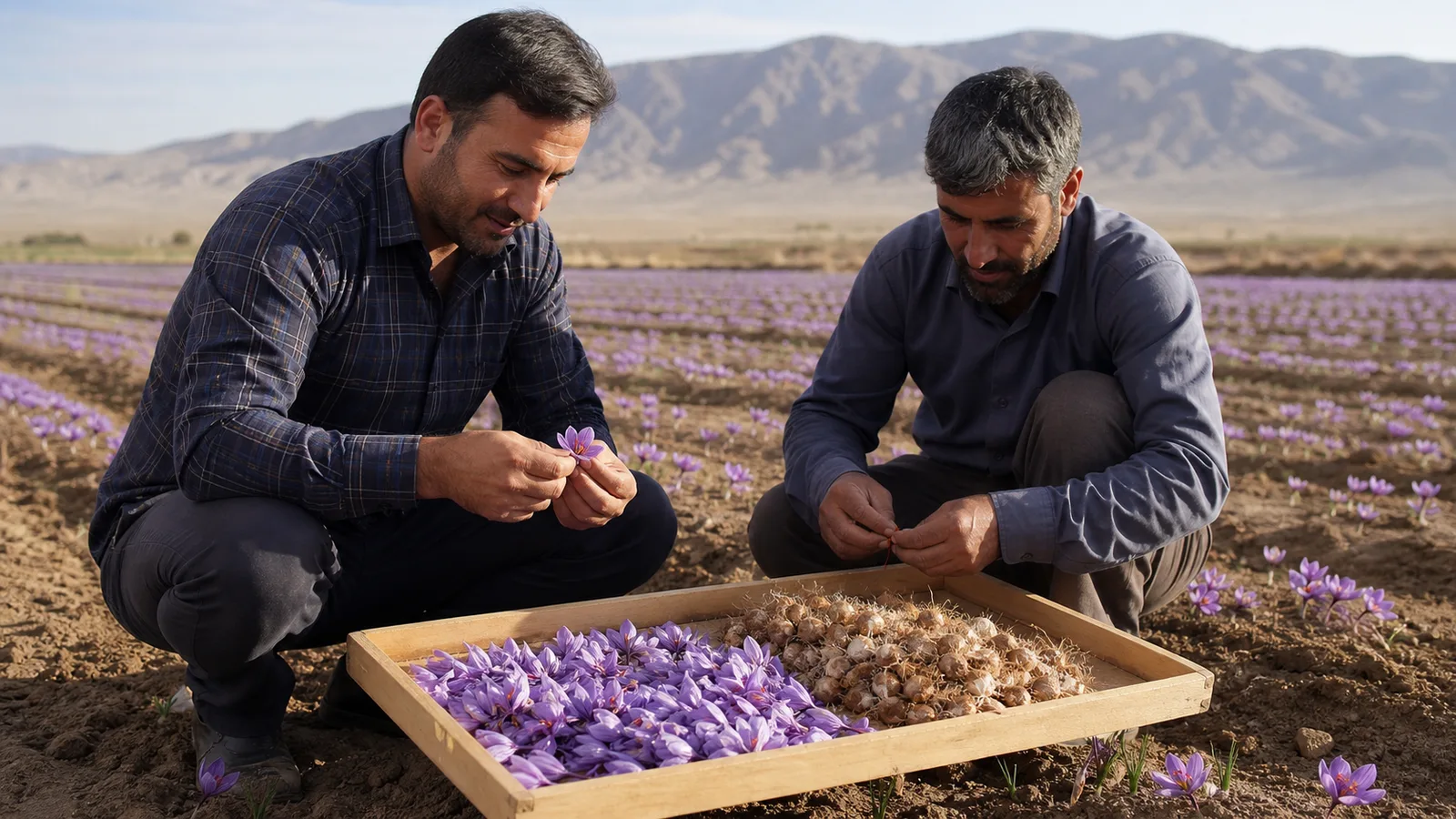
The spice consists of the dried red stigmas. Each flower carries only three, so a field produces a very small mass of commercial saffron compared with the volume of flowers and labour involved. The report estimated four to five kilograms from one hectare. That is an attributed historical yield, not a guarantee for every farm.
Yield varies with corm size and health, planting density, soil drainage, climate, irrigation, nutrition, weed pressure, harvest timing and the age of the field. High price reflects scarce usable material and intensive hand work, but market grade and authenticity also matter.
Saffron is propagated by corms
Cultivated Crocus sativus is sterile and does not produce viable seed for normal propagation. Farmers multiply it vegetatively using corms—solid underground storage organs sometimes called bulbs in everyday speech. A botanical review of saffron taxonomy and cytology discusses this sterile triploid crop and its vegetative reproduction.
Alizadeh described September planting and November flowering in the local calendar. Those months are useful historical regional guidance, not a universal schedule: soil temperature, altitude and seasonal weather change the workable dates. In many fields flowers emerge in autumn and the narrow leaves develop at or after flowering, remaining active through the cooler winter months.
Why the northwest attracted growers
The report highlighted a short flowering period, relatively low water demand once the crop is established, and tolerance of dry and cold conditions. Those traits can suit parts of northwestern Iran, but “drought resistant” does not mean no water or no risk. Irrigation timing still affects flower initiation and corm growth, while standing water can encourage rot.
A light, well-drained soil makes corm establishment and lifting easier. Fertility should come from a soil-informed plan. The original recommendation for “sufficient livestock manure” needs a hygiene qualification: manure should be properly treated and applied in a way that manages pathogens, salts and runoff. More manure is not automatically better.
Bunch and row planting methods
Alizadeh described two conventional systems:
- Bunch planting: three to five corms placed upright in a prepared hole, with holes about 20 cm apart in the account.
- Row planting: corms arranged more uniformly in rows, making mechanised field operations easier.
The best spacing is not one fixed number. Corm size, machinery, soil, irrigation and the planned number of years before lifting all influence density. Crowding may give many flowers initially but can reduce corm space and make disease management harder later.
Bonab and Marand compared with Khorasan
Alizadeh argued that saffron grown in Bonab and Marand was often superior to Khorasan saffron. The interview linked part of the difference to planting depth, saying corms in the northwest were planted about five centimetres differently and at roughly 20 cm.
That is a regional expert’s claim, not a result this article can generalise to every lot. Origin and depth alone do not prove quality. A credible comparison requires representative sampling and standard measurements of colouring strength, aroma-related compounds, moisture, foreign matter and other quality criteria. Excellent saffron can come from more than one province, and poor drying can damage a strong harvest from any field.
What creates saffron’s colour, aroma and taste
The report named three important chemical groups, but their roles need precise wording:
- Crocins are water-soluble carotenoid pigments chiefly associated with saffron’s golden colour.
- Safranal is a volatile compound that contributes strongly to characteristic aroma.
- Picrocrocin contributes bitterness and is also a precursor involved in aroma development during drying.
The old sentence said safranal and picrocrocin jointly “create” aroma and taste. Drying and storage alter these compounds, so post-harvest technique is part of the final sensory quality.
Can other flower parts be used?
The previous translation referred to “flag, female and cream,” which are not clear English botanical terms. Saffron flowers leave petals or tepals, stamens and style tissue after the red stigmas are removed. Researchers have measured compounds and antioxidant activity in some of these by-products and explored colourants for dyeing, cosmetics and extracted ingredients.
Laboratory potential does not make every discarded flower part an approved food, medicine or cosmetic ingredient. Safety, contamination, extraction, formulation and local regulations still need to be addressed before commercial use.
Health claims need separate evidence
Mood
Saffron has been studied in human trials for mood symptoms. A 2026 review of 34 randomised trials found improvement on some self-reported depression and anxiety scales, but several clinician-rated outcomes did not show the same result and studies varied. Saffron is not a replacement for diagnosis, counselling or prescribed treatment.
Pregnancy
The archival warning said excessive saffron could cause miscarriage. A 2026 integrative review of saffron and pregnancy found culturally important practices but limited and inconsistent safety evidence. Small food amounts and concentrated medicinal exposure are not equivalent; regular supplements or strong infusions should be discussed with an obstetric clinician throughout pregnancy.
Cancer
Cell and animal research has explored saffron compounds in cancer models. Those are preclinical leads, not proof that saffron prevents or treats cancer in people. A field-production article should not turn antioxidant or cell-culture findings into a medical promise.
What would strengthen a northwestern saffron hub
- farm-lot traceability that preserves Bonab or Marand origin;
- clean, rapid stigma separation and controlled drying;
- laboratory grading rather than unsupported superiority claims;
- cooperative access to packaging for small growers;
- storage that protects saffron from moisture, light and foreign odours;
- current published production data instead of recycled historical totals.
Bonab and Marand saffron production hubs had an agricultural base but an incomplete value chain. The lasting lesson is that local cultivation earns recognition only when origin, processing and quality stay connected all the way to the final package.

![Exporting Saffron to Turkey + Price Guide [Complete 0 to 100]](https://img.rowhanisaffron.com/20260827003933/saffron-export-turkey-quality-inspection.webp)



