Iranian researchers have conducted several clinical trials of saffron extract in people with Alzheimer disease. The findings are interesting, but they do not show that saffron prevents or cures the disease, and they are not a reason to replace prescribed treatment. What the studies offer is an early signal that standardized saffron extracts deserve further investigation.
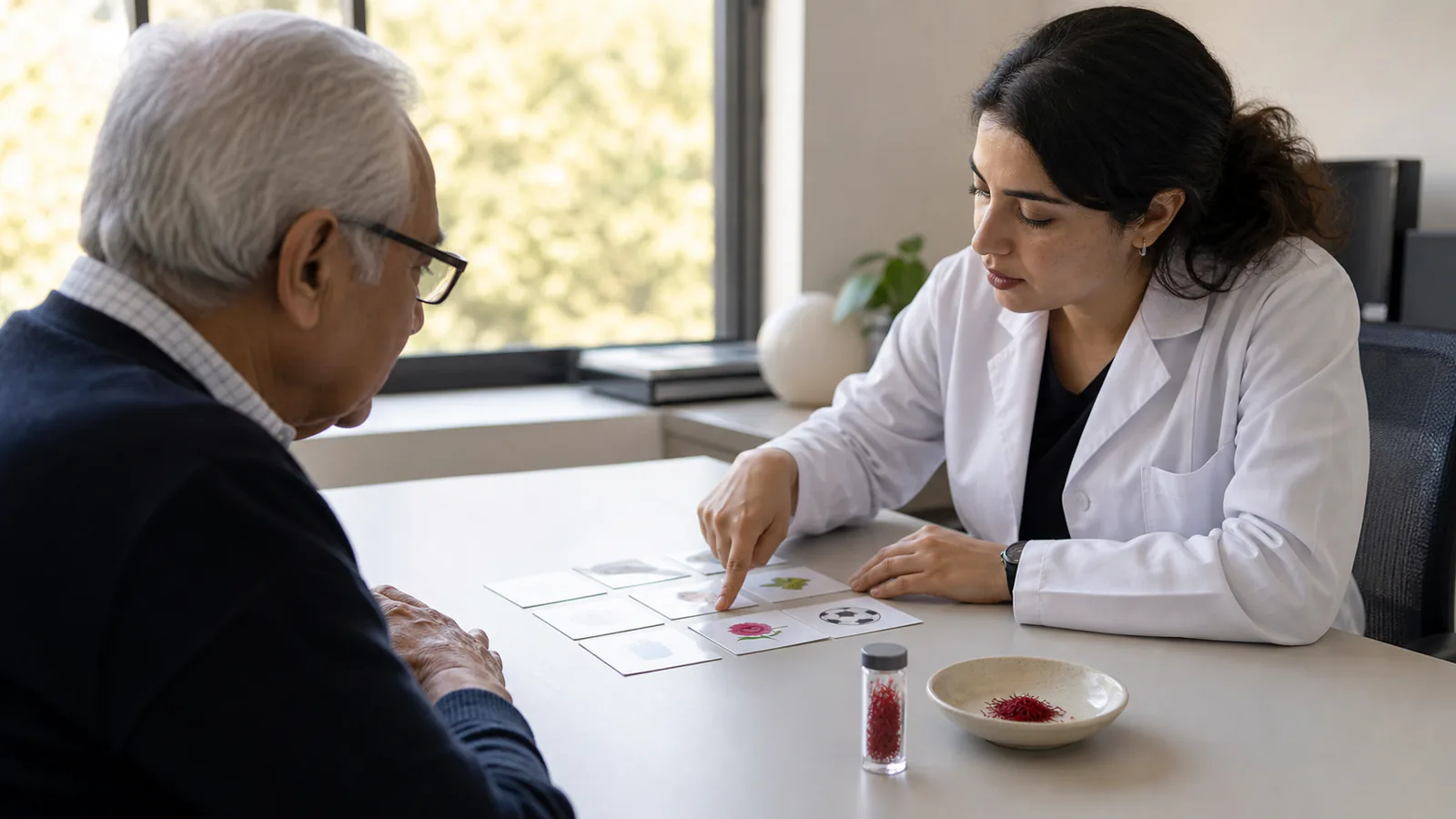
What the Iranian saffron studies actually found
The research most often discussed comes from university teams in Iran. Their trials used measured extracts and formal cognitive assessments, not saffron added casually to food or tea. Three studies are particularly relevant.
Saffron compared with placebo
In a 16-week randomized, double-blind study, 46 people with probable mild-to-moderate Alzheimer disease were screened and assigned to a saffron extract or placebo. The saffron group performed better on the study’s cognitive and clinical rating measures. Adverse events did not differ significantly between the groups.
This was a small, short trial. It suggests a possible symptomatic effect, but it cannot establish long-term benefit or show whether saffron changes the underlying course of the disease.
Saffron compared with donepezil
A separate 22-week phase II trial enrolled 54 adults with mild-to-moderate Alzheimer disease. Participants received either a standardized saffron extract or donepezil. The researchers reported no significant difference between the groups on their main cognitive and clinical outcomes, while vomiting occurred more often in the donepezil group.
“No significant difference” does not prove that two treatments are equivalent in every respect. With a modest sample and limited follow-up, the result is preliminary. It also does not justify switching medicines without medical supervision.
Saffron compared with memantine
A 12-month randomized trial compared saffron extract with memantine in 68 people with moderate-to-severe Alzheimer disease. The researchers found no significant difference between groups on the study’s cognitive and functional scales. They again called for larger and longer trials.
Taken together, these studies show why saffron attracted scientific attention. They do not establish it as an approved substitute for Alzheimer medication.
Why the evidence remains preliminary
A systematic review of five randomized trials involving 325 participants described the results as promising, while also identifying potentially high risk of bias and the need for larger, more rigorous studies. That caution matters. Small studies can overestimate an effect, and findings from one standardized extract do not automatically apply to every saffron product.
- Participant numbers were small. A few dozen people cannot represent everyone living with Alzheimer disease.
- The preparations were controlled. Trial extracts had defined quantities and protocols; retail products may differ.
- Rating scales measure symptoms and function. A change on a scale is not proof that brain pathology has slowed.
- Safety evidence is limited. A trial that reports similar adverse events over several months cannot prove safety for every person, dose, medicine combination or age group.
You can read more about how the compound research fits into the wider evidence in our review of saffron extract and memory. For a practical distinction between food use, supplements and study formulations, see our guide to saffron and memory.
What happened to the reported Iranian saffron medication?
An older news report behind this article referred to a product called “Safrotin” and said that it had received approval to enter the market. We have not found a product registration, manufacturer record or published clinical trial that reliably connects that name with the Alzheimer studies above. Without those records, its regulatory status and formulation cannot be verified.
The peer-reviewed Iranian trials are real and traceable. The stronger way to discuss them is by their published designs and results, not by treating an unverified product announcement as proof of an available medicine. Claims that saffron is safe for all ages, prevents Alzheimer disease or can replace imported medicine also go beyond what those trials established.
What this means for patients and families
Memory changes can have many causes, so assessment by a qualified clinician comes first. The US National Institute on Aging advises that no vitamin or supplement has been proved to prevent Alzheimer disease. It also warns that unproven products may interfere with other treatment.
Anyone diagnosed with Alzheimer disease should discuss saffron or any concentrated botanical extract with the clinician managing their care. Do not stop, reduce or replace a prescribed medicine because of a supplement claim or a small clinical trial. This is especially important when the person takes several medicines, has other health conditions, is pregnant, or has a known allergy.
How to read future saffron and Alzheimer claims
A reliable claim should let you answer a few basic questions:
- Was the research conducted in people, rather than only in cells or animals?
- Was it randomized and controlled, and how many people took part?
- What exact extract was studied, for how long, and against what comparison?
- Did the study measure symptoms, daily function, biomarkers or disease progression?
- Have larger independent studies reproduced the finding?
Iranian saffron and Alzheimer disease research has produced a credible early body of clinical evidence. The responsible conclusion is narrow: standardized extracts showed encouraging results in several small trials, but prevention, cure, broad safety and medication-replacement claims remain unproven.