


Iranian saffron benefits for health are being studied, but the evidence is much narrower than many online claims suggest. Human research is most developed for mood symptoms and age-related macular degeneration (AMD). Even there, most studies used measured supplements or extracts, not a few threads in food, and the results do not prove that saffron prevents blindness, cancer or Alzheimer’s disease.
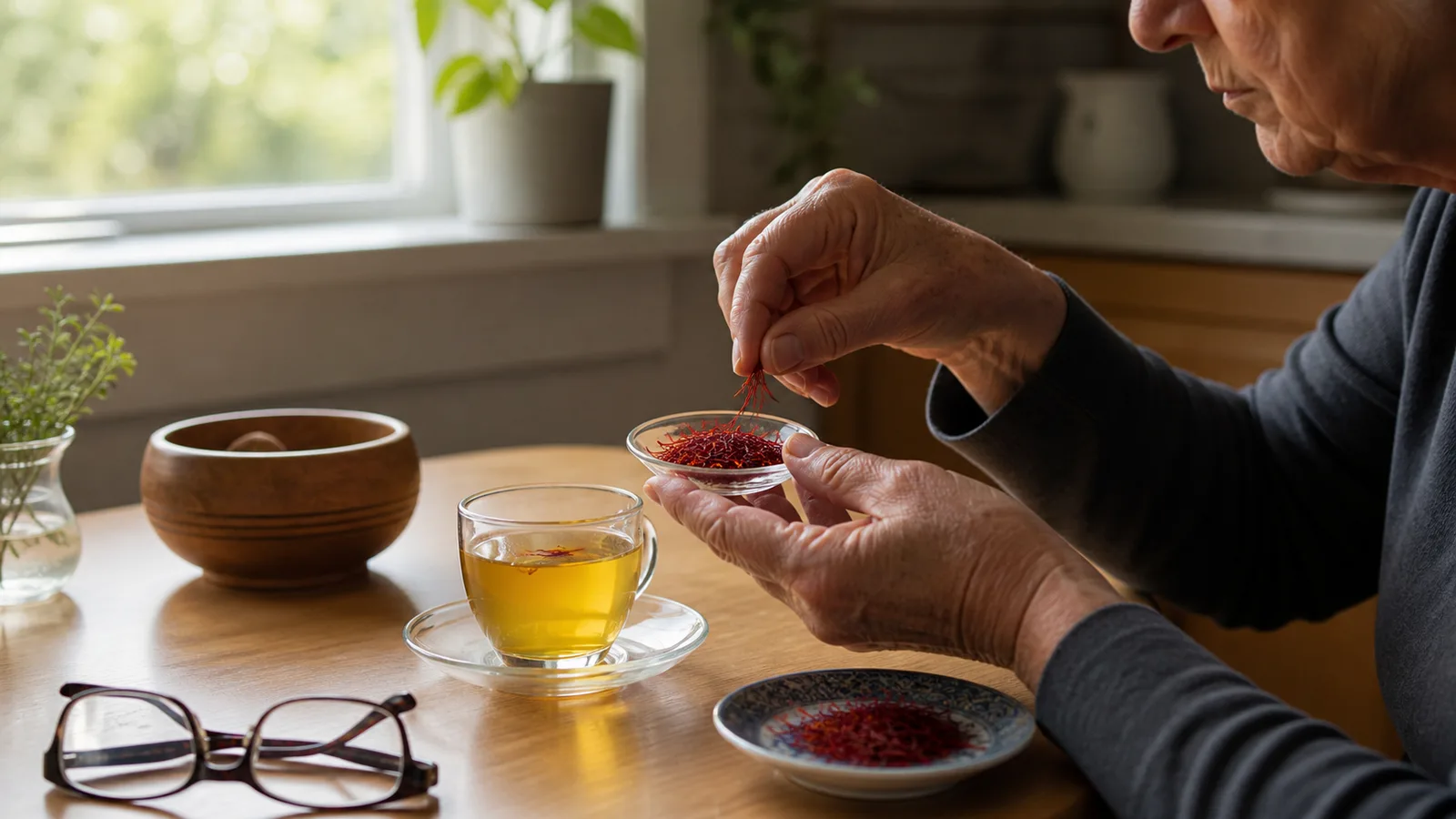
That distinction matters. Iranian saffron is a valued spice with crocin-related pigments, picrocrocin and safranal, yet a food can contain interesting compounds without becoming a treatment. This guide separates culinary use, traditional use and clinical research so you can understand what is promising, what remains uncertain and what should not be claimed.
Does Iranian saffron have different health effects?
Iran is a major saffron producer, and origin can matter to flavour, freshness, traceability and buying confidence. It does not by itself establish a stronger medical effect. Health studies usually identify the plant as Crocus sativus, then specify a powder, extract or isolated constituent and a measured dose. Results from one preparation cannot automatically be transferred to every Iranian saffron product.
The same caution applies to names such as sargol, negin, pushal and dokhtar-pich, sometimes translated as bunch saffron. These describe how much of the stigma and style remains and how the threads are presented. They are commercial forms, not separate medicines. A very red grade may have strong colouring power, but appearance alone cannot prove authenticity or predict a clinical outcome.
What the human evidence says about mood
Mood is one of the better-researched areas. A 2026 GRADE-assessed systematic review combined 34 randomised controlled trials involving 1,769 adults. Saffron improved scores on the self-reported Beck depression and anxiety scales on average, but it did not produce significant effects on several clinician-rated scales. Results also varied greatly between studies. The authors judged the certainty as moderate and described saffron as a possible complementary intervention.
That is not the same as saying saffron “relaxes the nerves” or treats depression. Someone with persistent low mood, anxiety, suicidal thoughts or a diagnosed condition needs appropriate care. A supplement should not replace prescribed treatment, and changing psychiatric medication without the prescriber’s help can be dangerous.
Saffron and eye health: promising research, not blindness prevention
The three older articles being consolidated here all described saffron as a way to preserve sight. Their common starting point was genuine research, but their conclusions went too far. The clearest human signal concerns people who already have AMD; it is not proof that ordinary saffron consumption prevents blindness in healthy adults.
What happened in the three-month AMD trial?
In a 2010 double-blind crossover trial, 25 people with early AMD received 20 mg of saffron a day or placebo for three months and then crossed to the other intervention. Retinal flicker sensitivity, measured by focal electroretinography, improved during the saffron period. The researchers themselves said that the result needed replication and that its clinical significance remained to be evaluated.
This is the “three-month pill” study behind the source articles. It did not show that damaged eye cells were repaired, that blindness was prevented or that everyone should take saffron. It measured a particular retinal response in a small group with a diagnosed condition.
What later research adds
A six-month randomised trial of 60 people reported some changes in retinal-function measures at three months, although several differences were not significant at six months. A later 12-month open-label study of 93 adults found modest improvements in some multifocal electroretinogram responses. It had no placebo group, and average best-corrected visual acuity was slightly worse at 12 months, possibly because of cataract progression.
Taken together, these studies make saffron an interesting research subject and a possible adjunct for selected patients. They do not place it alongside established AMD care. The US National Eye Institute explains that management depends on the stage and type of AMD and can include monitoring, AREDS2 nutrients for eligible patients, injections or photodynamic therapy. Sudden distortion, a new central blur or straight lines appearing wavy needs prompt eye assessment.
Bright light, “natural sunglasses” and inherited retinal disease
The vivid “natural sunglasses” description came from animal work, not a human sun-protection trial. In a 2008 study in albino rats, saffron given before intense continuous light reduced photoreceptor damage. Related laboratory studies explored programmed cell death, stress pathways and gene regulation. Animal retinas exposed under experimental conditions cannot establish that saffron protects a person’s eyes from sunlight. Sunglasses with appropriate ultraviolet protection still do that job.
The older posts also confused retinitis pigmentosa with “retinal pigment inflammation” and night blindness. These are not interchangeable terms. A small trial in 31 people with ABCA4-related Stargardt disease found no improvement in visual acuity and called for longer-term research. There is not enough human evidence here to recommend saffron for retinitis pigmentosa or inherited night blindness.
What about memory and Alzheimer’s disease?
Small clinical trials have studied saffron in people who already had mild cognitive impairment or Alzheimer’s disease. A systematic review of four randomised trials found possible improvements on some cognitive scales but concluded that there was insufficient high-quality evidence to recommend clinical use. These treatment studies do not show that saffron prevents Alzheimer’s disease in a healthy person.
Memory changes deserve medical assessment because medicines, sleep problems, mood disorders, vitamin deficiencies and several illnesses can contribute. Adding saffron to food can be enjoyable, but it is not a substitute for diagnosis or evidence-based dementia care.
Why the cancer claims should not be repeated
The former destination said that saffron prevented cancer-causing genetic mutations and stopped liver-cancer cells from growing. Those are treatment claims, and the post did not support them with human clinical evidence. Laboratory experiments involving cells or animals can help researchers choose what to study next; they cannot show that eating saffron prevents cancer or that a saffron product treats liver cancer.
Anyone being investigated or treated for cancer should discuss supplements with the oncology team. Concentrated products can introduce interactions, side effects or delays in effective care. Culinary saffron may remain part of a normal diet if the care team has not advised otherwise, but it should not be presented as anticancer therapy.
Can saffron brighten skin or treat acne?
Traditional recipes combine saffron with milk, sandalwood or basil for the skin. The previous article turned those recipes into promises of purification, lightening and acne treatment. Robust human trials do not establish those effects, and homemade mixtures can irritate skin or trigger allergy. Milk and plant material also do not make a sterile treatment.
If you choose to use a cosmetic product containing saffron, check the full ingredient list and follow its directions. Stop if irritation develops. Persistent acne, scarring, a changing pigmented lesion or a rash near the eyes deserves professional advice rather than a kitchen remedy.
Quality, adulteration and the meaning of saffron grades
Health-conscious buying begins with genuine, clean saffron. Added plant fibres, dyes, sugar, salt or excess moisture can change weight and appearance. A customer cannot reliably identify every adulterant by looking at the threads or watching colour spread in water. The current ISO 3632-2 laboratory standard specifies methods for filament and powdered saffron, including identification and measurement procedures.
Choose a seller that provides traceability, batch information and appropriate testing instead of relying on claims that one town or one poetic grade name is automatically “the finest.” Natanz has a real saffron-growing tradition, but geography alone does not certify a particular packet. Whole threads are easier to examine than powder, although either form still needs trustworthy handling.
How to store saffron without losing aroma
Keep saffron dry, sealed and away from light and heat. A clean airtight container made from dark glass or another food-safe, light-blocking material is practical. Plastic is not automatically unsuitable; the seal, food-contact quality and protection from light matter more than a blanket rule about material.
Store threads whole when possible and grind only the amount you plan to use soon. Grinding increases surface area, so aroma is lost more quickly. For more on the compounds responsible for saffron’s colour, bitterness and aroma, see our guide to saffron ingredients.
Culinary saffron and supplements are not the same exposure
A few threads used in rice, tea or dessert are not equivalent to a capsule containing a measured daily amount. Trial products can also differ in extract composition and standardisation. That is why a research dose should not be copied from an article and converted into a home prescription.
A 2026 systematic review of saffron adverse events found that it was generally well tolerated in human studies, with gastrointestinal symptoms the most frequently reported effects. The authors nevertheless advised clinical monitoring for medicinal use at higher doses or over longer periods. Pregnancy, breastfeeding, a medical condition, planned surgery or regular medication are reasons to ask a qualified clinician before using a concentrated saffron product.
The practical conclusion
Iranian saffron benefits for health should be described in proportion to the evidence. Mood and AMD studies provide real but limited human signals; cognition research is preliminary; cancer prevention, blindness prevention, “natural sunglasses” and acne treatment are not established. Buy authentic saffron for its culinary qualities, store it carefully and treat any supplement as a distinct health product that deserves professional guidance.

![Exporting Saffron to Turkey + Price Guide [Complete 0 to 100]](https://img.rowhanisaffron.com/20260827003933/saffron-export-turkey-quality-inspection.webp)



