Iranian saffron exporters were worried about two different problems in 2015: corms allegedly leaving Iran for Afghanistan without authorization, and Iranian-grown spice losing its identity after export. A short ISNA report joined those issues together and used confrontational language about Afghan producers. The underlying trade questions were real. The generalizations were not a sound way to answer them.
This article reconstructs what the report actually said, keeps its dated figures and named viewpoints, and separates those claims from evidence that became available later. The former English headline, “Iranian saffron Afghan new security,” was a broken machine translation. It did not describe the article clearly and should not be read as a current security notice.
Why Iranian saffron and Afghan production were linked in the report
The October 2015 report began from Iran’s dominant position in saffron. It said the country produced more than 90 percent of the world’s supply, yet much of its export value was captured elsewhere. Spain and the United Arab Emirates were singled out as markets where bulk Iranian saffron could be repacked and sent onward under a different commercial identity.
A second concern involved saffron corms, the underground planting material from which Crocus sativus grows. The report alleged that Iranian corms had been moved illegally across the eastern border into Afghanistan. Shams-Ali Hadizadeh Moallem, then identified as head of the Agriculture Commission at Iran’s Chamber of Commerce, described that movement as another threat to Iranian saffron.
Mohammad Hossein Roshanak, identified as head of the Trade Commission at the Mashhad Chamber of Commerce, Industry, Mines and Agriculture, took a more resigned view. He told ISNA that sending corms to Afghanistan was illegal, but argued that the long, busy border made the movement difficult to prevent and that enough material had already crossed for a simple border response to have limited effect.
Those statements are historical allegations by the people quoted. The stored article contained no seizure record, court finding or traceability evidence proving where particular Afghan plantings originated. It would be misleading to turn the report into a present-day claim about all cross-border trade or all Afghan growers.
The export figures and the value lost after harvest
The ISNA account said Iran had exported 126 tonnes of saffron to 45 countries in the preceding year. It also claimed that almost half was sent through countries such as Spain and the UAE, repacked, and then supplied to final markets under those countries’ names. Because the report did not publish its underlying customs table, both numbers are best treated as figures reported at the time.
A separate Iranian submission to the FAO/WHO Codex Committee later listed 121.573 tonnes for 2015. Its market table showed the UAE taking 43.414 tonnes and Spain 28.817 tonnes. Together, those two destinations represented a substantial share of Iranian exports, but a destination record alone does not prove how every shipment was labelled or where it was ultimately sold.
The distinction matters. Exporting bulk saffron to a trading or packaging centre is ordinary commerce. Losing origin information, making a false origin claim, or selling a blend without a clear label is an authenticity problem. They should not be treated as the same act.
The report also described a practical barrier to small retail packs. A National Saffron Council member identified only as Hosseini said that sending 10 kilograms of saffron in small packages could produce more than 300 kilograms of gross shipping weight, depending on the packaging. That striking estimate was not supported with a pack specification, so it cannot be verified from the article alone. The larger point is easier to defend: many small boxes, jars and protective inserts add material, handling and freight costs that a bulk exporter does not face.
Our separate review of Iranian saffron exports to 44 markets in 2015 explains another customs period and its package-size bands. Keeping the datasets separate avoids creating a single false total from unlike reporting windows.
Afghan saffron cannot be judged by nationality
The original English text went beyond the corm allegation and asserted that saffron from Afghanistan lacked Iranian quality and did not follow hygienic production principles. No test results accompanied that claim. It is not responsible to repeat it as fact.
Afghanistan has its own established saffron sector, especially around Herat. The FAO profile for Herat-Bastan saffron describes a recognized regional product whose colour, aroma and taste are tied to local conditions and production practices. Afghanistan also adopted a Herat quality-control regulation in 2014 and a regulation on corm purchasing, distribution and cultivation development in 2015.
More importantly, quality can be measured. A 2024 peer-reviewed comparison of samples from Herat and Torbat Heydarieh found meaningful variation between individual districts and villages. Several Herat samples performed strongly for crocin and picrocrocin, while Iranian samples led on some safranal measurements. Nearly all tested samples met the study’s first-grade threshold. That evidence does not establish that every Afghan or Iranian batch is excellent. It shows why a blanket national ranking is the wrong tool.
For a buyer, the useful questions are much more specific:
- Can the seller identify the farm, harvest and processing batch?
- Was the saffron dried and stored under controlled conditions?
- Do laboratory results support its colour, aroma, flavour and purity claims?
- Does the label distinguish origin, packer and exporter accurately?
- Can the paperwork follow the product through repacking or resale?
A passport cannot answer any of those questions. Traceability and testing can.
What the Iranian trade representatives wanted changed
Roshanak’s proposed response was to give Iranian saffron a verifiable identity and export more of it under Iranian brands. In practical terms, that means preserving origin through the chain rather than relying on the buyer to remember where a bulk lot began.
Hadizadeh Moallem placed the problem in a wider agricultural-export setting. He said exporters were not consistently meeting market-specific standards or adapting products to customer requirements. He called for private investment, supported by government, in processing industries. He also wanted agricultural export rules to be predictable enough for a business to know the duties, incentives and support that would apply over a five-year period.
That is a more useful diagnosis than blaming a neighboring industry. Exporters make long-term decisions about dryers, laboratories, packaging lines and distribution agreements. Constantly changing costs or incentives make those investments harder to price. Poor processing or a label that does not meet the destination market’s rules can close a sale regardless of how good the raw saffron was.
The report’s final point concerned stable agricultural exports and hygienic production. It anticipated that better production requirements could improve the market. The claim should be kept modest: sanitation, controlled drying and clean packaging reduce avoidable risk, but they do not guarantee demand or a price premium by themselves.
Protecting origin without misrepresenting competitors
Iran’s place in saffron remains unusually large. FAO has described the country as contributing roughly 90 percent of global production, while also warning that adulteration and inconsistent post-harvest handling can erode trust. Its more recent work on saffron authenticity in Iran focuses on testing, traceability and value-chain controls.
Those measures address the two vulnerabilities underneath the 2015 dispute. A traceable lot is harder to relabel without leaving a documentary break. A tested batch gives a buyer something stronger than a national reputation. Accurate origin and processing records also allow an Iranian producer to keep credit for work that would otherwise disappear inside a foreign retail pack.
Branding still matters, but it has to rest on evidence. The wider problem is explored in our article on why the Iranian saffron brand risked being forgotten. A name on a box is only the final layer. Consistent grading, documented custody, honest labels and reliable supply are what make that name credible.
What remains unresolved from the 2015 account
The surviving report does not show how much planting material crossed the Iran–Afghanistan border, when it moved, or whether authorities verified the allegation. It does not provide the calculation behind the 10-to-300-kilogram packaging example. Nor does it demonstrate that half of the reported exports were ultimately sold under a false origin rather than simply traded through Spain or the UAE.
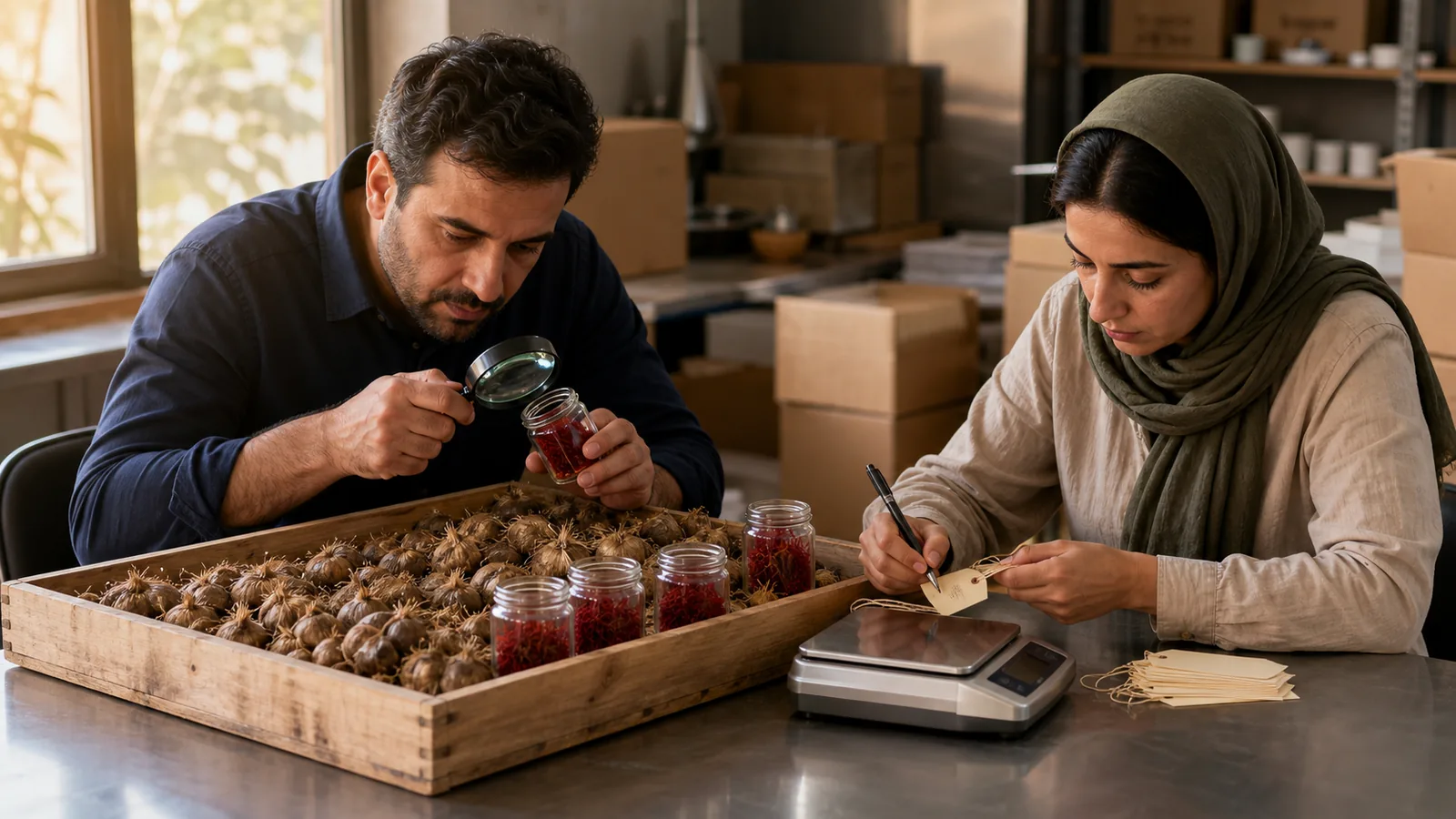
Those gaps do not make the trade concerns imaginary. They define what evidence would be needed to judge them. Shipment and customs records can document movement. Batch identifiers can preserve origin through repacking. Laboratory results can test quality and authenticity. Retail labels can be checked against the chain of custody.
The strongest lesson from the dispute is therefore narrower than its original rhetoric. Iranian saffron producers protect their value when the product remains identifiable from field to final pack. Afghan producers deserve to be assessed by the same standard. Competition between the two sectors is real; nationality-wide accusations are not a substitute for proof.

![Exporting Saffron to Turkey + Price Guide [Complete 0 to 100]](https://img.rowhanisaffron.com/20260827003933/saffron-export-turkey-quality-inspection.webp)