


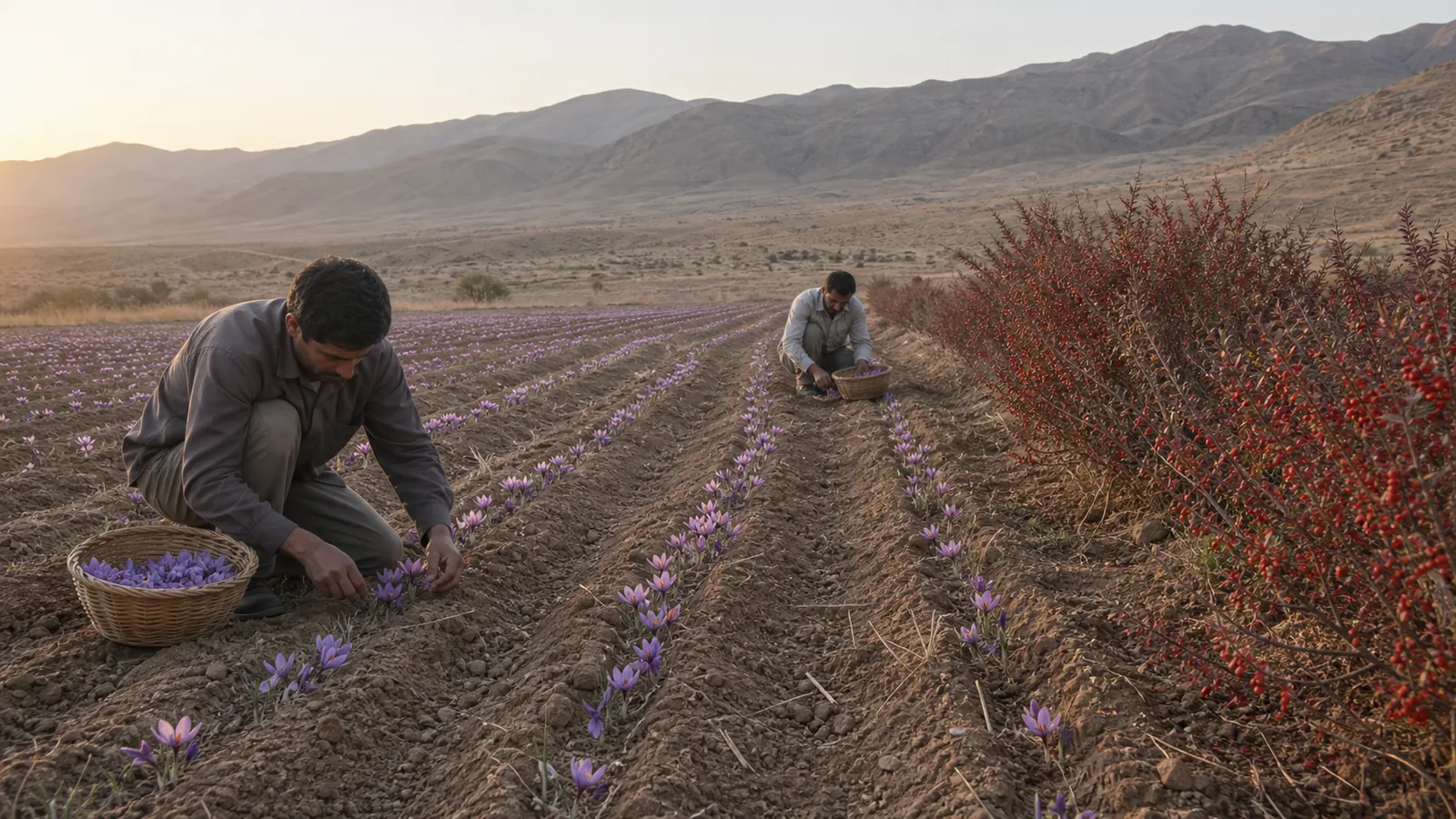
The width of the red desert was how a 2015 ISNA report described farmland around Zarand at harvest time. Saffron flowers coloured the ground purple and red; barberry shrubs carried their own deep-red crop. The view was beautiful, but the reason for changing the landscape was practical. Kerman Province was living with scarce groundwater, and local officials were encouraging crops they believed could return more value from a limited seasonal water supply.
The original English version damaged that story with literal translations and conflicting figures. Read carefully, it records two linked experiments: a small barberry programme in Dashtkhak and a much larger expansion of saffron across Zarand County. It also carries a warning that still matters. A lower-water crop can ease pressure, but it cannot repair an aquifer if total withdrawals continue to exceed recharge.
Why Zarand’s fields became a red desert
Ali Zarei, then identified as director of Agricultural Jihad in Zarand, described the county’s cooler districts as suitable for saffron and barberry. Repeated drought and declining well flows had made the existing crop pattern harder to sustain. Farmers in Dashtkhak responded by planting both crops, which the report presented as alternatives to expanding water demand from conventional orchards, including pistachios.
The comparison needs care. Saffron has a growth cycle that fits arid and semi-arid regions and generally needs less irrigation than many conventional crops. It is not waterless. Soil, corm density, field age, rainfall, salinity and the timing of each irrigation all affect the result. A change in crop name does not automatically produce a water saving.
The red-desert image therefore describes more than colour. It shows a farming community trying to keep land productive while the physical limits beneath it were becoming harder to ignore.
The 2015 barberry harvest in Dashtkhak
Zarei said barberry planting had begun in the Dashtkhak area in Persian year 1386, corresponding to 2007/08. By the 2015 report, 11 hectares were under the crop. Five hectares were productive and six had not yet reached bearing age.
The forecast was 700 kilograms of dried barberries. That total matches the reported average of 140 kilograms per productive hectare across the five bearing hectares. The harvest itself was expected to take about a week.
Zarei called Dashtkhak’s crop the finest barberry in the area and said his office would support farmers who expanded it in suitable mountain districts. That was an official’s local assessment, not the result of a published comparison. The article provided no measurements for berry size, moisture, colour, acidity or market grade.
Its more useful observation was structural. Six of the 11 hectares were still immature, so the planting area could not be read as current production capacity. Orchard crops take time to establish, and a headline area figure tells a buyer very little unless productive and non-productive hectares are separated.
Zarand’s saffron figures, kept in their original scope
The same report described Zarand as the leading saffron-producing county in Kerman Province and the origin of the desert’s “red gold.” Zarei gave an area of 170 hectares across Dashtkhak, Sarbanan and Hutkan, then named Dashtkhak, Sarbanan, Jorjafak and Hutkan as the county’s saffron-growing districts.
He forecast about 800 kilograms of dried saffron for that season and placed average yield at four to five kilograms per hectare. Eight hundred kilograms divided by 170 hectares is about 4.7 kilograms per hectare, so those two figures are internally compatible.
Other numbers in the article do not align as neatly. One passage said saffron area had risen by 10 hectares; a repeated version said 12. Zarei also referred to a model farmer whose yield had doubled, but the article gave neither the field’s before-and-after yields nor the practices responsible. Both details belong in the record, but neither supports a countywide productivity claim.
The most striking labour statement was that saffron harvest created daily employment for 12,000 people in Zarand. The report did not say whether that meant workers present on a peak day, seasonal participants counted over the harvest, or person-days. It should not be converted into 12,000 permanent jobs. What it does convey is the labour intensity of picking flowers quickly and separating stigmas while they are fresh.
Why the governor’s acreage did not match
Habibollah Khanjari, then governor of Zarand, supplied a second set of figures. He said 210 hectares in the county were planted with saffron, of which 160 hectares were productive. He also said planted area had increased fivefold from the previous agricultural year.
The article never reconciled his 210 hectares with Zarei’s 170, or the fivefold claim with the reported 10- or 12-hectare annual increase. The most plausible explanations are different geographic scopes, different cut-off dates, or a transcription error, but the surviving text does not let us choose between them.
That uncertainty matters because each number answers a different management question. Total planted area includes young fields. Productive area is the better denominator for current yield. District totals may omit land elsewhere in the county. A growth percentage is only meaningful when the starting area and time window are known.
Khanjari said grants were being made available to help farmers adopt alternative crops, and credited Agricultural Jihad support and growers’ work for Zarand’s development as a Kerman saffron centre. The report did not state the grant amount, eligibility rules or uptake. It is a historical programme reference, not a current funding offer.
Saffron uses less water, but timing still decides the crop
Zarei described 17 years of drought alongside excessive, poorly targeted pumping from underground reserves. Some agricultural wells had dried completely, he said, while the flow from others had fallen sharply. His answer was to revise the crop pattern and replace higher-demand cultivation where local conditions allowed.
Research supports saffron’s usefulness in water-scarce regions, with an important qualification. A peer-reviewed crop-coefficient study in semi-arid Iran found that the plant’s demand changes sharply through its growing cycle. A later review of saffron water requirements likewise describes high water productivity and drought tolerance, while stressing irrigation quantity, quality and timing.
In plain language, saffron avoids much of the hottest-season demand because its active cycle runs mainly from autumn into spring. It still needs well-timed water to support flowering, leaf growth and replacement corms. Too little water at the wrong stage can reduce the current crop or weaken the next one.
National water-footprint research adds another caution. The measured footprint of Iranian saffron varied significantly by province, and a large share came from irrigation and avoidable field losses. Expanding saffron where economic water productivity is poor can reproduce the same problem under a more drought-tolerant crop.
Our guide to saffron in water-scarce regions explains that distinction in practical growing terms. Low seasonal demand is an advantage. It is not permission to ignore irrigation design, salinity, field age or aquifer balance.
What a defensible crop switch would measure
The 2015 officials were right to connect crop choice with water availability. A sound decision, however, needs farm records rather than a county slogan. Before changing a field from pistachios or another established crop, a grower or extension service would need to compare:
- usable water allocation and well flow across the full year;
- soil texture, salinity, drainage and winter temperature;
- water applied per hectare, not merely the number of irrigations;
- productive versus establishing years for saffron, barberry and the existing crop;
- labour availability during the short saffron flower harvest;
- dry yield, grade, post-harvest loss and the price actually received;
- the effect of any area expansion on total groundwater withdrawals.
A farm can use less water per hectare yet increase total pumping if the planted area grows quickly enough. Conversely, a carefully managed high-value crop may return more income from the same or a smaller allocation. That is why field-level water and yield records matter more than calling one crop simply “low water.”
What the red expanse tells us now
The report closed by repeating that Zarand ranked first for saffron harvest in Kerman Province and that planted area had risen fivefold. Those claims belong to its 2015 reporting window, not to the county’s present position. Readers looking for the wider regional picture can continue with our Kerman Province saffron harvest overview.
What survives clearly is the reason farmers were interested. Saffron and barberry offered income from crops suited to cooler, dry districts at a time when wells were failing. The visual transformation gave the article its title; the water figures gave it its importance.
The unresolved acreage totals do not erase that story. They set the standard for reading it responsibly. Keep 170 hectares, 210 hectares, 10 hectares, 12 hectares and the fivefold statement in the historical record, but do not pretend they form one clean dataset. The width of the red desert was growing. Whether that growth conserved groundwater depended on measurements the original article never published.

![Exporting Saffron to Turkey + Price Guide [Complete 0 to 100]](https://img.rowhanisaffron.com/20260827003933/saffron-export-turkey-quality-inspection.webp)



