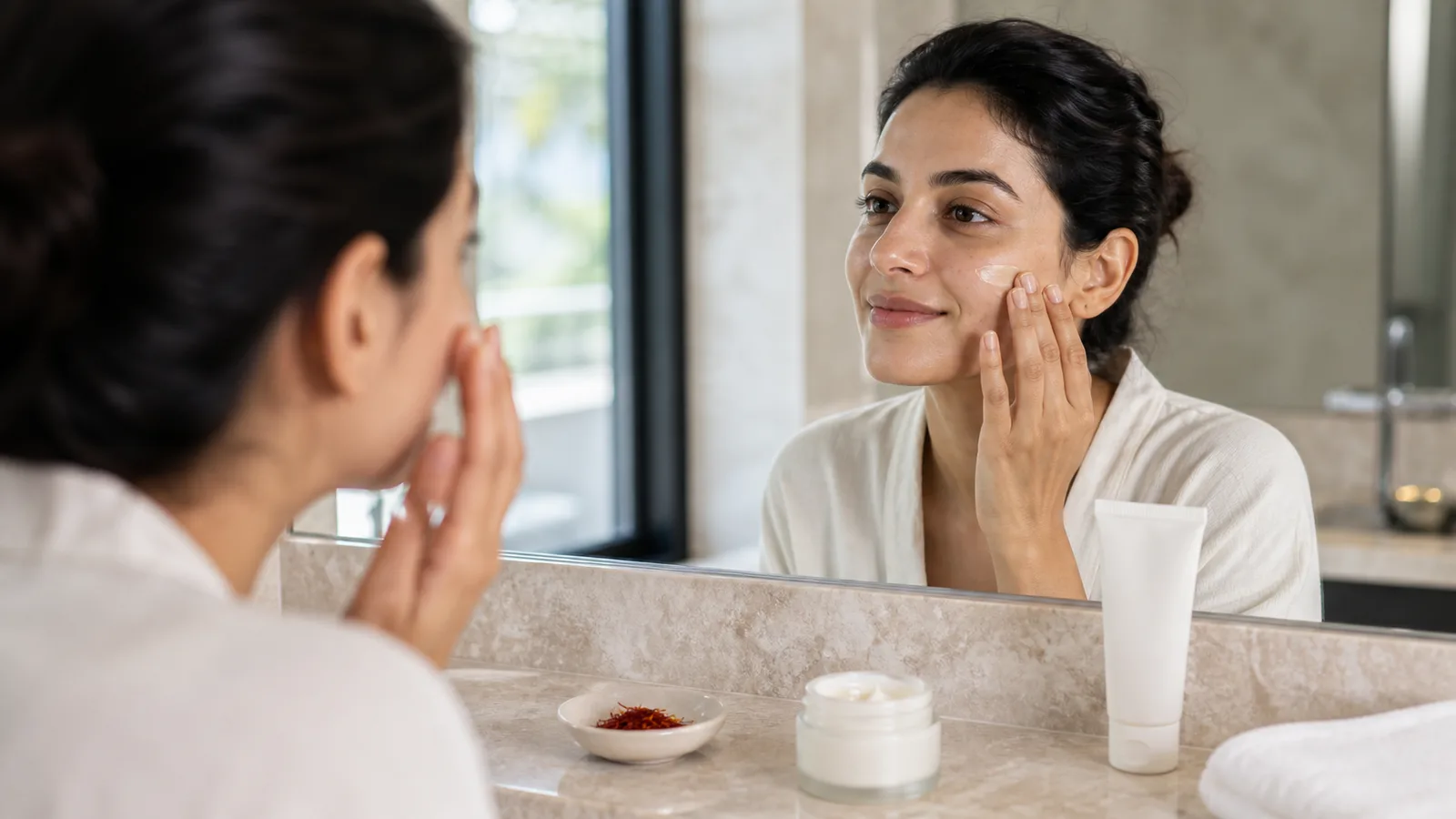
If you want to add saffron to a daily skincare routine, the safest approach is to use a properly formulated cosmetic that lists saffron extract among its ingredients. Apply it exactly as its label directs, after patch-testing it, then follow with moisturizer and daytime sunscreen. Raw threads mixed with milk, yogurt, lemon, honey, oil, or water are not proven substitutes for a tested facial product, and “natural” does not mean irritation-free.
That distinction matters here. Saffron is a food spice, while a face cream is a finished formulation with measured ingredients, a suitable pH, and a preservation system. Research on topical saffron is still limited. One small study evaluated a cream containing saffron extract and avocado oil; it did not test kitchen-made saffron mixtures or show that applying raw saffron every day will brighten skin or remove pigmentation.
How to apply saffron on face
For a straightforward saffron skincare routine, start with the product rather than a homemade recipe. Choose a leave-on cream or serum made for facial skin. Read the full ingredient list, especially if you react to fragrance or botanical extracts.
- Patch-test first. The American Academy of Dermatology recommends using the normal amount on a small area twice daily for seven to ten days. For a rinse-off product, leave it on only as long as the label says.
- Cleanse gently. Wash with lukewarm water and a mild, non-abrasive cleanser. Pat the skin dry; vigorous scrubbing can add irritation without improving the product’s effect.
- Apply a thin layer. Use the labelled amount of the saffron cosmetic. Avoid the eyelids, lips, broken skin, and any area that is already inflamed unless the product specifically says it is suitable there.
- Add moisturizer if needed. A fragrance-free moisturizer can help reduce dryness and support the skin barrier.
- Protect your skin in daylight. Finish the morning routine with broad-spectrum SPF 30 or higher. Sunscreen is far more established for preventing sun-related darkening and visible ageing than any DIY saffron mask.
Stop using the product if the test area becomes red, itchy, swollen, or painful. Wash it off gently. A severe or persistent reaction deserves medical advice rather than another home remedy.
Can you use saffron on your face every day?
Daily use is reasonable only when the finished product’s directions recommend it and your skin tolerates it. More is not necessarily better. If the label says to use the product a few times a week, keep to that schedule. Introducing it on alternate days can also make it easier to identify irritation.
Do not judge a routine by an immediate yellow or orange tint. That is staining from the spice, not evidence that pigmentation has been treated. Changes in uneven tone take time, and persistent or changing patches can have many causes. A dermatologist can identify the cause and suggest an appropriate treatment.
How to apply saffron on face overnight
Do not leave a homemade saffron, milk, yogurt, lemon, honey, or water mixture on your face overnight. The longer contact time can make an irritant reaction worse, and a water- or dairy-based mixture made in a kitchen has no validated preservative system or shelf life.
If you have a manufactured saffron night cream, patch-test it and use the stated amount after cleansing. Apply moisturizer afterwards only if the product directions and your skin require it. In the morning, cleanse gently and use sunscreen. Never assume that “overnight” means a thicker layer; excessive product can increase irritation and transfer to the eyes or bedding.
What about the popular saffron face recipes?
The familiar recipes are easy to find, but their benefits are often described more confidently than the evidence permits. Here is how to think about each one.
Saffron-infused oil
Recipes commonly soak a few threads in olive or almond oil for 12 to 24 hours, then suggest massaging the face for five to ten minutes. That process does not create a standardized extract, and massage is not proof that the mixture improves circulation or treats dark spots. Almond oil is unsuitable for someone with an almond allergy; heavier oils may also feel uncomfortable on acne-prone skin.
If your search is specifically about how to use saffron oil on face, use a labelled cosmetic facial oil, not an unmeasured infusion. Patch-test it, apply only a few drops as directed, and stop if it causes stinging, rash, or new breakouts.
Saffron and milk face pack
A tablespoon of milk with soaked saffron threads is often promoted as a lactic-acid exfoliant. Household milk, however, is not a calibrated exfoliating treatment, and the mixture has not been shown to remove dark spots. If exfoliation is your goal, use a facial product formulated at an appropriate concentration and pH, and introduce it gradually.
Saffron and honey mask
Honey can make a mixture feel moist, but that does not establish that the mask reduces pigmentation. Do not add lemon juice. Straight lemon juice is acidic and unpredictable on facial skin, so the potential for irritation outweighs the promised “brightening” shortcut.
Saffron and yogurt paste
Yogurt is also described as soothing or rejuvenating because it contains lactic acid and live cultures. That does not make a spoonful of yogurt a tested skincare formula. It has no standardized strength, and there is no good basis for promising that a 20-minute yogurt-and-saffron paste will lighten dark spots or change skin texture.
Saffron-infused water
Soaking threads in water overnight and washing with the coloured water may feel refreshing, but water alone does not lock moisture into the skin. Storing an unpreserved infusion also creates a contamination question. A gentle cleanser followed by moisturizer is the more reliable morning routine.
How to use saffron for face care without overpromising
When people ask how to use saffron for face care or how to use saffron on face, they often want help with dullness, dryness, or uneven colour. Those concerns need different solutions. Moisturizer helps dry skin hold water. Daily sun protection helps prevent additional UV-related darkening. Acne, eczema, melasma, and post-inflammatory marks may need targeted treatment.
A saffron cosmetic can be an optional part of that routine, but it should not replace those basics. It is also worth separating evidence about a finished cream from claims about the raw spice. The published cream study was small and formulation-specific. Occupational research has also documented contact dermatitis among people exposed to saffron, which is one reason patch testing matters.
A simple morning and evening saffron skincare routine
Morning
- Wash with a gentle cleanser, or simply rinse if that suits your skin and dermatologist’s advice.
- Apply the patch-tested saffron facial product according to its label.
- Use moisturizer where needed.
- Apply broad-spectrum, water-resistant SPF 30 or higher before going outdoors.
Evening
- Remove makeup and sunscreen with a gentle cleanser.
- Use the saffron product only at the labelled frequency.
- Finish with a suitable moisturizer.
Keep the routine simple while you test a new product. Adding several active ingredients at once makes it hard to know what helped and what caused a reaction. Our shop offers saffron as a culinary spice; it should not be mistaken for a safety-tested cosmetic. For a face product, choose one manufactured and labelled for that purpose.
Sources
- American Academy of Dermatology: How to test skin care products
- American Academy of Dermatology: Skin care on a budget
- U.S. Food and Drug Administration: Homemade cosmetics and microbiological safety
- Journal of Cosmetic Dermatology: Saffron-extract and avocado-oil cream study
- Dermatitis: Contact dermatitis in saffron workers