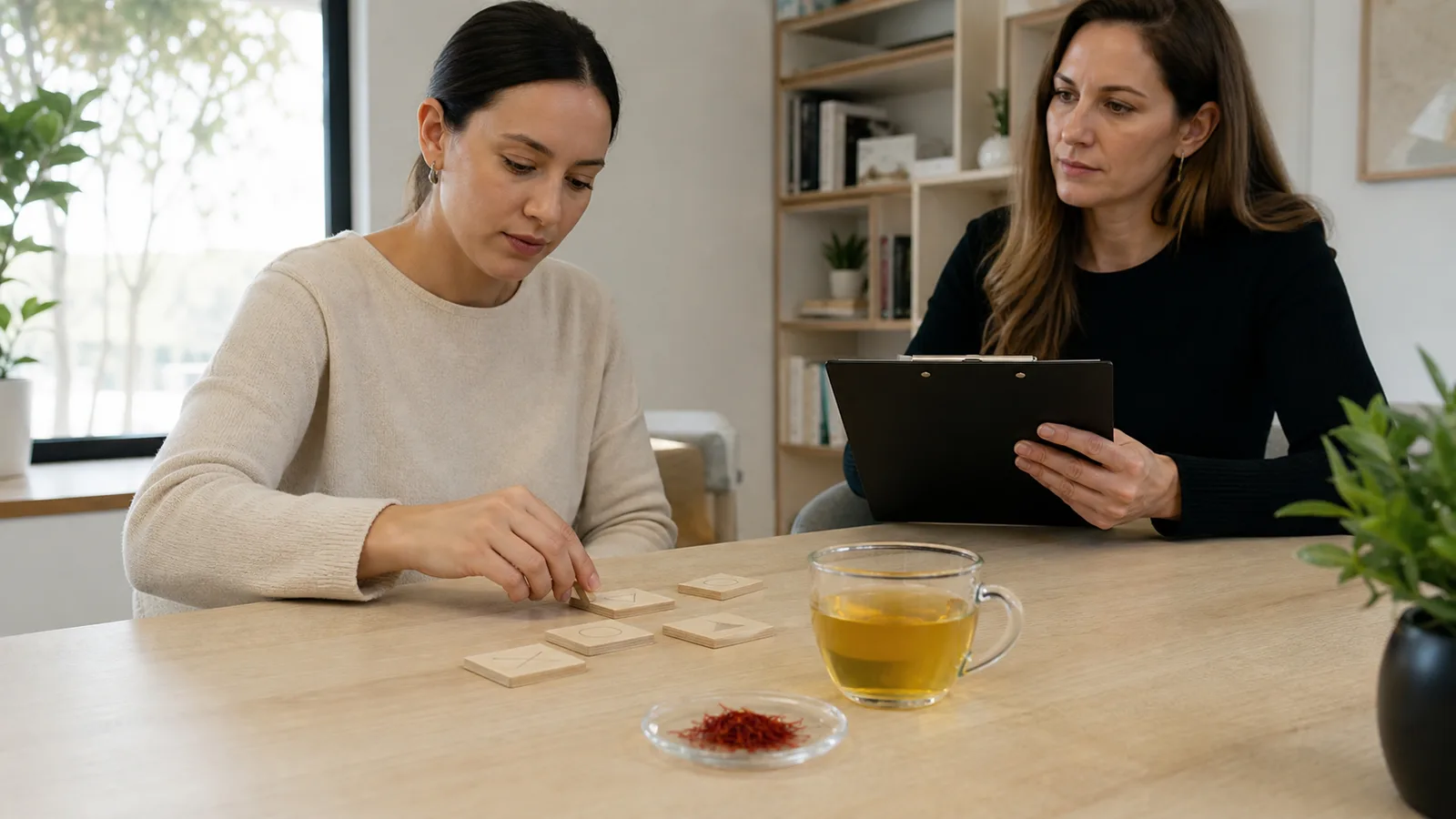
Saffron may affect the brain through several biological pathways, but human research measures outcomes such as mood scores and memory tests—not a visible “boost” in brain activity. The clearest clinical evidence concerns standardised extracts studied for several weeks. It does not show that a pinch of saffron immediately improves focus, raises serotonin or prevents a neurological disease.
That distinction matters. Saffron in a meal, a defined extract in a trial and a mixed supplement sold for “brain health” are not interchangeable.
Saffron effects on the brain: what has actually been measured?
Researchers are interested in crocin, crocetin and safranal, compounds found in saffron. Laboratory and animal studies have explored antioxidant activity, inflammatory signalling and communication between nerve cells. These experiments can suggest a mechanism to investigate, but they cannot tell us that saffron protects a human brain from free radicals, environmental toxins or other damage.
Human trials usually do not measure neurotransmitters directly. They ask participants to complete validated symptom scales or cognitive tests before and after taking a specific preparation. Therefore, the familiar explanation that saffron simply “increases serotonin in the brain” is too certain. Serotonin-related signalling is one hypothesis, not a clinical fact established by those questionnaires.
What does saffron do to the brain and mood?
A 2026 systematic review of 34 randomised trials found improvements on some self-reported depression and anxiety scales, but not on several clinician-rated scales. Results varied substantially among studies, and the reviewers rated the overall certainty as moderate. That is a more useful picture than calling saffron a natural mood booster.
A separate six-week trial published in 2025 studied healthy adults with subclinical symptoms and found no significant improvement in its primary combined measure of depression, anxiety and fatigue. Together, these findings show why a promising average result cannot predict how one person will feel.
Small trials have also compared saffron extracts with antidepressants. Similar short-term scores in a small study do not make saffron equivalent to a prescribed medicine, and they do not support replacing treatment. Product standardisation, participant selection, study duration and limited sample sizes all affect what can be concluded.
Saffron for brain health, memory and cognition
Claims about saffron benefits for brain health often blend two different questions: whether it helps people with diagnosed cognitive impairment, and whether it sharpens memory or attention in healthy adults. Evidence for the second claim is especially limited. The same caution applies to a broad search for “saffron brain benefits.”
A systematic review of cognitive trials found only five eligible studies of cognitive function involving 325 people. Four enrolled participants with mild cognitive impairment or Alzheimer’s disease, while just one involved cognitively healthy adults. The results were encouraging, but the reviewers warned that the evidence came from studies with potentially high risk of bias.
Another review of mild cognitive impairment and dementia trials reached a similarly cautious conclusion: there may be potential, but the limited number of high-quality studies is not enough to recommend saffron for clinical use. A result on a cognitive scale does not prove that saffron prevents Alzheimer’s disease, Parkinson’s disease or age-related decline.
Does saffron improve memory or focus?
Saffron memory findings mainly come from selected clinical populations and specific extracts. They cannot be turned into a promise of better recall, mental clarity or attention span for every healthy person. Sleep, stress, medicines, hearing, vision and underlying health can all affect concentration; a persistent or sudden change deserves a proper assessment rather than a supplement experiment.
What do 2025 and 2026 studies say about saffron, cognition and mood?
Recent work has not produced one simple verdict. The 2026 mood meta-analysis found benefits on some outcomes and no significant effect on others. The 2025 healthy-adult trial missed its primary mood outcome. Cognitive reviews remain based on a small pool of trials, many conducted in people who already had impairment.
This is why “saffron effects on brain cognition mood studies 2025 or 2026” should not be reduced to a headline about proven neuroprotection. The research signal is worth following, but the strength of a claim has to match the population, preparation and outcome that were actually studied.
Food use is different from a brain-health supplement
A few saffron threads used in cooking add aroma, colour and flavour. Clinical studies typically use a measured, standardised oral preparation every day for a defined period. You cannot reliably reproduce that exposure by counting threads, and one commercial extract may not match another.
Mixed “focus” or “mood” products introduce another problem: an effect or adverse reaction cannot automatically be attributed to saffron when caffeine, other herbs or undisclosed ingredients are present. Check the full label rather than relying on a saffron image on the front.
When to speak with a healthcare professional
Do not use saffron to delay care for depression, anxiety, memory loss or a new neurological symptom. Seek urgent help for thoughts of self-harm, sudden confusion, weakness on one side, trouble speaking, a severe new headache or a seizure.
Discuss a saffron supplement first if you take prescription medicines, are pregnant or breastfeeding, have bipolar disorder, are preparing for surgery or are being treated for a mental-health or neurological condition. Bring the exact product label; the amount, extract and additional ingredients matter.
The practical answer
How does saffron affect the brain? Human studies suggest that certain standardised preparations may influence some mood and cognitive outcomes, while other well-designed results are negative or uncertain. Proposed antioxidant, anti-inflammatory and neurotransmitter pathways are explanations under study—not proof of cognitive enhancement or protection from disease.
Enjoy saffron as a spice for its flavour. Treat a concentrated product as a supplement with limits and uncertainties, not as a substitute for diagnosis or care.