


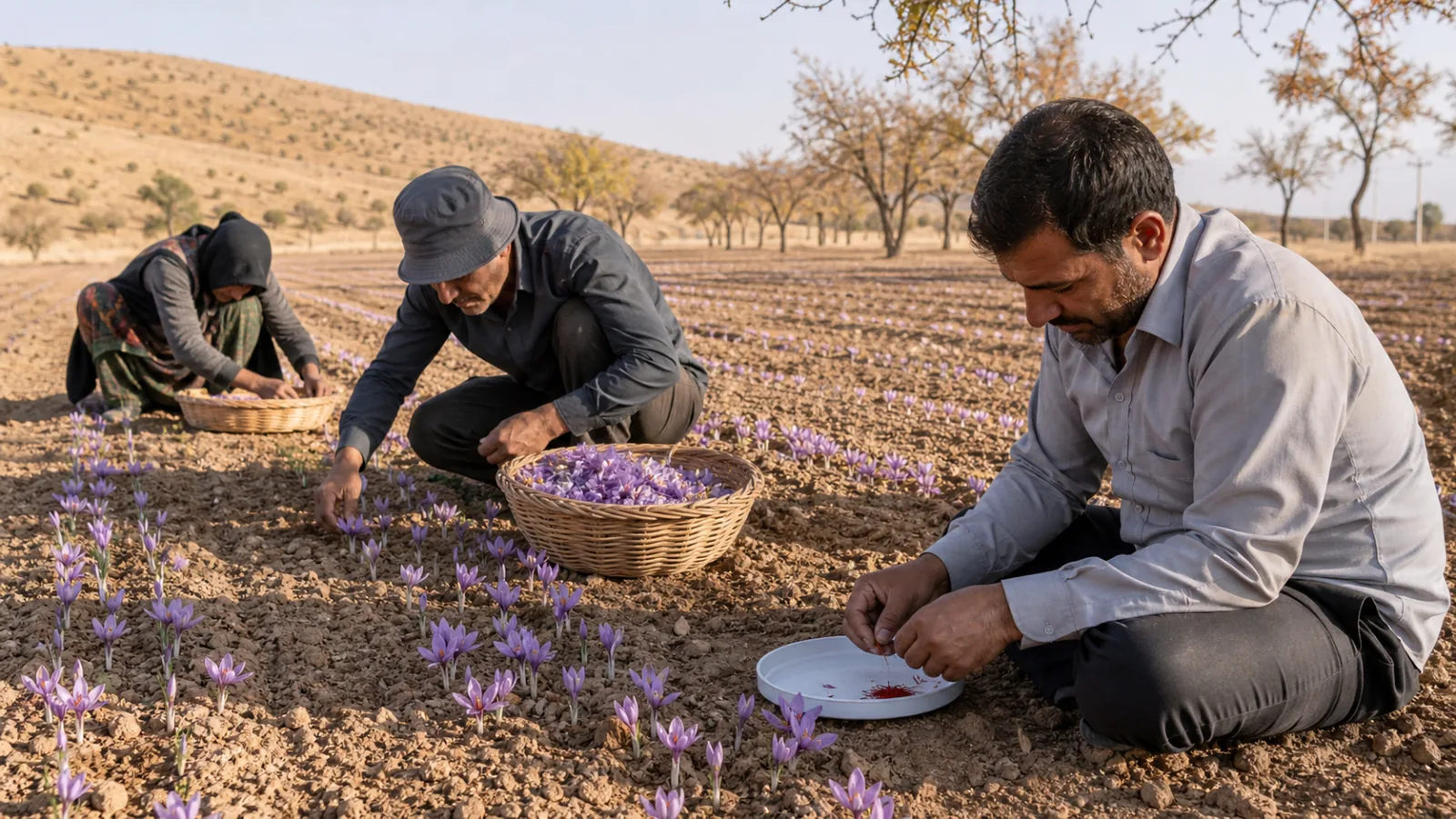
Fars province situation in saffron production is part of a much larger agricultural story. Fars grows field crops, orchard fruit, dates, citrus, Damask roses and nuts across markedly different climates. Saffron has a smaller footprint than the province’s best-known crops, but Estahban has a documented history of cultivation and was responsible for most of the provincial harvest in the report preserved here.
The figures in the old English article were damaged by translation. Its “4.5 to 5.5 tons per hectare” should be kilograms per hectare, and “2,300 tons” should be 2.3 tonnes, or about 2,300 kg. That correction is supported by the original arithmetic: roughly 460 hectares multiplied by 4.5–5.5 kg per hectare produces a little over two tonnes, not thousands of tonnes.
Main crops in Fars province
The provincial account described Fars as one of Iran’s major agricultural regions. It highlighted wheat, figs, walnuts, citrus—especially lemons—dates, apples, pomegranates, sugar beet, cotton, grains, pulses and saffron. It also said Fars had held a leading position in wheat production for 26 years at the time of the report.
That list should be read as a map of agricultural diversity, not as a current ranking. Fars covers warm southern districts, colder uplands and dry interior areas. A crop associated with one county may be unsuitable in another, and production changes with water, weather and planted area.
The old report’s central concern was recognition. Goods grown in Fars were often sold under a better-known place name, leaving the producing county invisible to the consumer. Estahban figs and saffron, and rosewater from Meymand and Darab, were its clearest examples.
Crops grown in Bavanat, Fars
Bavanat—mistranslated as “Bavanad” in the archived article—was named among the province’s saffron-producing counties. It was also grouped with Sepidan, Eqlid, Beyza, Khorrambid and parts of Shiraz for apples, walnuts and pomegranates. The source supplied no county-level acreage or yield, so these are crop associations rather than a current production league table.
Crops grown in Darab, Fars
Darab appeared in two parts of the report. It was associated with Damask rose and rosewater alongside Meymand, and with dates and citrus alongside Jahrom, Kazerun, Lar and Lamerd. The article claimed that rose production in Darab and Meymand exceeded the better-known Qamsar trade by several times, but gave no year, unit or comparable dataset. The sensible conclusion is that Fars had substantial rose-growing capacity—not that an exact multiple has been proven.
Crops grown in Sepidan, Fars
Sepidan was listed as a saffron-producing county and as an area for apples, walnuts and pomegranates. Its inclusion in both groups reflects Fars’s climatic range. The source did not say that every farm or elevation in Sepidan suits all four crops; local temperature, soil, drainage and water supply still decide what is viable.
Elsewhere, the article associated Neyriz and Arsanjan with pomegranates. It named Jahrom, Darab, Kazerun, Lar and Lamerd for dates and citrus. It did not provide a Fars province date-production percentage, so adding one now would mix a new statistic with an undated historical list.
Estahban’s place in Fars saffron production
The corrected provincial snapshot is internally coherent:
- about 460 hectares planted with saffron;
- 20 percent more cultivated area than the preceding year;
- a forecast of just over 2 tonnes, later stated as 2.3 tonnes;
- an average yield of 4.5–5.5 kg of dried saffron per hectare in Estahban, compared in the report with a national range of about 4–5 kg; and
- more than 90 percent of Fars saffron attributed to Estahban.
The report attributed these figures to Assad Sharifi, identified as Fars Agricultural Jihad’s director of horticulture. It described Fars as one of Iran’s top five saffron-producing provinces at the time and named Estahban, Bavanat, Abadeh, Eqlid and Sepidan as producing counties. Harvest was expected to begin around mid-November.
It also said saffron cultivation in Estahban went back about 200 years. That is a historical claim from the provincial account rather than a dated archaeological finding. What can be said safely is that the crop was already established locally and was not a new trial.
Why the corrected units matter
A yield of 5 kg per hectare is realistic for dried saffron; 5 tonnes is not. At 460 hectares, the reported range implies approximately 2.07–2.53 tonnes. The forecast of 2.3 tonnes sits almost exactly in the middle.
The article linked a 2–3 percent yield improvement to suitable rainfall, irrigation and field operations in the reported season. It should not be turned into a permanent growth rate. A change in rainfall timing, corm condition, field age, plant density, nutrition, weeds or harvest labour could produce a different result in another year.
The flower-to-spice conversion was also mistranslated. The archived copy said that 20 flowers produce one gram. ISO’s quality overview gives about 250,000 flowers for 1 kg of saffron, equivalent to roughly 250 flowers per gram. The exact count varies with flower and stigma size, but 20 is not credible. This large labour requirement explains why flowers must be picked and the stigmas separated quickly during a short harvest window.
Saffron from Shiraz and Estahban
“Mashhad saffron” was the familiar name in the old report, even among travellers returning to Fars. By contrast, saffron from Shiraz and the wider province—زعفران شیراز—had weaker recognition. The article said traders valued Estahban saffron and sometimes blended it with Khorasan saffron for aroma and taste.
That blending statement describes a trade practice and sensory preference, not proof that one origin is universally better. Quality should be established for the actual lot through clean handling, moisture control, absence of foreign matter and agreed chemical and sensory specifications. Codex CXS 351-2022 sets physical and chemical criteria for dried saffron; a place name alone does not certify that a batch meets them.
Origin should also remain truthful after blending. A pack containing saffron from more than one region should not present itself as a single-origin Estahban or Khorasan lot. Good batch records protect both the buyer and the producing region’s reputation.
Estahban is also a major fig landscape
The original article used Estahban’s figs to illustrate the same recognition problem. That point has since gained stronger documentation. In 2023, the Food and Agriculture Organization designated the Estahban Rainfed Fig Orchards Heritage System as a Globally Important Agricultural Heritage System. FAO describes millions of trees and a rainwater-harvesting tradition adapted to steep, dry land.
Figs and saffron should not be conflated: their field systems and harvests are different. Together, however, they show why Estahban deserves to be identified as a producing place rather than disappearing behind another region’s label.
Water demand needs a careful explanation
Saffron is often described as a low-water crop because its irrigation calendar and total demand can be lower than those of many alternatives. “Low water” does not mean “no water,” and it does not make every dry field suitable. Establishment, pre-flowering irrigation where used, drainage and the timing of moisture all affect the crop.
Water scarcity is not a historical footnote in Fars. A 2025 study indexed by FAO AGRIS examined the province’s 2023–24 irrigated cropping pattern and found that substantial changes would be needed to reduce applied irrigation water without reducing farm income. That does not prescribe saffron for every location; it supports comparing crops by local water availability, agronomy and saleable return rather than by a “drought-resistant” slogan.
The old report also described research into out-of-season sugar beet, attributed to Mehrzad Kherad of Fars Agricultural Jihad. It said the autumn type required less water than spring beet and produced better quality. Those claims need the original trial design and current extension recommendation before a grower acts on them.
What a current Fars saffron status report should show
The archived figures are useful as a baseline, not a live dashboard. A current assessment should publish, for the same crop year:
- harvested rather than merely planted area by county;
- dry saffron output in kilograms or tonnes;
- yield in kilograms per hectare and the method used to calculate it;
- irrigation source, rainfall period and major crop losses;
- the number and capacity of drying, testing and packing facilities;
- farm-gate and wholesale prices for defined grades; and
- sales by destination, with direct exports separated from domestic trade.
The 2018 English post also repeated a claim that Iran supplied more than 95 percent of world saffron demand and named China, Germany, Britain and Persian Gulf countries as importers. That belongs to its historical source. It should not be reused as a current global share without a year and comparable trade or production data.
For growers considering the crop, our guide to planting saffron corms in Fars province explains the older local field evidence and the checks needed before expansion.
Sources
- The archived ISNA agricultural report cited by the original post, for the historical Fars crop map, officials and production figures
- International Organization for Standardization: saffron quality and flower-to-spice conversion
- Codex CXS 351-2022: Standard for Dried Floral Parts—Saffron
- FAO AGRIS: 2025 study of Fars irrigated cropping patterns and water scarcity

![Exporting Saffron to Turkey + Price Guide [Complete 0 to 100]](https://img.rowhanisaffron.com/20260827003933/saffron-export-turkey-quality-inspection.webp)



