


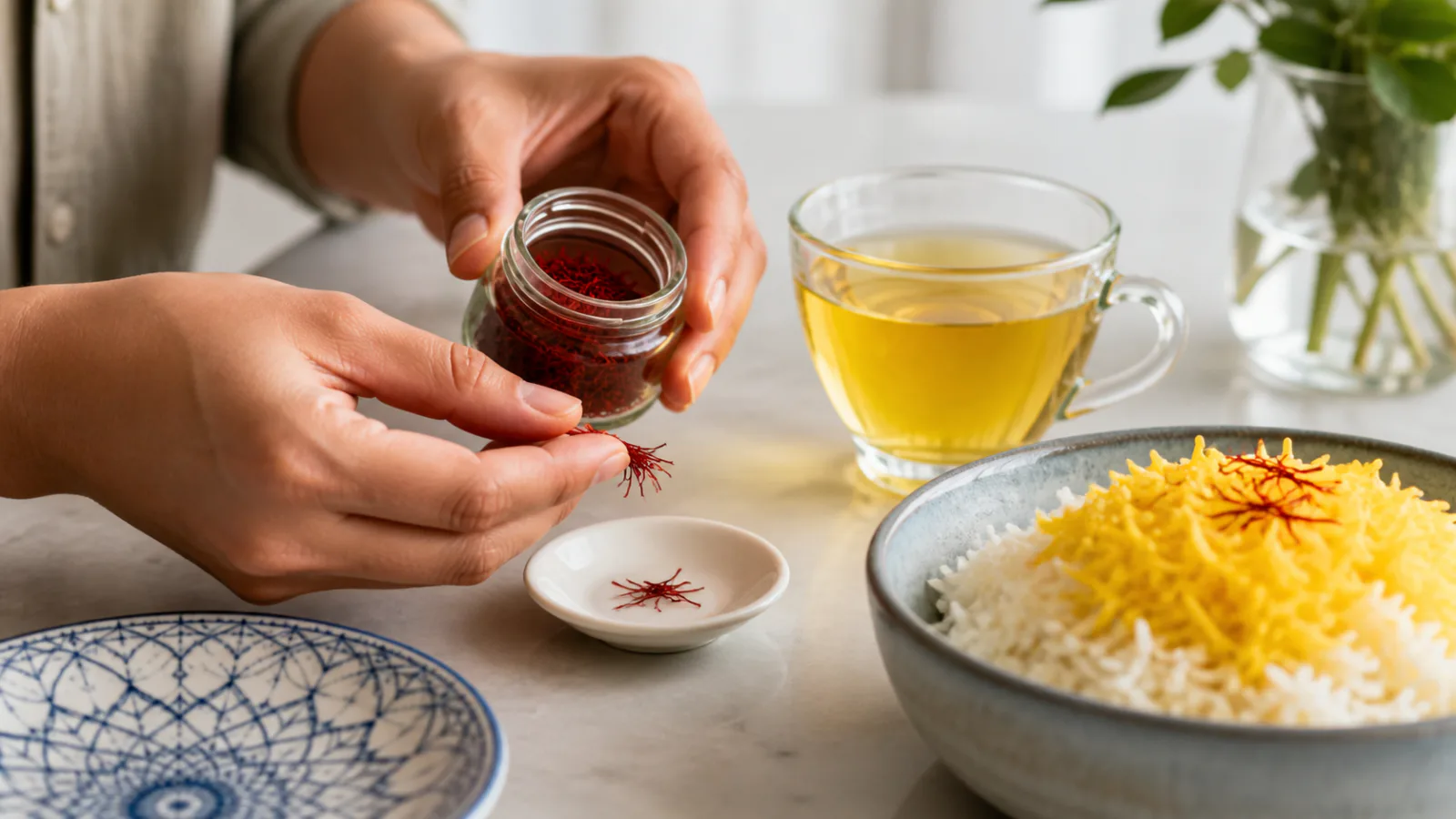
Familiar with saffron begins as a sensory idea: a few deep-red threads release a hay-like, honeyed aroma, a gently bitter taste and a golden colour. In Iranian cooking, that small amount can change rice, a stew, tea, a dessert or a festive dish without hiding the other ingredients.
Saffron also carries agricultural and cultural meaning. Its flowers are gathered during a short autumn harvest, the stigmas are separated largely by hand, and much of the world’s supply is associated with Iran, especially Khorasan. Price, labour and memory meet in the same spice jar.
From the attari to the kitchen
The old version of this article opened with the fragrance of a “Cartier” shop. The intended word was almost certainly attari: a traditional Iranian herb and spice shop. Its mixture of dried plants, seeds and aromatics can evoke kitchens and family recipes across generations.
Iranian spice use is not one fixed formula. Geography, season, household and dish affect the blend. Saffron may appear beside rose water, cardamom, cinnamon, cumin or dried lime, but it is often used alone so its own aroma remains clear.
Why Khorasan is linked with saffron
Khorasan’s saffron identity comes from generations of cultivation, processing knowledge and trade. The FAO’s account of a Khorasan harvest visit describes work on cultivation, harvesting and processing practices, while the wider FAO quality-integrity programme emphasises traceability, innovation and a stronger value chain.
“Iranian” or “Khorasan” on its own does not prove grade. Drying, storage, cleanliness, adulteration and laboratory results still matter. Provenance is meaningful when it is specific and verifiable.
The flower and the threads
Crocus sativus grows from an underground corm. Each purple flower normally carries three red stigmas, which become saffron after careful separation and drying. The plant is propagated by corms rather than seed.
The old text called the roots “saffron fillets” and suggested one universal four-, six- or ten-year schedule. In practice, field life and replanting depend on climate, soil, disease pressure, corm density and farming method. A grower may keep a field for several seasons, then lift, grade and replant healthy daughter corms when yield or plant health requires it.
A short harvest and a long chain of work
Flowers are picked when cool conditions help protect quality, then moved quickly for stigma separation. Drying must reduce moisture without scorching the material or flattening the aroma. Sorting, testing, packing and storage follow.
This delicate work has involved women and men across farms, homes, cooperatives, laboratories and businesses. The old article framed spice making as feminine and butchery as masculine. That stereotype is unnecessary; what deserves recognition is the skilled labour and knowledge of the people doing each task.
How saffron connects with Iranian art and memory
Flavour can carry memory in the same way music, carpets and tilework do. The comparison in the original article was poetic rather than scientific, but it captured something real: aroma is tied closely to place, celebration and family routine.
A saffron dish can mark hospitality or make an ordinary meal feel considered. Giving a small package as a souvenir can also signal care because the spice is useful, portable and valuable. That meaning belongs to the relationship between giver and recipient, not to stereotypes about a nationality, religion or social group.
How much saffron to use
Saffron is used by the pinch, not by a monthly health quota. The old claim that every person should consume three grams per month, that more than five grams per month is always harmful, and that five grams in a meal necessarily causes death is not a sound rule.
For cooking, start with a small pinch, bloom it and spread it through several servings. Deliberate gram-level use is not culinary and can be dangerous. Our measured guide explains how much saffron to eat in a month without turning an unsupported threshold into advice.
How to bloom saffron
- Place the threads on a clean saucer and crush them lightly.
- Add a small amount of warm water, milk or another recipe liquid.
- Cover and leave for about 10 minutes.
- Add both the liquid and threads to the dish near the stage the recipe specifies.
Blooming distributes the colour and aroma. Hard boiling for a long time is unnecessary. Use a dry, clean utensil so moisture does not enter the storage container.
A simple saffron potato rice
The old article ended with fragments about potatoes, Iranian rice and fresh herbs. They can become a coherent dish: prepare plain steamed rice, bloom a small pinch of saffron, and mix the infusion into a portion of the cooked rice. Fry or roast thin potato slices until golden and use them as a base or garnish, depending on your preferred rice method.
Serve the white and saffron rice together with the potatoes and herbs. Exact technique varies among families, particularly for tahdig; the important point is to keep the saffron aromatic rather than burying it under many spices.
Spice blends and regional taste
The original article mentioned Tabrizi household blends containing rose, cinnamon, cumin, ginger, green pepper, clove and jujube. Such combinations should be understood as examples of local or family practice, not a universal recipe for Tabriz or all Iranian food.
When building a blend, ask what the dish needs. Cumin and pepper suit savoury food; rose, cinnamon and cardamom may suit rice or sweets. Saffron is usually added separately after blooming so its amount and aroma remain controllable.
Where saffron is used
Saffron colours and flavours rice, sauces, soups, cakes, confectionery, dairy foods and alcoholic or non-alcoholic drinks. It has also been used as a textile dye and fragrance material. Pharmaceutical research studies saffron compounds, but a standardised extract is not equivalent to ordinary seasoning or a cup of tea.
The current ISO 3632-1:2025 specification sets requirements for dried saffron. Quality is not simply “the reddest” or “the most expensive”; identity, sensory character, moisture, handling and appropriate testing all matter.
How to store saffron
Keep dry threads in a tightly closed food-safe glass or metal container, away from light, heat, moisture and strong odours. Do not store the jar over a stove or dip a damp spoon into it. Close the lid promptly because volatile aroma compounds gradually escape and oxidise.
Whole threads are easier to inspect and generally hold their aroma better than pre-ground material. Buy an amount you can use while it remains fragrant rather than treating a large jar as a permanent treasure.
Becoming familiar with saffron
Start with the real plant, a traceable source and a small recipe. Notice the dry aroma, then what changes after blooming. Compare the colour and taste in rice, tea and a dairy dish. That direct sensory knowledge is more useful than a list of miracle claims.
Saffron’s cultural story can be told warmly without romanticising unsafe doses or assigning food knowledge to one gender or group. It is a crop, a craft and an ingredient: delicate in the field, concentrated in the kitchen and memorable because a few threads are enough.

![Exporting Saffron to Turkey + Price Guide [Complete 0 to 100]](https://img.rowhanisaffron.com/20260827003933/saffron-export-turkey-quality-inspection.webp)



