


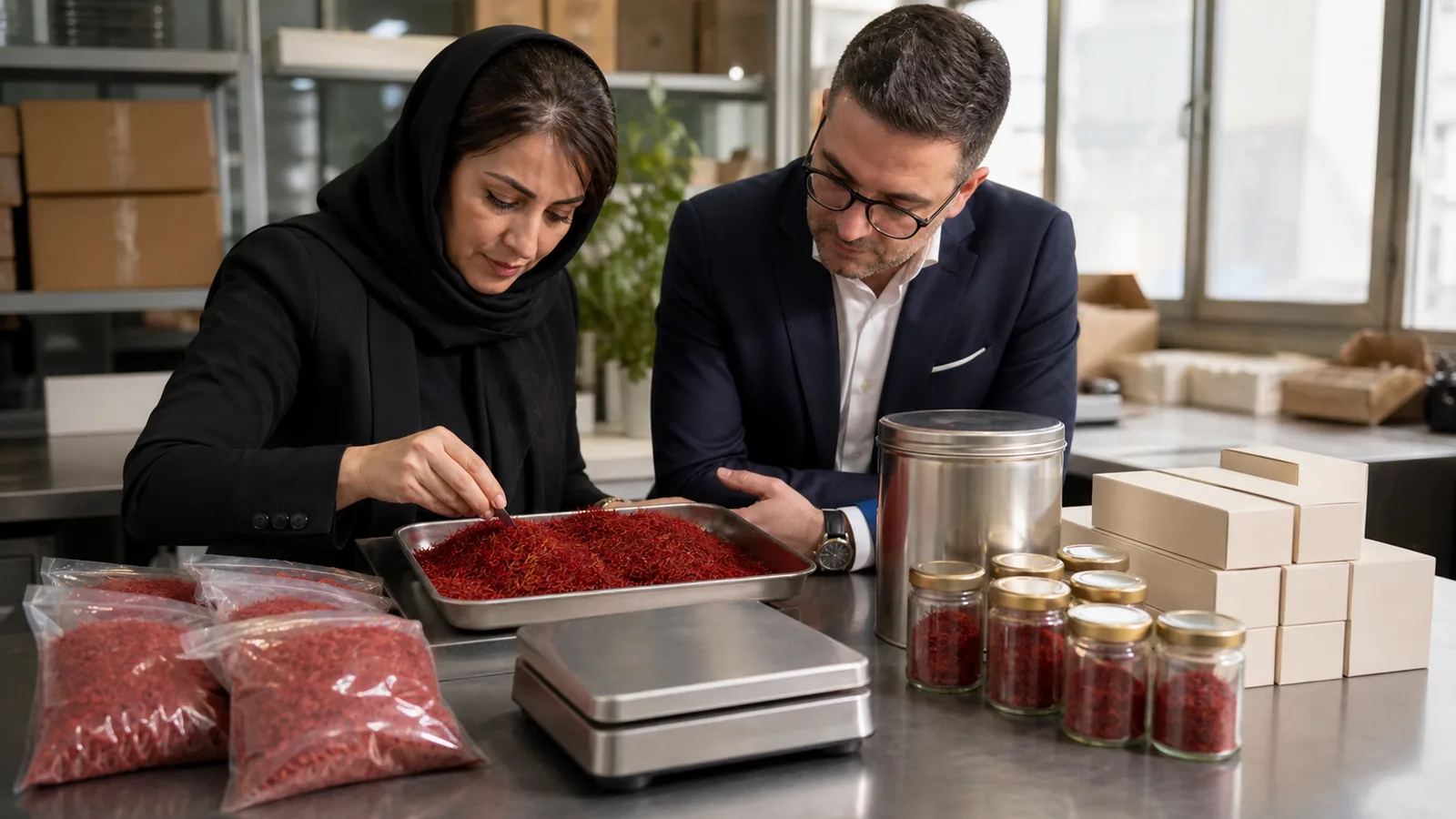
The export of Iranian saffron does not always end with an Iranian brand on the shelf. A lot may leave Iran in bulk, be tested and packed by a buyer, then appear under a distributor’s private label in another country. That can be a normal commercial arrangement. The important question is whether the product’s Iranian origin, the responsible packing business and the claims on the final label are accurate.
This distinction gives the original title—“Export of Iranian Saffron” brand in other countries—a clearer meaning. Brand ownership, country of packing and country of origin are related, but they are not the same thing. A jar packed in Europe or the Gulf may still contain Iranian saffron. Repacking does not by itself turn the crop into saffron grown somewhere else.
What the original export report said
The first version of this article reported comments by Gholamreza Miri, then identified as president of a union representing saffron exporters and sellers. He described a 15 percent fall in saffron exports during the first eight months of the year, through the beginning of December, compared with the same period a year earlier.
Miri connected the decline with exchange-rate volatility and an export foreign-currency commitment. His argument was that the obligation raised difficulty for formal exporters while saffron could move through neighbouring countries instead. He called for the customs requirement to be cancelled and said the situation was disturbing for production and trade.
The report also said Iranian saffron was sent to more than 46 countries, naming Persian Gulf markets, Australia, Germany, Austria and Hong Kong among them. These are historical statements from a dated trade dispute. They are retained because they explain the article, but neither the 15 percent figure nor the old currency-obligation demand should be read as a current rule or forecast.
What current trade data can—and cannot—show
Iran saffron export data is sometimes incomplete or difficult to compare across reporting systems, so imports reported by destination countries provide a useful second view. The World Bank WITS presentation of UN Comtrade data lists 2024 imports of saffron under HS 091020 reported as coming from Iran. The destinations include China, European markets, Bahrain, Australia, Switzerland, Austria, Oman, Japan, Canada, India and Hong Kong.
The data supports the broad point that Iranian saffron reaches varied markets. It does not identify the consumer brand on each package, distinguish every bulk lot from retail packs, or prove where value was added after import. Customs values are also not a live supplier price. They aggregate consignments with different grades, quantities, delivery terms and reporting practices.
The European Union’s 2024 import record is one useful example. It reports US$69.55 million and 53,530 kilograms of saffron imported from Iran. That establishes Iranian origin in the trade data; it does not mean every final European pack carried an Iranian-owned trademark.
How Iranian saffron appears under another country’s brand
There are several legitimate routes from an Iranian farm or processor to a foreign shelf.
Bulk supply to a local packer
An importer buys a tested bulk lot and packs it in the destination market. The importer may use its own brand, choose local pack sizes and take responsibility for labels and retail distribution. The saffron remains Iranian in origin when it was grown and harvested in Iran.
Private-label packing in Iran
An Iranian processor packs the buyer’s brand before shipment. The buyer controls the brand presentation, while the Iranian facility works to an agreed specification. This route can reduce handling after arrival, but artwork, language, weights, barcodes and market-specific food information need approval before the packs are produced.
An Iranian brand sold through a distributor
The exporter keeps its own brand and appoints an importer or distributor. That can preserve more visible connection to origin, but it also requires trademark planning, consistent supply, local marketing and clear responsibility for regulatory work. The WIPO Madrid System is one route businesses may investigate for international trademark protection; eligibility and the countries covered need to be checked for the owner’s situation.
Re-export through a trading centre
A trader in another country may import and later re-export the saffron. Warehousing, consolidation and repacking can all be legitimate. The commercial route still needs traceable invoices, lots and origin information. Changing the box or seller does not automatically change where the saffron was produced.
Brand, packer and origin should not be confused
A brand tells the customer who is presenting the product. “Packed by” identifies the business responsible for a packing operation. Country of origin describes where the product originated under the rules applied to that shipment and market. A truthful label can show all three without pretending that they mean the same thing.
Exact labelling requirements differ by destination and pack format. The importer should confirm the current food-information and origin rules before artwork is printed. Exporters should avoid a universal label template that was merely accepted in another country. Language, legal business name, net quantity, lot marking, best-before information, storage instructions and importer details may all require market-specific treatment.
The safest private-label agreement assigns responsibility clearly. It should say who approves the artwork, who verifies claims, who releases a production lot, who keeps traceability records and what happens if a label or product is rejected.
What a serious Iranian saffron exporter supplies
A credible offer is more than a price and a photograph. The exporter should be able to define the material being sold: filament style, cut, agreed quality characteristics, crop or packing information where relevant, net weight, packaging, lot identity and test evidence. The buyer needs the same specification in the quotation, sample approval and final shipment.
The Codex standard for dried saffron recognises filaments, cut filaments and powder and sets essential composition and quality factors. A buyer may set additional contractual limits or require destination-specific tests. Those requirements should be agreed before price comparison, because two lots described only as “Iranian saffron” may not be equivalent.
Documentation needs the same discipline. The invoice, packing list, transport document, origin evidence, certificate set and labels should agree on parties, weights, package counts, product description and lot references. Our guide to Iranian saffron exporter formalities explains how to organise that file while checking current rules instead of copying a historical checklist.
Branded packs or bulk export?
Neither model is automatically better. Bulk trade can move larger lots and fit an importer’s established distribution network. It may also leave the producer and exporter less visible to the final customer. A branded retail pack can keep more identity around the product, but small-pack production, design, registration, inventory and marketing cost money in every market.
The choice should follow the buyer and channel. A spice manufacturer may need a standard bulk pack with a precise industrial specification. A specialist retailer may value origin storytelling and intact premium filaments. A supermarket distributor may want private-label packs that fit its own shelf system. Trying to force one pack and one brand strategy into all three channels usually creates avoidable cost.
Before choosing, calculate the margin after testing, packaging, freight, duties, distributor allowance, promotion, returns and local stock. A higher retail price does not necessarily mean the exporter receives a higher net return.
How to protect the value of Iranian origin
Traceability is the practical foundation. Keep a lot identity from received flowers or dried raw material through cleaning, grading, test sampling, packing and shipment. Retain approved artwork and a reference sample from the released lot. If a complaint arises, the exporter and buyer should be able to identify what was packed, when and for whom.
Origin also needs to be described honestly in marketing. A foreign brand may explain that it selected and packed Iranian saffron. An Iranian exporter may explain the producing region and handling process when those statements are documented. Neither party should invent a farm, region, organic status, harvest date or laboratory result simply because the story sounds attractive.
Trademark protection and distribution terms matter as well. Agree who owns local registrations, online listings, translations, product photography and customer data. If an importer develops the market, the contract should still prevent unauthorized changes to origin, quality claims or pack content.
A buyer’s check before placing the order
- Confirm whether the quote is for bulk saffron, Iranian-branded packs or private label.
- Approve the exact style, grade, lot and testing requirements.
- Verify the exporter, packer and importing business rather than relying on a trading name alone.
- Have the importer approve current label and entry requirements.
- Match the sample, contract, invoice, certificates and final pack description.
- State the delivery term, payment route, inspection point and rejection procedure.
- Keep origin and lot information through any repacking or re-export stage.
What the old concern means now
The 2014 complaint was about formal exporters losing ground when currency rules and exchange movements made legitimate trade harder. That policy question is date-sensitive, but its commercial lesson remains useful. When the route is opaque, more of the value can move away from the producer, and the final buyer may know little about the real origin of the saffron.
A stronger export model does not depend on pretending every foreign brand is improper. It makes origin visible, specifications verifiable and responsibilities clear, whether the product is sold in bulk, under private label or with an Iranian trademark. That is how the export of Iranian saffron can serve a foreign market without losing the meaning of where the product came from.
Trade data, standards and trademark resources reviewed 28 August 2026. Customs, currency and labelling requirements can change; verify them for the destination and shipment date.

![Exporting Saffron to Turkey + Price Guide [Complete 0 to 100]](https://img.rowhanisaffron.com/20260827003933/saffron-export-turkey-quality-inspection.webp)



