


A historical provincial report said Khorasan Razavi exported 122 tonnes of saffron worth $170 million during the first seven months of its reporting year. The same official expected a 310-tonne provincial harvest and described a production network involving 137,800 people, with roughly 680,000 family members connected to their livelihoods.
A companion report from the Khorasan Razavi Governorate explains the scale behind those exports: the province was credited with 79% of Iran’s saffron production, hundreds of tonnes of licensed processing capacity, and a package of support plans covering finance, quality systems, planting material, market organization, and research. These are dated reports and policy targets, not current statistics.
Khorasan Razavi saffron exports reached $170 million
Ali Rasoulian, identified in both archived articles as a senior economic-affairs official in the provincial governorate, reported that 122 tonnes left Khorasan Razavi during the seven-month period. He put their value at $170 million.
Dividing value by weight gives an implied average of about $1,393 per kilogram. That is a calculation across the reported shipment mix, not a quoted price for a particular grade, package, contract, or day.
Compared with the corresponding period a year earlier, export weight increased 42% and value increased 43%. Because the two growth rates were close, the implied average value per kilogram changed much less than the headline totals.
The province dominated Iran’s recorded export flow
Rasoulian said Khorasan Razavi accounted for 90.4% of Iran’s saffron-export weight and 95.5% of export value during those seven months. The larger value share suggests that the province’s recorded shipments had a higher average declared value than exports attributed to the rest of the country, although the report does not provide enough detail to identify the reason.
Origin, customs clearance, and company location can affect provincial export statistics. These percentages should therefore be read as the reporting system attributed them, not as proof that every flower was grown, processed, packed, and shipped within one province.
A 310-tonne harvest was forecast
The destination report forecast 310 tonnes of saffron from the province for the full year. It did not provide the completed harvest, cultivated area, weather conditions, or yield calculation, so 310 tonnes remains a forecast rather than a verified final result.
The article counted 137,800 people as active in saffron production and said their family networks reached about 680,000 people. A final isolated reference to another 1,500 people lacks a role in the stored translation and cannot be interpreted safely, so it is not converted into a workforce category.
Why the reported 79% production share is plausible
The companion article’s headline attributed 79% of Iranian saffron production to Khorasan Razavi. It did not state the crop year or show the national denominator, so that exact share remains a dated official claim.
An independent historical benchmark is close. Figures submitted by Iran to the FAO/WHO Codex Committee recorded 218.348 tonnes from Khorasan Razavi out of 280.323 tonnes nationally in 2014–15. That works out to about 77.9%, supporting the scale of the claim without proving that the 79% figure belongs to the same season.
For more context on how production spread beyond the traditional centers while Greater Khorasan remained dominant, see our guide to saffron cultivation across Iran.
Employment was measured in working days per hectare
Rasoulian said saffron generated an average of 210 working days per hectare, which the source described as roughly one permanent job. The figure captures labor demand across cultivation, flower picking, stigma separation, drying, and handling, but it should not be read as 210 different workers or a guaranteed full-time position on every farm.
The Sixth Development Plan set targets of six to seven kilograms per hectare and 450 tonnes of annual production. Those were policy goals. They do not establish that either yield or national output was achieved, and the archived reports provide no completion assessment.
Processing and packaging capacity
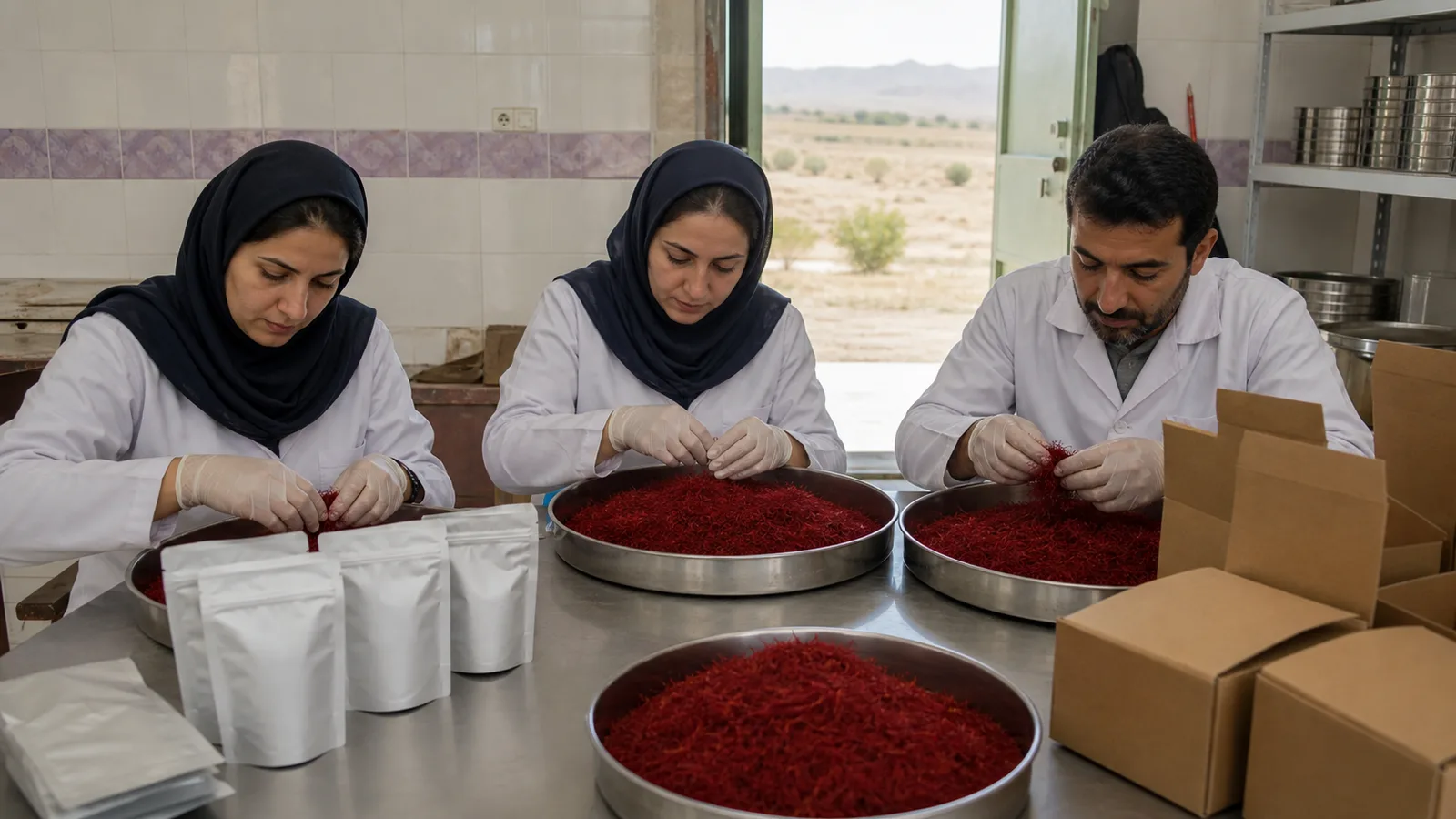
The source recorded 121 licensed saffron processing and packaging units in Khorasan Razavi with a combined nominal capacity of 400 tonnes. It separately listed 114 operating licenses for packaging, with capacity of 235 tonnes per year.
Mashhad had 34 of those packaging licenses, Gonabad 15, Kashmar 11, and Torbat Heydariyeh 10. These four counts total 70, so the remaining licenses were distributed elsewhere in the province. Nominal capacity is also not the same as actual annual throughput; equipment, working capital, orders, labor, and compliance determine how much is used.
Building processing capacity was intended to retain more grading, drying, packing, and product-development value near the farms. The source also identified bulk exporting and underused processing capacity as continuing problems, showing that licenses alone did not solve the market challenge.
Development funding was at different stages
In 2016, the report said 18,700 million rials—18.7 billion rials—had been paid to nine production units as working capital from the National Development Fund and an optimization program.
For Iranian year 1396, it cited a further 29,000 million rials, or 29 billion rials, for cases introduced to banks and still under review or contract preparation. That second amount should not be described as money already disbursed.
The distinction matters because an approved credit line, a bank referral, and cash received by a processor are different stages. The archived source only supports completed payment for the earlier 18.7-billion-rial amount.
The 2016 national export benchmark
Rasoulian also cited Islamic Republic of Iran Customs statistics for 2016: approximately 203 tonnes of saffron exported with a value of $286 million. The wording presents this as a national customs figure, not a Khorasan Razavi-only total.
Its implied average was about $1,409 per kilogram, close to the $1,393-per-kilogram average calculated from the later provincial seven-month report. Similar averages do not prove identical grades or markets; they simply provide a useful arithmetic check on the translated figures.
Our Iran saffron export statistics article provides a broader place to compare other dated trade reports without treating one season as current.
Support programs covered the whole value chain
The governorate report described a broad saffron organization program rather than one isolated subsidy. Measures already approved or launched included planned cultivation to balance supply and demand, action against illegal movement of saffron corms, finance for mechanized equipment, a saffron exchange, and preparation of a HACCP-based food-safety system from production through processing.
Planned work included a national saffron brand, modern processing units, corm sorting and production centers, flower and corm terminals, domestic standards, a sector support fund, standardized planting material, genetic registration, stronger producer organizations, and development of new export markets.
The source also mentioned five support-purchase centers operating in five cities under the provincial Rural Cooperative Union and the agricultural authority’s purchase-coordination committee. It did not name the cities or report volumes bought.
Problems the programs were meant to address
The report’s challenge list was candid: traditional cultivation methods, low yields, limited working capital for processors and packers, persistent bulk exports, weak producer organizations, insufficient research and development, inadequate market studies, and dependence on a narrow group of trading destinations.
It also called for research on food, pharmaceutical, coloring, and cosmetic applications. That is an agenda for evidence and product development, not proof that saffron treats disease or that every proposed use is effective or approved.
What these historical figures show
Khorasan Razavi’s saffron economy joined farming, seasonal labor, processing, finance, quality systems, and export logistics at unusual scale. The $170-million seven-month figure is meaningful because it sits within that larger production network.
The reports also show the gap between capacity and outcome. Production targets, licenses, credit proposals, and branding plans describe what authorities wanted to build. Completed harvests, utilized capacity, paid finance, tested quality, and retained export value are the measures needed to judge what actually happened.

![Exporting Saffron to Turkey + Price Guide [Complete 0 to 100]](https://img.rowhanisaffron.com/20260827003933/saffron-export-turkey-quality-inspection.webp)



